All species › Waterfowl › Ducks, swans and geese › Ruddy Duck
Ruddy Duck | Oxyura jamaicensis
Rosse stekelstaart | Malvasía canela | Pato-de-rabo-alçado-americano
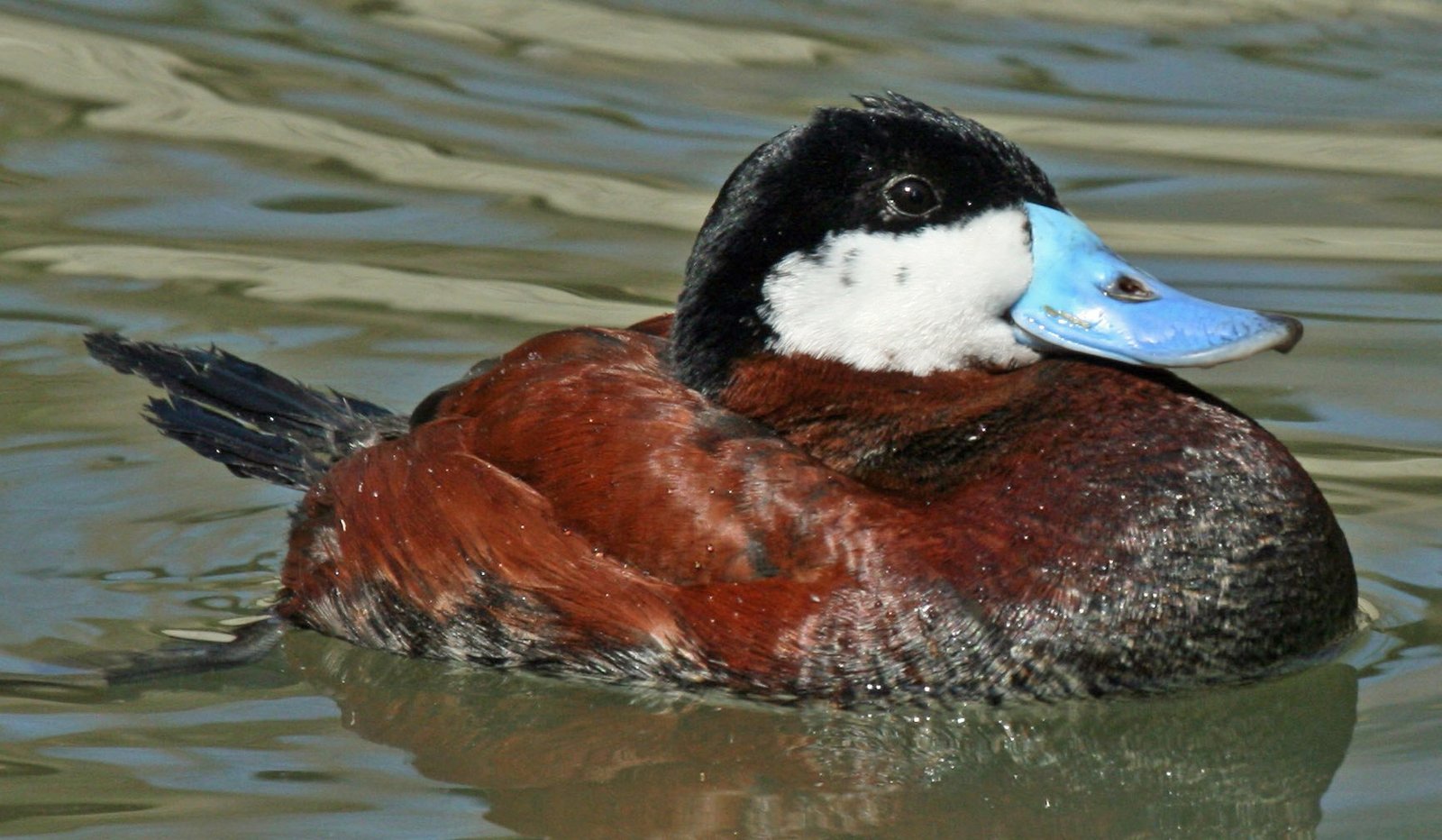
In the guide area the Ruddy Duck is represented by the Andean form, a large, dark stiff-tailed duck of highland lakes that is often treated as a separate species (Andean Duck, Oxyura ferruginea). The male has a chestnut body, a black head and a bright blue bill. This form lives from Colombia to southern Chile and Argentina on lakes with reeds and totora.
Voice
Mostly silent. In display the male makes ticking and bubbling sounds by striking its bill against its inflated breast.
Recording: Bruce Lagerquist — CC BY-NC-SA 4.0 · xeno-canto
Identification
40–48 cm, a stocky diving duck with a broad, slightly upturned bill and a stiff, black tail that is often held cocked. The breeding male is deep chestnut, with a black head and a bright blue bill; in the Eastern Andes of Colombia many males show some white on the cheek. The female is dark brown, with a dark bill and a paler cheek with a single dark stripe. Outside the breeding season the male's bill is greyer. In flight the wings are plain dark.
Confusion species
Masked Duck Nomonyx dominicus is smaller, lives mainly in the lowlands, has a white wing patch and, in the female, two dark stripes across the face. Puna Teal Spatula puna also has a blue bill, but a white cheek, a black cap and a buff, spotted body, and dabbles rather than dives. The female Black-headed Duck Heteronetta atricapilla, a very rare vagrant, has a soft tail and a pale eyebrow.
Habitat
Freshwater lakes, lagoons and ponds fringed with reeds and totora in the Andes, mostly between 2000 and 4500 m, locally lower and sometimes on the coast. It dives for insect larvae, small molluscs, seeds and roots of aquatic plants. The nest is a cup of plant material in reeds or totora above the water; the eggs are very large for the size of the bird.
Where the bird is most at home, classified by the vegetation units of the Andes and the west coast.


Range and movements
In Colombia in the Andes, mainly in the Eastern Andes around Bogotá and in the south in Nariño. In Ecuador on highland lakes along the whole length of the Andes. In Peru on Andean lakes such as Lake Junín and Lake Titicaca, and locally on the coast. In Bolivia on the lakes of the altiplano and in the Andes. Absent from the Galápagos. Outside the guide area in Chile and Argentina south to Tierra del Fuego; the northern form lives from Canada to the Caribbean.
- Resident
- dark = core range, pale = thinly spread
How and when to look
The páramo lakes near Papallacta and Antisana in Ecuador, the marshes of the Sabana de Bogotá in Colombia and the reedbeds of Lake Junín and Lake Titicaca in Peru are suitable sites. Breeding males often sit with cocked tails in open water just in front of the reeds.
Conservation status
Not Evaluated in this broad treatment of the species; the Andean form is widespread. Locally it suffers from the drying out, pollution and silting up of lakes and from the harvesting of totora.
Scientific name
Oxyura jamaicensis | (Gmelin, 1789)
Gmelin described the species in 1789 as Anas jamaicensis; because it was later moved to another genus, the author and year stand in brackets. The genus Oxyura was introduced in 1828 by Bonaparte. The genus name comes from Greek oxus, 'sharp', and oura, 'tail', after the stiff, pointed tail feathers. The species name jamaicensis refers to Jamaica, not necessarily the type locality. The specimen the first description was based on came from Jamaica.