All species › Swifts › Hummingbirds › Coppery-bellied Puffleg
Coppery-bellied Puffleg | Eriocnemis cupreoventris
Koperbuikpluimbroekje | Calzadito cobrizo | Calçudo-de-ventre-acobreado
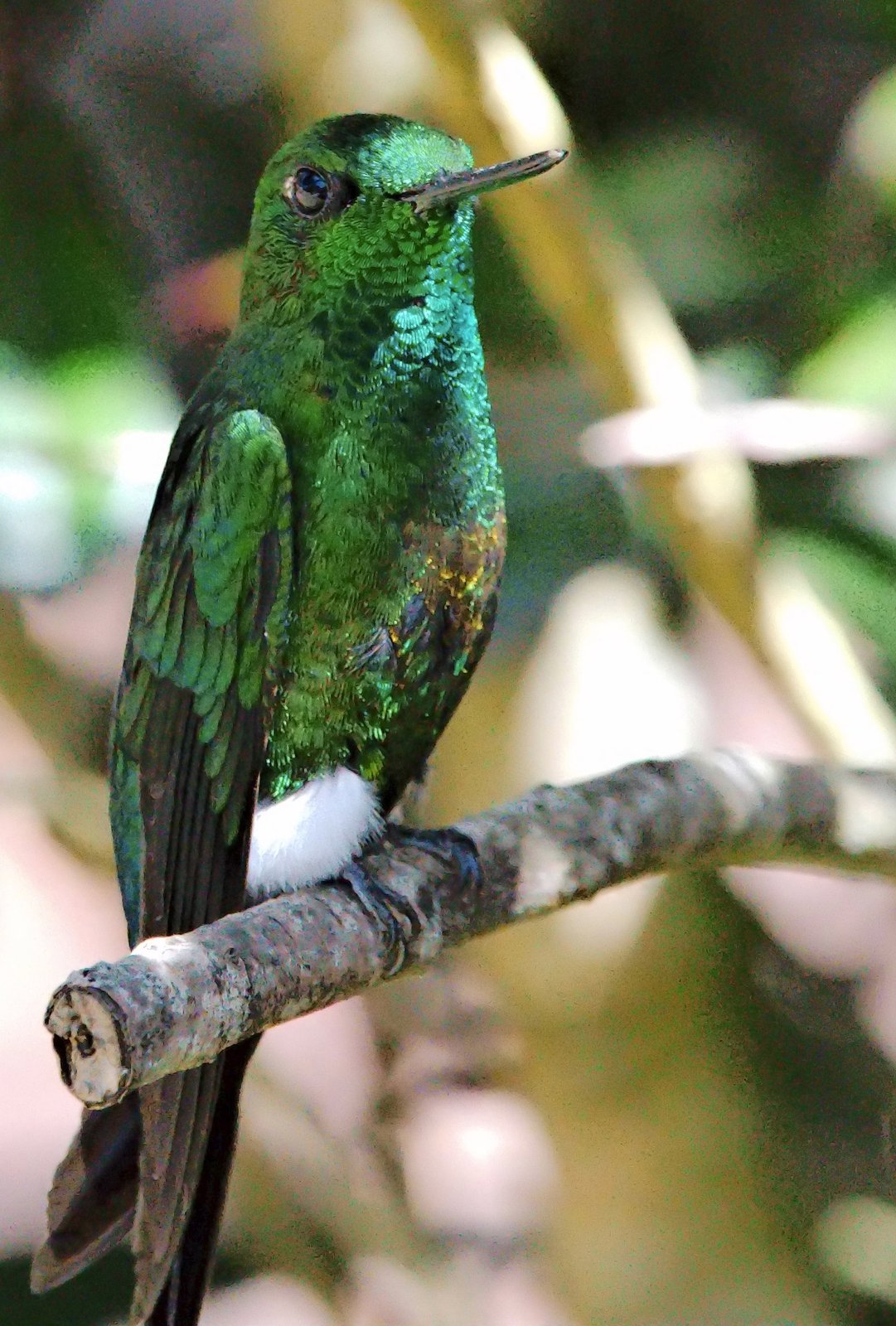
The Coppery-bellied Puffleg is a green hummingbird of the Eastern Andes of Colombia and the adjacent Andes of Venezuela. The male owes its name to its glittering coppery belly. Like all pufflegs it has thick white downy tufts around the legs.
Voice
A high, dry tsit and a thin twitter in chases.
Recording: Bernabe Lopez-Lanus — CC BY-NC-SA 3.0 · xeno-canto
Identification
9–10 cm, with a short, straight black bill and a forked, blue-black tail. The male is green above, with a glittering green throat and breast that become shining copper to golden bronze on the belly. The undertail coverts are violet-blue and the leg puffs white. The female resembles the male but is duller, with less copper on the belly.
Confusion species
Glowing Puffleg Eriocnemis vestita has a violet-blue throat patch and a glittering golden-green rump and lacks the coppery belly; in the Eastern Andes it usually lives higher. Golden-breasted Puffleg Eriocnemis mosquera has a golden breast, greyish undertail coverts and a bronze-green tail, and lives in the Western and Central Andes. Metaltails such as Tyrian Metaltail Metallura tyrianthina have a rufous or coppery tail and no conspicuous leg puffs.
Habitat
Upper cloud forest, forest edges, scrub, thickets and hedgerows in the transition to páramo, roughly between 2000 and 3000 m, locally higher. It feeds at flowering shrubs at the forest edge and in semi-open country, often low down, and catches small insects in flight. The nest is a small cup of moss and plant down in a shrub.
Where the bird is most at home, classified by the vegetation units of the Andes and the west coast.


Range and movements
In Colombia in the Eastern Andes, from Norte de Santander south to Cundinamarca. Absent from Ecuador, Peru, Bolivia and the Galápagos. Outside the guide area in the Andes of western Venezuela.
- Resident
- dark = core range, pale = thinly spread
How and when to look
At flowering shrubs along forest edges and in scrub on the slopes above the Bogotá plateau and in Boyacá. Males often sit on a fixed perch near their food plant.
Conservation status
Least Concern. Forest in the Eastern Andes is heavily fragmented by farming and cattle ranching; the species does, however, use scrub and forest edges.
Scientific name
Eriocnemis cupreoventris | (Fraser, 1840)
Fraser described the species in 1840 as Trochilus cupreo-ventris; because it was later moved to another genus, the author and year stand in brackets. The genus Eriocnemis was introduced in 1849 by Reichenbach. The genus name combines Greek erion, 'wool', with knēmis, 'legging', after the downy feather tufts on the legs. The species name combines Latin cupreus, 'coppery', with venter, 'belly'. The specimen the first description was based on came from Bogotá, Colombia.