All species › Swifts › Hummingbirds › Sapphire-vented Puffleg
Sapphire-vented Puffleg | Eriocnemis luciani
Saffierpluimbroekje | Calzadito colilargo | Calçudo-de-crisso-safira
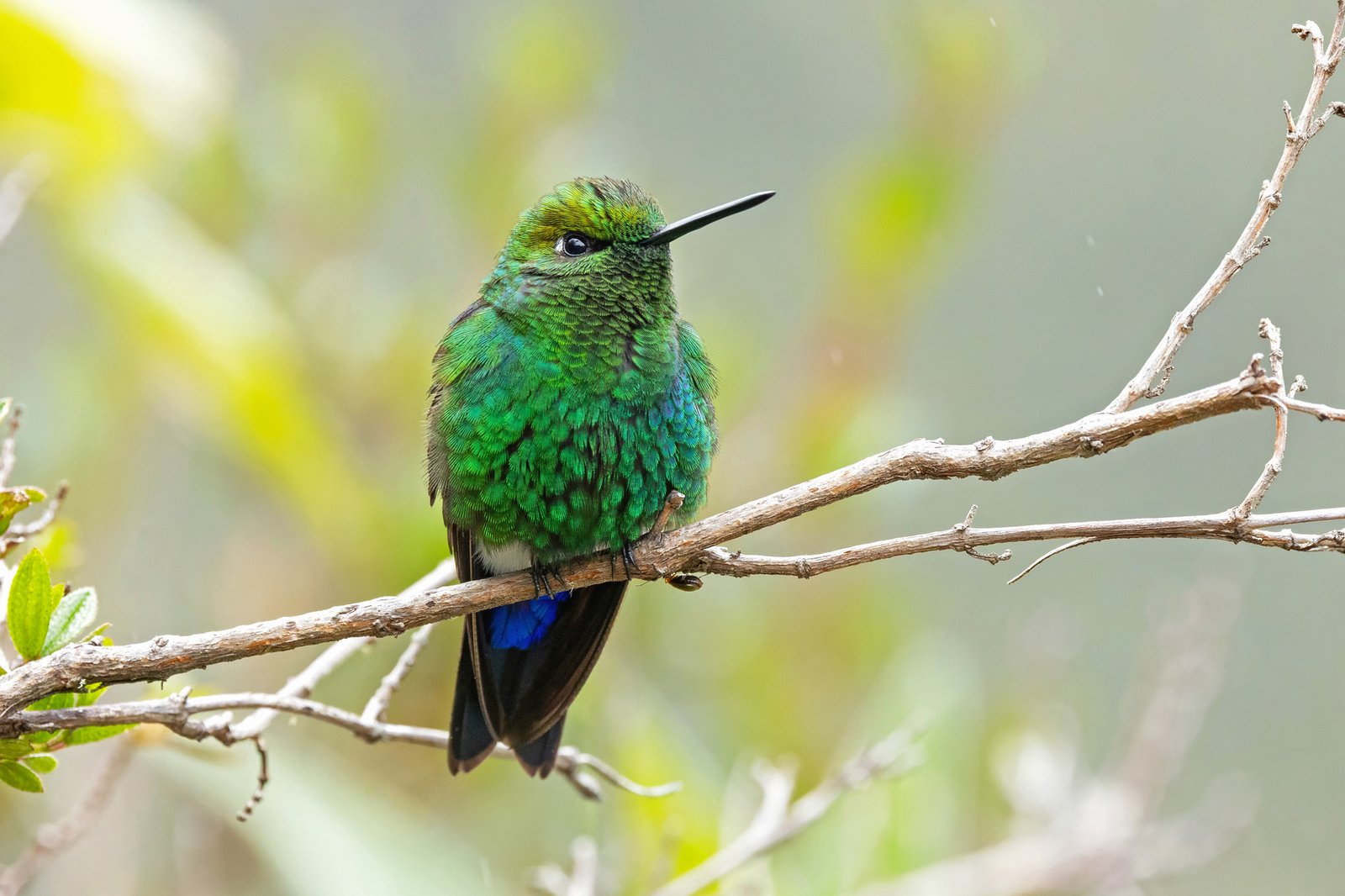
The Sapphire-vented Puffleg is the largest puffleg, with a long, deeply forked tail. It lives at the treeline and in páramo scrub from Colombia to southern Peru. In the taxonomy followed here, the Peruvian form with a coppery nape, treated elsewhere as a separate species (Eriocnemis sapphiropygia), is included in this species.
Voice
A high tsit or tseet, often in series, and a harsh twitter in chases.
Recording: Niels Krabbe — CC BY-NC-SA 3.0 · xeno-canto
Identification
11–13 cm, with a short, straight black bill and a long, deeply forked, steel-blue tail. Both sexes are glittering green, with violet-blue undertail coverts and large white leg puffs. In Colombia and Ecuador birds have a blue to violet-blue gloss on the forehead and crown; in Peru they have a coppery gloss on the nape and the tail is somewhat shorter. The female is slightly duller and has a shorter tail.
Confusion species
Glowing Puffleg Eriocnemis vestita is smaller, with a shorter tail, a violet-blue throat patch and a glittering golden-green rump. Black-thighed Puffleg Eriocnemis derbyi has black leg puffs. Golden-breasted Puffleg Eriocnemis mosquera has a golden breast and greyish undertail coverts. Great Sapphirewing Pterophanes cyanopterus is much larger, with blue wings.
Habitat
High cloud forest and elfin forest at the treeline, forest edges, páramo scrub and Polylepis groves, roughly between 2800 and 4000 m. It feeds at flowering shrubs, also in open scrub above the treeline, and often defends a group of flowers. It also catches small insects in flight. The nest is a cup of moss and plant down in a shrub.
Where the bird is most at home, classified by the vegetation units of the Andes and the west coast.


Range and movements
In Colombia in the Andes of the south and centre of the country. In Ecuador on both slopes and in the high parts of the Andes throughout the country. In Peru along the eastern Andes from the north to the south. Not definitely recorded in Bolivia, though it reaches close to the border. Absent from the Galápagos. Outside the guide area a subspecies is reported from the Andes of western Venezuela.
- Resident
- dark = core range, pale = thinly spread
How and when to look
At flowering shrubs along trails and roads at the treeline, for example in the high parts of national parks around Quito. Look for the long forked tail and the blue undertail coverts when the bird hovers.
Conservation status
Not Evaluated in the taxonomy followed here; the species in the broad sense is listed as Least Concern. Its treeline habitat is locally affected by fires and grazing.
Scientific name
Eriocnemis luciani | (Bourcier, 1847)
Bourcier described the species in 1847 as Trochilus luciani; because it was later moved to another genus, the author and year stand in brackets. The genus Eriocnemis was introduced in 1849 by Reichenbach. The genus name combines Greek erion, 'wool', with knēmis, 'legging', after the downy feather tufts on the legs. The species name honours the French entomologist Jean Baptiste Lucien Buquet (1807–1889). The specimen the first description was based on came from Guaca, Ecuador.