All species › Swifts › Hummingbirds › Coppery Emerald
Coppery Emerald | Chlorostilbon russatus
Koperkleurige smaragdkolibrie | Esmeralda cobriza | Esmeralda-acobreada
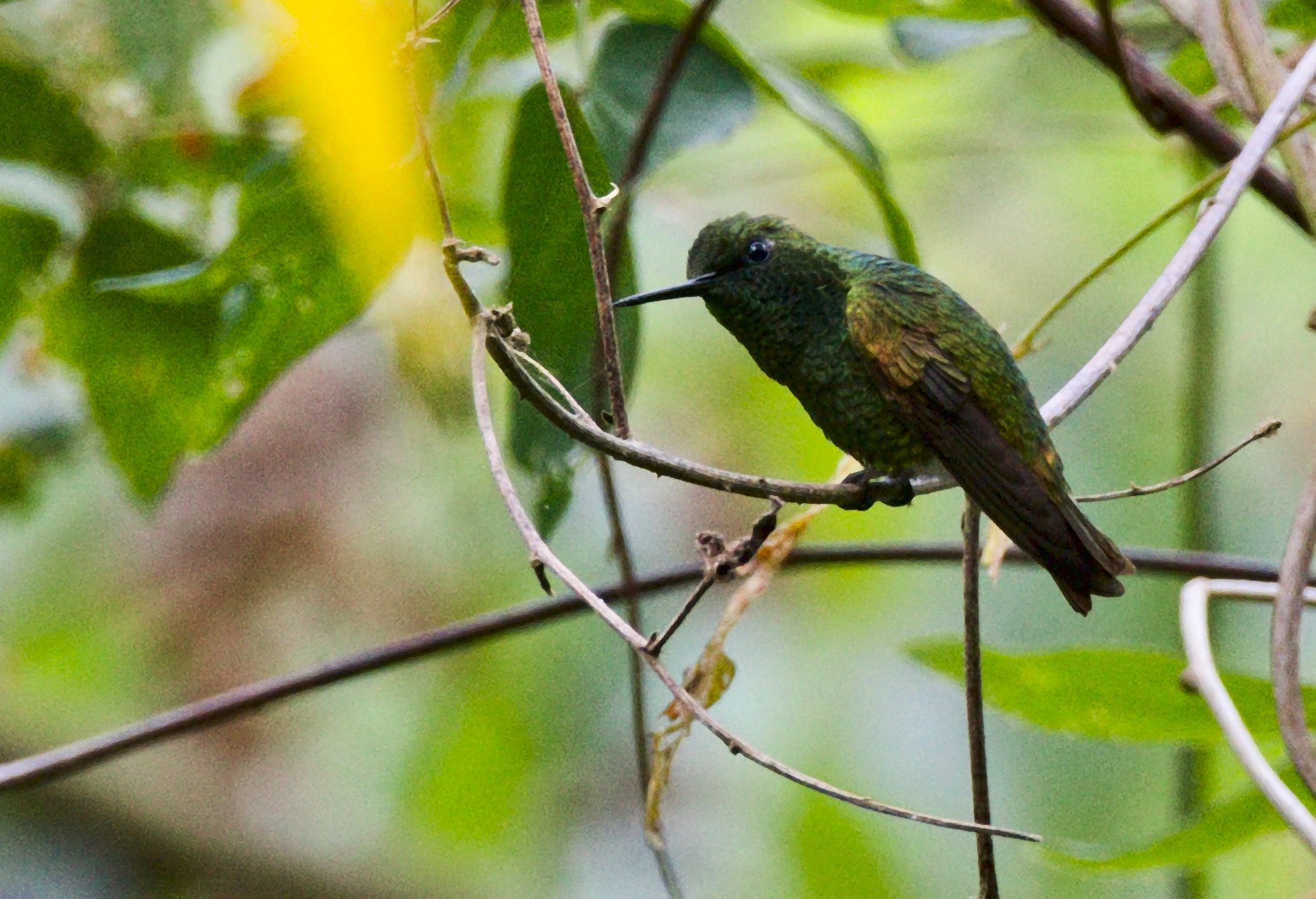
The Coppery Emerald is a small emerald of the Sierra Nevada de Santa Marta and the Serranía del Perijá in northern Colombia and adjacent Venezuela. It is more golden green than the other emeralds and has a coppery tail. It lives in semi-open country, forest edges and plantations.
Voice
While foraging a repeated short tsik or trrk.
No recording with a suitable Creative Commons licence is available for this species yet.
Identification
7–8 cm; the male is slightly larger. The bill is short, straight and black in both sexes. The male is shining golden green above and glittering golden green below, with coppery-green uppertail coverts and a slightly forked, golden-copper tail. The female is coppery green above and smoky grey below; the tail is greenish copper, the outer feathers with a coppery-purple band and pale tips. Young birds resemble the female, with buffy fringes to the head feathers.
Confusion species
Red-billed Emerald Chlorostilbon gibsoni lives mostly lower and has a red bill with a black tip and a blue-black tail. Western Emerald Chlorostilbon melanorhynchus and Blue-tailed Emerald Chlorostilbon mellisugus have a blue-black tail and are purer green.
Habitat
Semi-open and open country, scrub, forest edges and farmland, also plantations and parks, from sea level to about 2600 m, mostly between 500 and 1700 m. It takes nectar from small flowers and catches small insects. It possibly moves seasonally in elevation. The cup nest is placed low in a shrub; the female alone incubates.
Where the bird is most at home, classified by the vegetation units of the Andes and the west coast.


Range and movements
In Colombia in the Sierra Nevada de Santa Marta, the Serranía del Perijá and adjacent parts of the lower Magdalena valley. Absent from Ecuador, Peru, Bolivia and the Galápagos. Outside the guide area only on the Venezuelan side of the Perijá.
- Resident
- dark = core range, pale = thinly spread
How and when to look
Look at flowering shrubs along roads and coffee plantations on the lower and middle slopes of the Santa Marta, for example around Minca.
Conservation status
Least Concern. The range is small, but the species tolerates man-made habitats such as plantations and parks.
Scientific name
Chlorostilbon russatus | (Salvin & Godman, 1881)
Salvin & Godman described the species in 1881 as Panychlora russata; because it was later moved to another genus, the author and year stand in brackets. The genus Chlorostilbon was introduced in 1853 by Gould. The genus name combines Greek khlōros, 'green', with stilbōn, 'glittering'. The species name comes from Latin russatus, 'clothed in red', referring to the coppery plumage. The specimen the first description was based on came from Santa Marta, Colombia.