All species › Swifts › Hummingbirds › Western Emerald
Western Emerald | Chlorostilbon melanorhynchus
Westandessmaragdkolibrie | Esmeralda occidental | Esmeralda-ocidental
The Western Emerald is the small, all-green emerald of the western slope of the Andes, the inter-Andean valleys and the western lowlands of Colombia and Ecuador. It lives in open, shrubby country, gardens and parks, up into the high, settled valleys. Some authors treat it as a form of Blue-tailed Emerald.
Voice
A dry tsit or tchik, often repeated, and a soft, high twittering.
Recording: Mitch Lysinger — CC BY-NC-SA 4.0 · xeno-canto
Identification
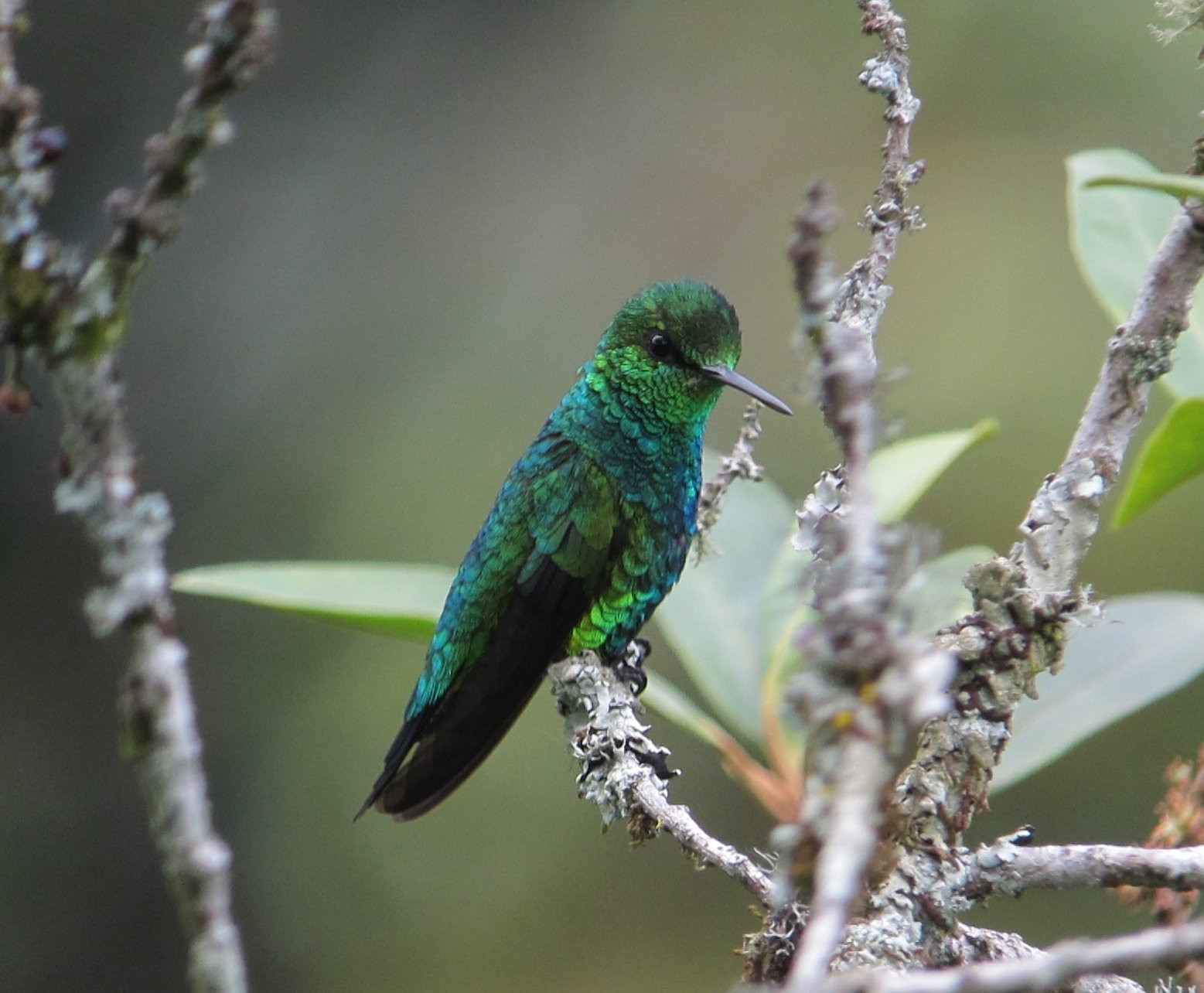
7–8 cm, with a short, straight, all-black bill and a blue-black, forked tail. The male is entirely glittering green, with a blue or golden-green sheen on the throat and breast. The female is bronzy green above and pale grey below, with a white stripe behind the eye, a dark ear patch and grey-white tips to the outer tail feathers. Young birds resemble the female.
Confusion species
Blue-tailed Emerald Chlorostilbon mellisugus is almost identical and lives east of the Andes; range is the best feature. Red-billed Emerald Chlorostilbon gibsoni in northern Colombia has a red bill with a black tip. Short-tailed Emerald Chlorostilbon poortmani has a clearly shorter tail. The female Violet-tailed Sylph Aglaiocercus coelestis is larger, with a white throat, a cinnamon belly and a longer tail.
Habitat
Shrubby slopes, forest edges, clearings, hedges, gardens, parks and plantations, also dry scrub, from sea level to about 2800 m in the inter-Andean valleys. It takes nectar from small flowers in the lower strata and catches small insects. The cup nest is placed low in a shrub; the female alone incubates two white eggs.
Where the bird is most at home, classified by the vegetation units of the Andes and the west coast.


Range and movements
In Colombia in the west of the country, in the Andes and inter-Andean valleys and in the western lowlands. In Ecuador in the western lowlands, on the western slope and in the inter-Andean valleys, up into the gardens of the highland cities. In Peru absent or nearly so; absent from Bolivia and the Galápagos. Not found outside the guide area.
- Resident
- dark = core range, pale = thinly spread
How and when to look
Look in gardens and parks in the inter-Andean valleys and along shrubby roadsides on the western slope. The male often perches on a low, bare twig near a flowering shrub.
Conservation status
Not Evaluated under the current species limits. The species lives in open and man-made habitats and is locally common; no significant threats are known.
Scientific name
Chlorostilbon melanorhynchus | Gould, 1860
Gould described the species in 1860 and placed it straight away in the genus where it still stands. The genus Chlorostilbon was introduced in 1853 by Gould. The genus name combines Greek khlōros, 'green', with stilbōn, 'glittering'. The species name combines Greek melas, 'black', with rhunkhos, 'bill'. The specimen the first description was based on came from Vicinity of Quito, Ecuador.