All species › Swifts › Hummingbirds › Violet-headed Hummingbird
Violet-headed Hummingbird | Klais guimeti
Paarskopkolibrie | Colibrí cabecivioleta | Beija-flor-de-cabeça-violeta
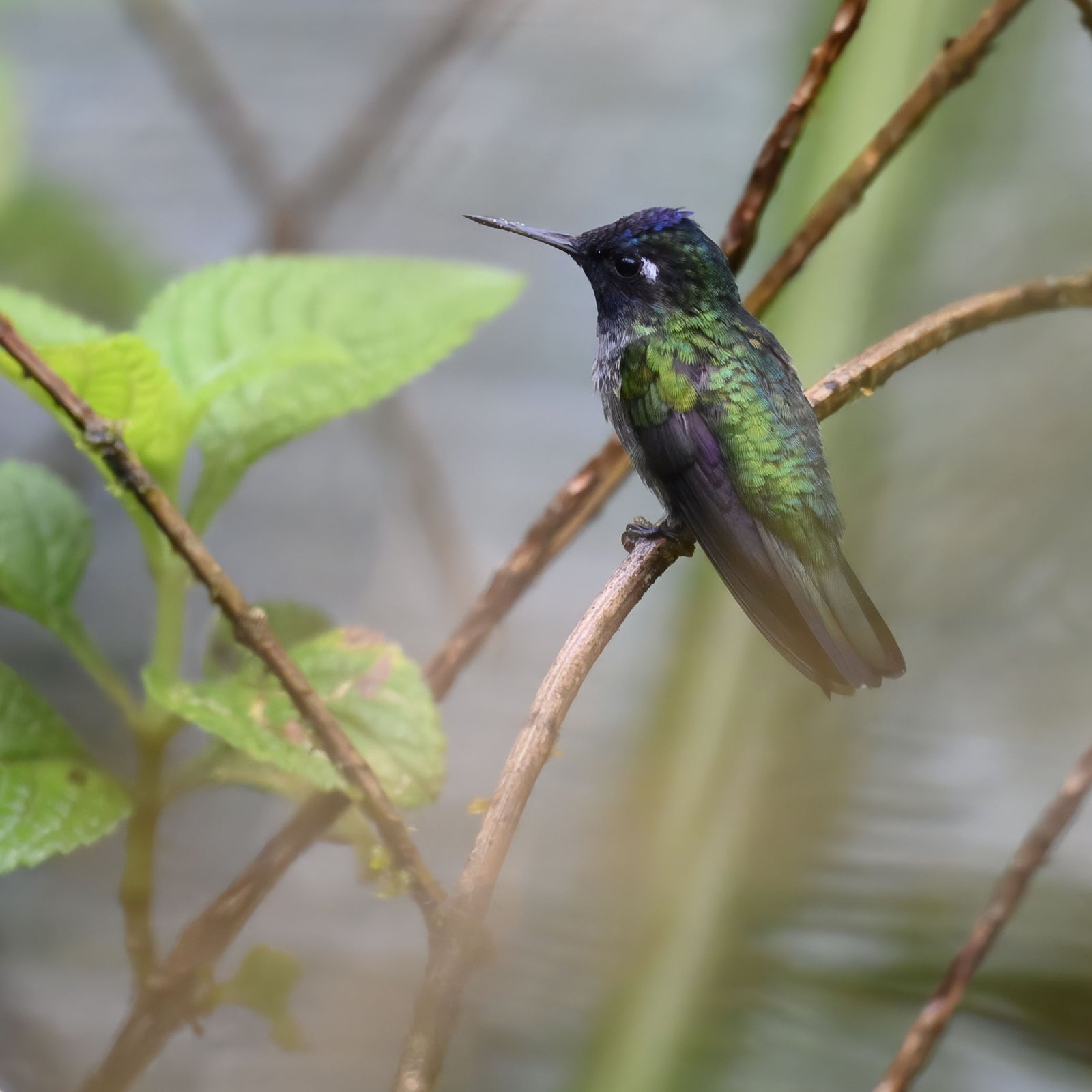
The Violet-headed Hummingbird is a small hummingbird of foothills and lower mountain slopes, with a short, straight bill and a white spot behind the eye. The male has a glossy violet-blue head and throat. Males often sing in small, loose groups from bare twigs along forest edges.
Voice
The song is a series of high, thin, squeaky notes, repeated for long periods from a fixed perch. The call is a short, dry tsik.
Recording: Paul Driver — CC BY-NC-SA 4.0 · xeno-canto
Identification
8 cm, with a short, straight, black bill. The upperparts are bronzy green and the underparts pale grey. There is a distinct white spot behind the eye. The male has a glossy violet-blue crown, cheeks and throat. The female has a duller blue-green crown and a pale grey throat. The tail is green, with a dark band before the greyish-white tips of the outer feathers. Juveniles resemble the female.
Confusion species
Golden-tailed Sapphire Chrysuronia oenone is larger, with a reddish lower mandible, a green belly and a golden-bronze tail, and lacks the white spot behind the eye. Blue-headed Sapphire Chrysuronia grayi has a red bill with a black tip and no white eye spot. Tolima Blossomcrown Anthocephala berlepschi also has a white spot behind the eye, but has a pale forecrown, a chestnut hindcrown and no blue on the head.
Habitat
Edges of humid forest, clearings, older secondary forest and shade plantations in the foothills and on the lower slopes, mostly between about 400 and 1500 m, locally lower or higher. It takes nectar from small flowers in the lower and middle levels, including flowering trees, and catches small insects in flight. The nest is a small cup in a low shrub or on a twig.
Where the bird is most at home, classified by the vegetation units of the Andes and the west coast.


Range and movements
In Colombia in the foothills and on the lower slopes of the Andes, including the Magdalena Valley and the eastern slope. In Ecuador on the eastern slope of the Andes along its whole length. In Peru on the eastern slope of the Andes from north to south. In Bolivia in the foothills and lower Yungas of La Paz and Cochabamba. Absent from the Galápagos. Outside the guide area from Honduras to Panama, in Venezuela and locally in northern Brazil.
- Resident
- dark = core range, pale = thinly spread
How and when to look
Search flowering shrubs and trees along forest edges and roads in the foothills, for example on the eastern slope in Ecuador and Peru. Singing males sit on fixed bare twigs; their high song gives them away.
Conservation status
Least Concern. The species tolerates forest edges and secondary forest, but remains dependent on forested foothills.
Scientific name
Klais guimeti | (Bourcier, 1843)
Bourcier described the species in 1843 as Trochilus Guimeti; because it was later moved to another genus, the author and year stand in brackets. The genus Klais was introduced in 1854 by Reichenbach. The genus name refers to Kleis, the daughter of the Greek poet Sappho of Lesbos. The species name honours Jean-Baptiste Guimet (1795–1871), a French chemist who developed synthetic ultramarine. The specimen the first description was based on came from Colombia; Caracas, Venezuela.