All species › Swifts › Hummingbirds › Santa Marta Blossomcrown
Santa Marta Blossomcrown | Anthocephala floriceps
Santamartabloemkroonkolibrie | Colibrí florido de Santa Marta | Coroa-florida-de-santa-marta
The Santa Marta Blossomcrown is a small, plainly patterned hummingbird found only in the Sierra Nevada de Santa Marta in northern Colombia. The male has a pale, creamy forecrown that grades into rufous at the back, which gives the group its name. Until 2014 the Tolima Blossomcrown was treated as the same species.
Voice
A series of high, thin tsip notes and short, dry chips while foraging.
Recording: Oswaldo Cortes — CC BY-NC-SA 3.0 · xeno-canto
Identification
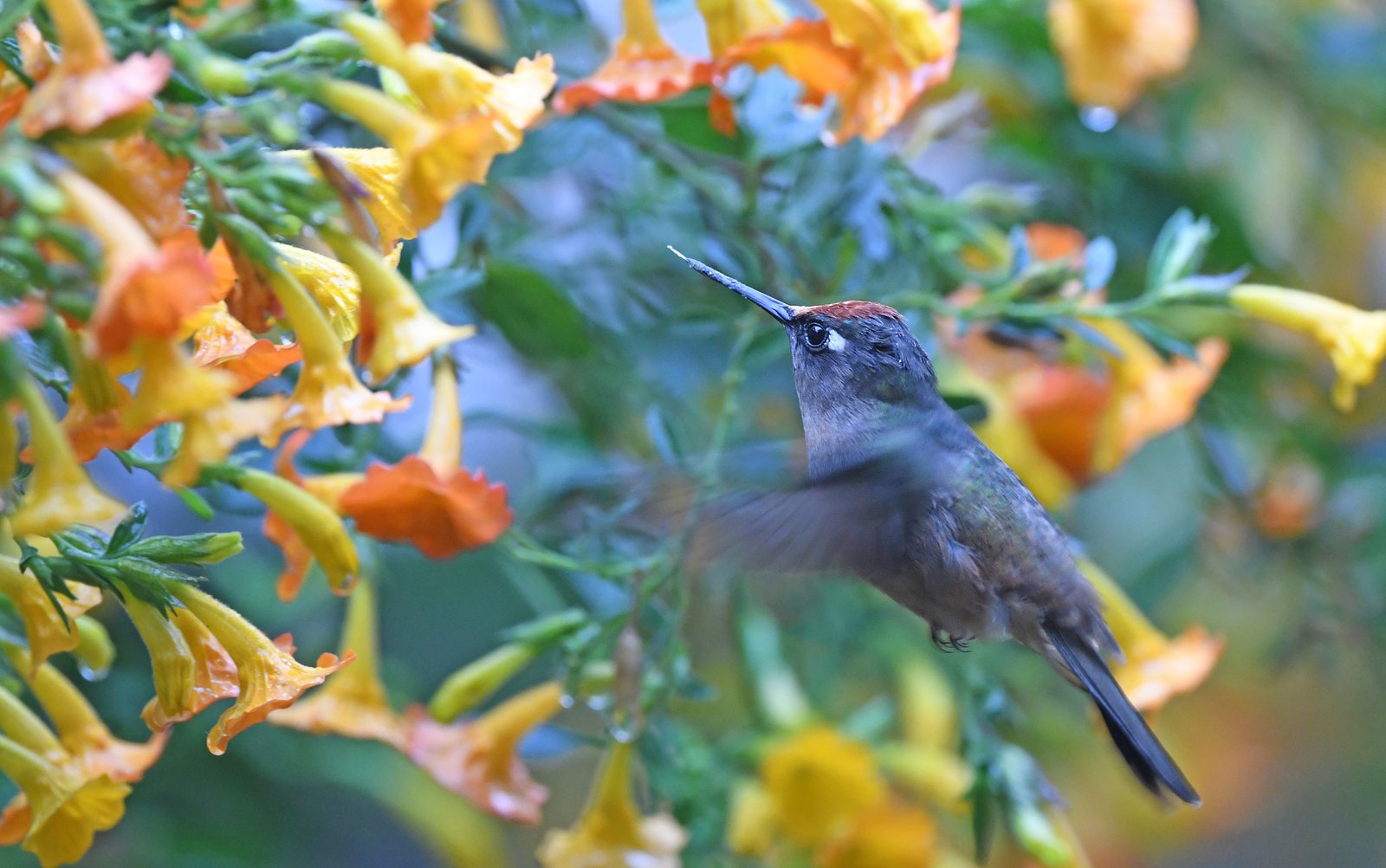
8–9 cm, with a short, straight, black bill and a white spot behind the eye. The upperparts are shining green and the underparts greyish buff. The male has a creamy white to pale buff forecrown and a rufous hindcrown. The tail is bronzy green, with a black band before the pale buff to whitish tips of the outer feathers. The female and juveniles have an entirely brownish crown without the pale front.
Confusion species
No other blossomcrown occurs in the Sierra Nevada de Santa Marta. Tolima Blossomcrown Anthocephala berlepschi is very similar, but lives only in the upper Magdalena Valley. Speckled Hummingbird Adelomyia melanogenys has a white stripe behind the eye, a dark ear patch, a speckled throat and a plain brown crown. Female Fork-tailed Woodnymphs Thalurania furcata are larger, with a forked blue-black tail and no pale forecrown.
Habitat
The interior and edges of humid montane forest, older secondary forest and shade coffee, mostly between about 600 and 1700 m, sometimes higher. It forages at low to middle heights, often in the understorey, visiting small flowers of shrubs and herbs; it also takes small insects. Little is known about the nest.
Where the bird is most at home, classified by the vegetation units of the Andes and the west coast.


Range and movements
In Colombia only in the Sierra Nevada de Santa Marta (Magdalena, Cesar, La Guajira). Absent from Ecuador, Peru, Bolivia and the Galápagos. Not found outside the guide area.
- Resident
- dark = core range, pale = thinly spread
How and when to look
Search in the Sierra Nevada de Santa Marta along the road to San Lorenzo and around Minca, at forest edges and in shade coffee at middle elevations, near low flowering shrubs.
Conservation status
Vulnerable. The range is small and much of the forest at middle elevations of the Sierra Nevada has been converted to farmland and coffee plantations.
Scientific name
Anthocephala floriceps | (Gould, 1853)
Gould described the species in 1853 as Trochilus (--?) floriceps; because it was later moved to another genus, the author and year stand in brackets. The genus Anthocephala was introduced in 1860 by Cabanis & Heine. The genus name combines Greek anthos, 'flower', with kephalē, 'head'. The species name combines Latin flos, floris, 'flower', with -ceps, 'headed'. The specimen the first description was based on came from Sierra Nevada de Santa Marta, Colombia.