All species › Swifts › Hummingbirds › Tolima Blossomcrown
Tolima Blossomcrown | Anthocephala berlepschi
Magdalenabloemkroonkolibrie | Colibrí florido de Tolima | Coroa-florida-de-tolima
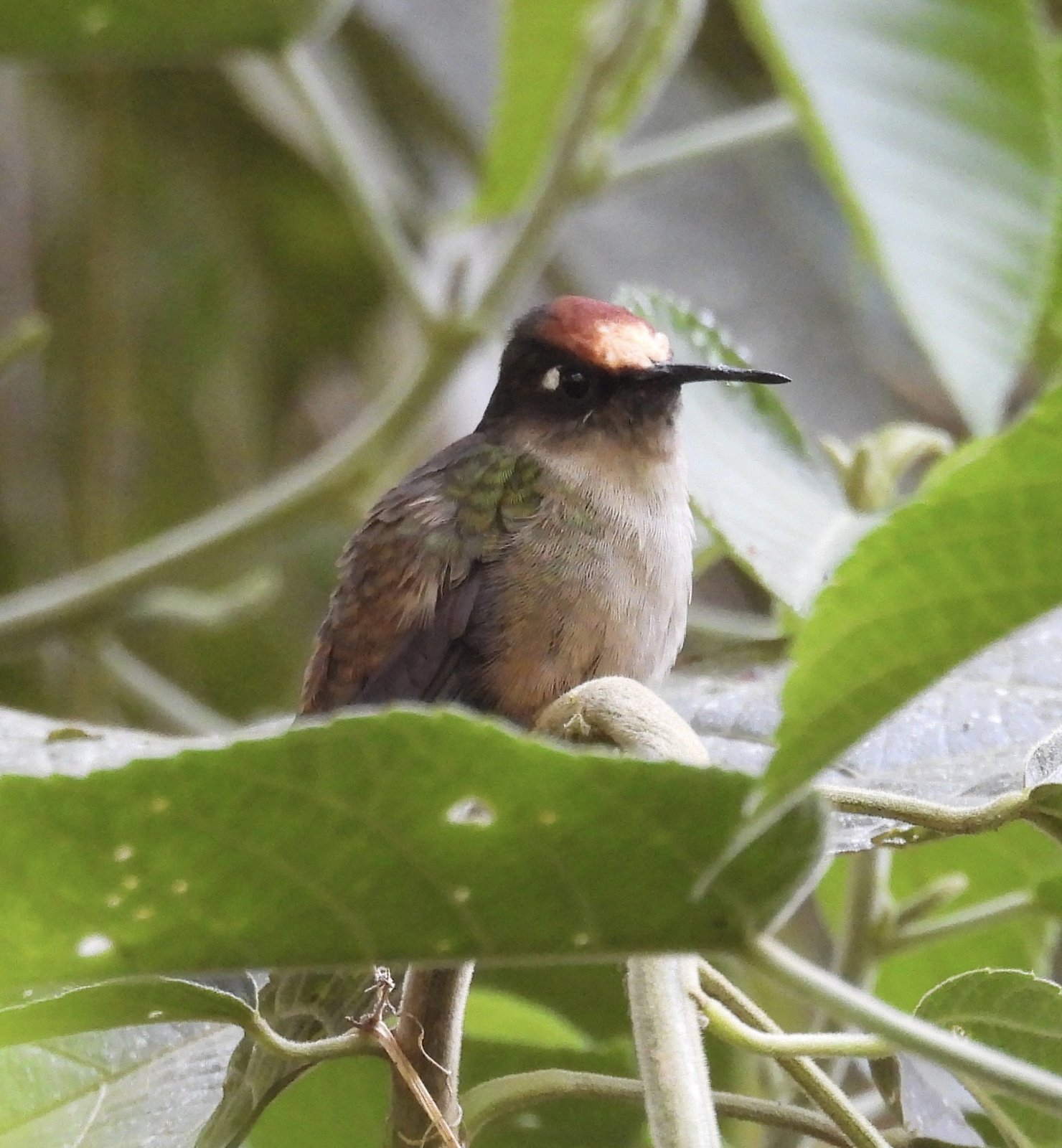
The Tolima Blossomcrown is a small hummingbird found only in the upper Magdalena Valley in Colombia. It was split from the Santa Marta Blossomcrown in 2014, after a study showed large genetic and climatic-niche differences. The male has the same pale forecrown and rufous hindcrown.
Voice
The song is a long series of repeated, high tsip notes.
Recording: Jerome Fischer — CC BY-NC-SA 4.0 · xeno-canto
Identification
8–9 cm, with a short, straight, black bill and a white spot behind the eye. The upperparts are shining green, with a rusty lower back and uppertail coverts; the underparts are greyish buff. The male has a buffy white forecrown and a chestnut hindcrown. The tail is bronzy green with broad white tips; all but the central pair of feathers have a black band before the tip. The female and juveniles have an entirely brownish crown.
Confusion species
Santa Marta Blossomcrown Anthocephala floriceps looks almost identical, with somewhat buffier tail tips, but lives only in the Sierra Nevada de Santa Marta. Violet-headed Hummingbird Klais guimeti also has a white spot behind the eye, but the male has a violet-blue head and the female a blue-green crown. Speckled Hummingbird Adelomyia melanogenys has a dark ear patch, a speckled throat and a pale stripe behind the eye.
Habitat
The interior and edges of humid primary forest and older secondary forest, also forest edges, gallery forest and shade coffee, between about 1200 and 2500 m. It forages in the lower and middle levels at small flowers of shrubs and herbs and catches small insects. Little is known about the nest.
Where the bird is most at home, classified by the vegetation units of the Andes and the west coast.


Range and movements
In Colombia only in the upper Magdalena Valley, mainly on the eastern slope of the Central Andes in Tolima, Quindío, Cauca and northern Huila. Absent from Ecuador, Peru, Bolivia and the Galápagos. Not found outside the guide area.
- Resident
- dark = core range, pale = thinly spread
How and when to look
Search forest remnants and shade coffee on the slopes above the Magdalena Valley in Tolima and Huila, at low flowering shrubs along forest edges and stream valleys.
Conservation status
Vulnerable. The range is small and the population, estimated at fewer than 4500 mature individuals, is declining. Much forest has been cleared for agriculture and what remains is fragmented; the species occurs in two national parks.
Scientific name
Anthocephala berlepschi | Salvin, 1893
Salvin described the species in 1893 and placed it straight away in the genus where it still stands. The genus Anthocephala was introduced in 1860 by Cabanis & Heine. The genus name combines Greek anthos, 'flower', with kephalē, 'head'. The species name honours Hans von Berlepsch (1850–1915), a German ornithologist with a large collection of South American birds. The specimen the first description was based on came from Bogotá, Colombia.