All species › Passerines › Wagtails and pipits › Correndera Pipit
Correndera Pipit | Anthus correndera
Correnderapieper | Bisbita correndera | Caminheiro-de-espora
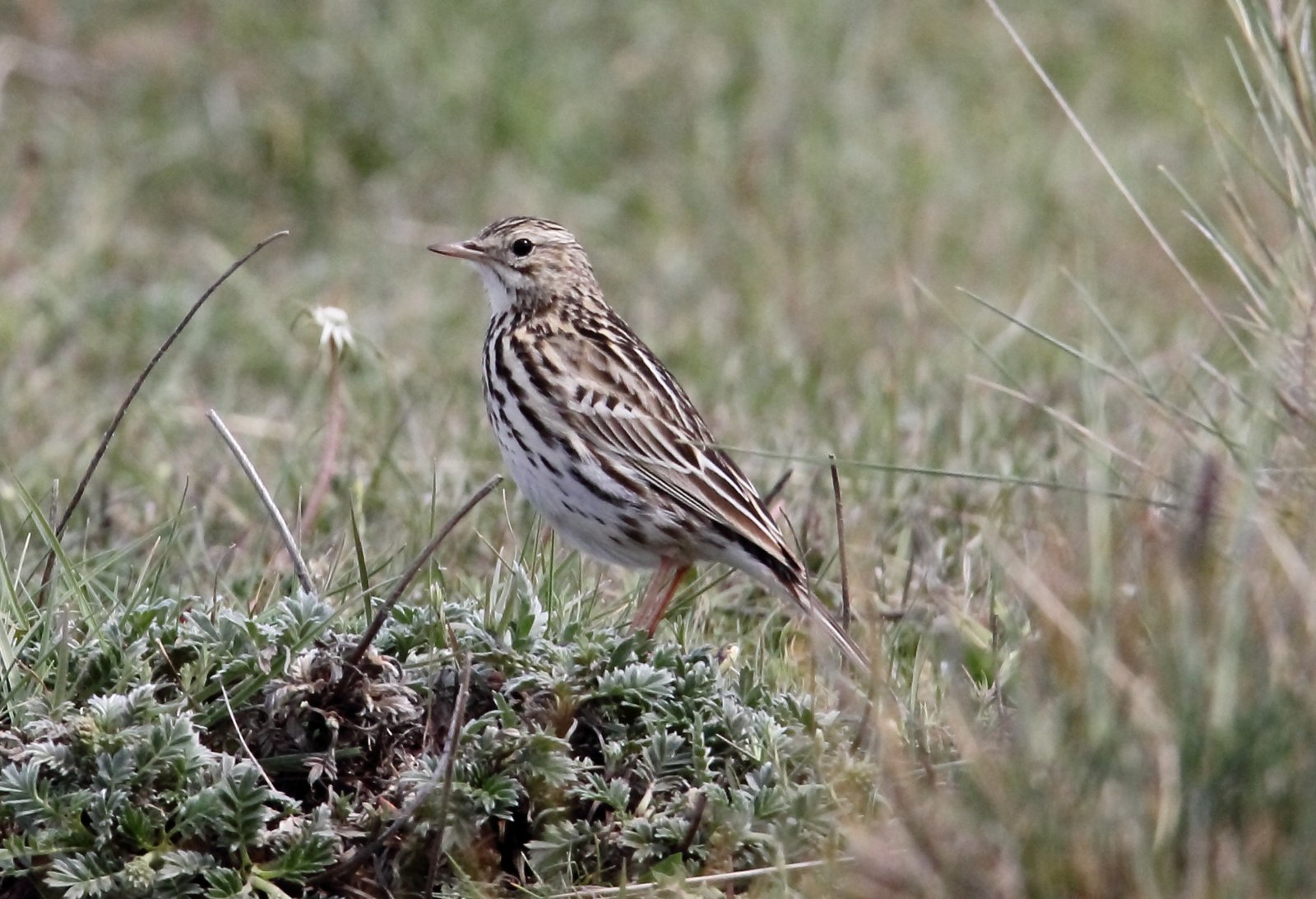
The Correndera Pipit is the most heavily streaked pipit of the guide area, a bird of damp grassland and bog edges in the puna of Peru and Bolivia. Further south it also lives in the lowlands, as far as the Falkland Islands. Its name comes from the Spanish correndera, 'runner', after the way the bird runs over the ground.
Voice
The song, given in a song flight, is a series of sharp notes and buzzy trills that runs into a descending tsee-tsee-tsrrreeeu. The call, especially when flushed, is a sharp tsip or tcheep.
Recording: Meena Haribal — CC BY-NC-SA 4.0 · xeno-canto
Identification
14–15 cm, with a thin bill and a long, straight hind claw. The upperparts are brown, heavily streaked with black, with two prominent whitish stripes along the back. The underparts are whitish to buff, with bold black streaks on the breast that continue along the flanks. The outer tail feathers are white. The sexes are alike.
Confusion species
Puna Pipit Anthus brevirostris lacks the pale back stripes and has unstreaked flanks. Paramo Pipit Anthus bogotensis is plainer buff below, with few streaks. Hellmayr's Pipit Anthus hellmayri is more finely streaked, warmer in colour and usually lives on drier, lower slopes. Peruvian Pipit Anthus peruvianus is smaller and more lightly streaked, and lives on the coast.
Habitat
Damp short grassland, edges of bofedales and bogs, and grassy lakeshores in the puna, in Peru and Bolivia at about 3000 to 4600 m. It searches the ground for insects and other small invertebrates. The nest is on the ground, hidden in a grass tussock.
Where the bird is most at home, classified by the vegetation units of the Andes and the west coast.


Range and movements
In Peru in the puna of the central and southern Andes. In Bolivia on the altiplano and in the puna of the western Andes. Absent from Colombia, Ecuador and the Galápagos. Outside the guide area in Chile, Argentina, Uruguay, southern Brazil, Paraguay and the Falkland Islands.
- Resident
- dark = core range, pale = thinly spread
How and when to look
Search the grassy edges of bofedales and lakes on the altiplano, for example around Lake Titicaca. Flushed birds rise with a sharp call and drop back into the grass a short distance away.
Conservation status
Least Concern. Common in suitable habitat; drainage and overgrazing of bofedales degrade its habitat locally.
Scientific name
Anthus correndera | Vieillot, 1818
Vieillot described the species in 1818 and placed it straight away in the genus where it still stands. The genus Anthus was introduced in 1805 by Bechstein. The genus name is Latin anthus, a small bird of grasslands mentioned by Pliny the Elder. The species name comes from 'Correndera', an Aragonese vernacular name for the meadow pipit; Félix de Azara gave the bird this name because it seemed very close to the bird so called in Aragon. The specimen the first description was based on came from Paraguay.