All species › Passerines › Wagtails and pipits › Red-throated Pipit
Red-throated Pipit | Anthus cervinus
Roodkeelpieper | Bisbita gorgirrojo | Caminheiro-de-garganta-vermelha
The Red-throated Pipit breeds on the tundra of northern Europe, Siberia and western Alaska and winters in Africa and southern and south-eastern Asia. In the guide area it is only a very rare vagrant. A bird on the coast of Esmeraldas in Ecuador in March 2008 was considered the first record for South America.
Voice
The call, especially when flushed, is a thin, drawn-out, sharp pseeeeh, the most useful clue to the species. The song, on the breeding grounds, is a series of clear, thin trills.
Recording: Stanislas Wroza — CC BY-NC-SA 4.0 · xeno-canto
Identification
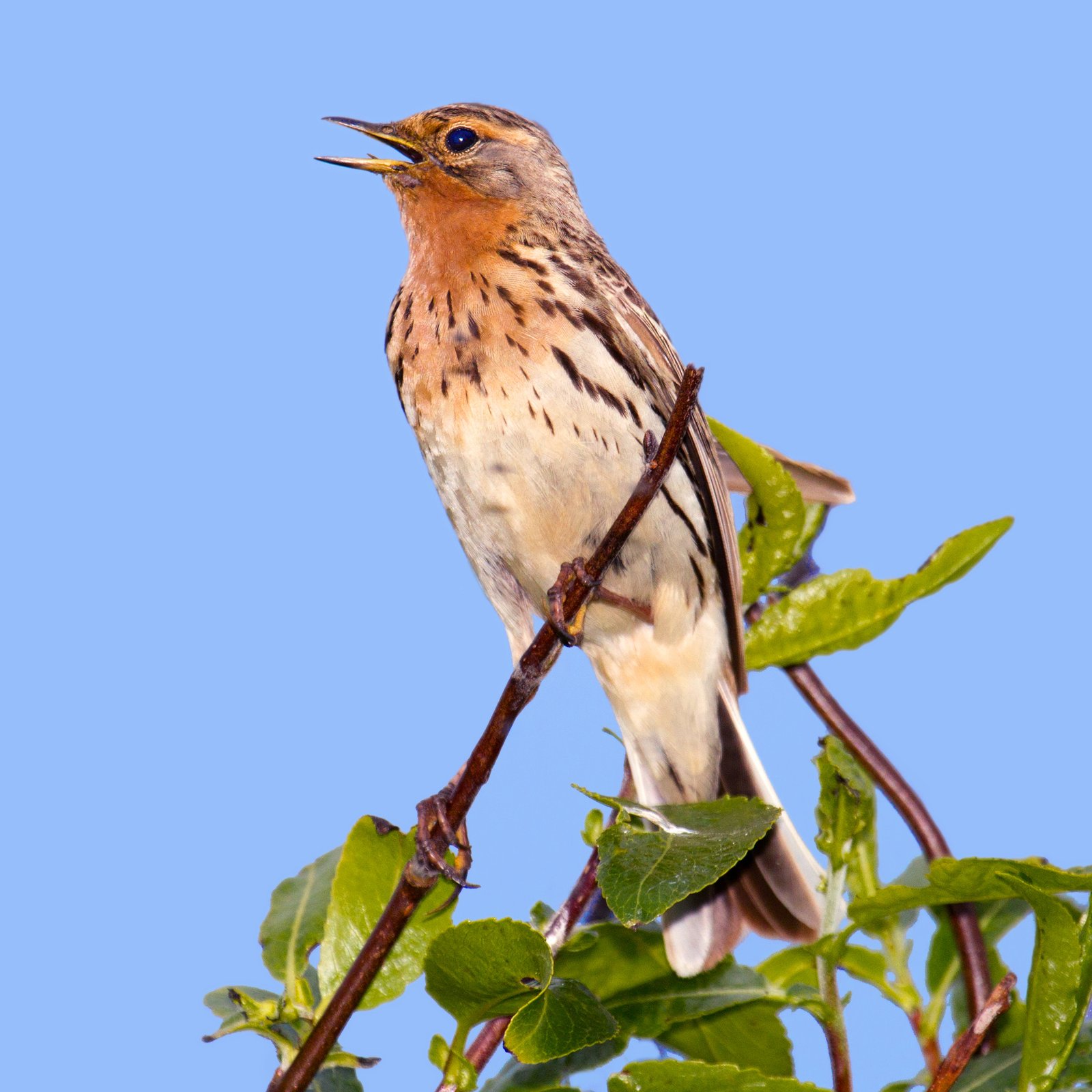
14–15 cm, with a thin bill and a fairly short tail. The upperparts are brown with black streaks and often two pale back stripes; the rump is also streaked. In breeding plumage the throat, head and breast have a brick-red to pinkish tinge, stronger in the male. In non-breeding plumage and in young birds the underparts are whitish to buff with bold black streaks on the breast and flanks and a dark malar stripe. The outer tail feathers are white.
Confusion species
Correndera Pipit Anthus correndera is very similar to non-breeding birds, with pale back stripes and heavily streaked flanks, but lives in the puna and has an unstreaked rump. Yellowish Pipit Anthus chii and Peruvian Pipit Anthus peruvianus are smaller, more finely streaked and lack a red throat.
Habitat
In winter quarters damp short grassland, fields, rice paddies and grassy shores, often on the coast. It searches the ground for insects. The bird in Ecuador was seen on a beach.
Where the bird is most at home, classified by the vegetation units of the Andes and the west coast.


Range and movements
In the guide area confirmed as a vagrant only from the coast of Ecuador (Río Verde, Esmeraldas, March 2008). It does not occur regularly in Colombia, Ecuador, Peru, Bolivia or the Galápagos. Outside the guide area it breeds in northern Eurasia and western Alaska; it is a rare but almost annual autumn vagrant to the west coast of North America.
How and when to look
A pipit with a streaked rump and heavy streaks on the breast and flanks on a beach or field in the lowlands deserves attention; the thin, drawn-out call is the key feature. Take photographs and sound recordings.
Conservation status
Least Concern. Common in its large breeding range.
Scientific name
Anthus cervinus | (Pallas, 1811)
Pallas described the species in 1811 as Motacilla cervina; because it was later moved to another genus, the author and year stand in brackets. The genus Anthus was introduced in 1805 by Bechstein. The genus name is Latin anthus, a small bird of grasslands mentioned by Pliny the Elder. The species name is Latin cervinus, 'of a deer', in the sense of fawn-coloured, for the reddish throat. The specimen the first description was based on came from Kolyma, Russia.