All species › Waterfowl › Ducks, swans and geese › Coscoroba Swan
Coscoroba Swan | Coscoroba coscoroba
Coscorobazwaan | Cisne coscoroba | Capororoca
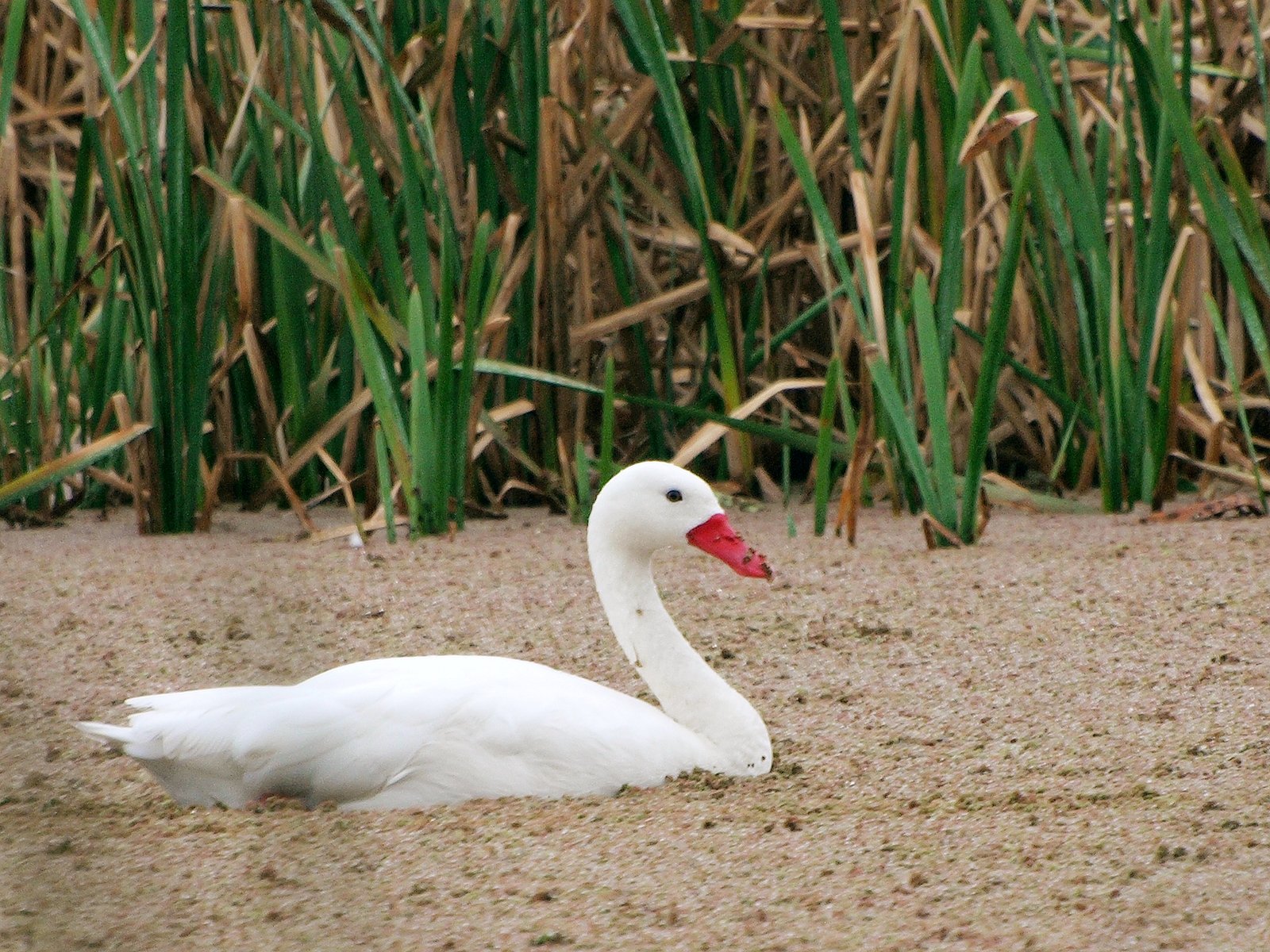
The Coscoroba Swan is the smallest swan in the world and with its red bill and pink legs resembles a goose in some respects. It breeds in southern South America and moves north in the austral winter. In the guide area the species occurs only as a very rare vagrant.
Voice
A loud, trumpeting four-syllable call, cos-co-ro-ba, from which the name is derived.
Recording: Bernabe Lopez-Lanus — CC BY-NC-SA 4.0 · xeno-canto
Identification
90–115 cm, entirely white, with only black tips to the outer primaries, which are barely visible at rest. The bill is bright red to pink, broad and fairly short; the legs are pink. The male is larger than the female. Juveniles have greyish-brown patches on the head and back and a duller bill.
Confusion species
Snow Goose Anser caerulescens, also a very rare vagrant, is smaller, with a pink bill with a black 'grin patch' and clearly black primaries. White domestic geese are more heavily built, with an orange bill and without black wingtips.
Habitat
Fresh and brackish lakes, lagoons, marshes and flooded grassland in open country. It dabbles in shallow water and grazes on banks, eating aquatic plants, seeds and small invertebrates. In the south of its range it breeds in reeds or on islets.
Where the bird is most at home, classified by the vegetation units of the Andes and the west coast.


Range and movements
In the guide area recorded only as a very rare vagrant, with a few records in the lowlands of south-eastern Bolivia. Not known from Colombia, Ecuador, Peru or the Galápagos. It breeds in Chile, Argentina, Uruguay, the far south of Brazil and the Falkland Islands; in the austral winter it moves north to Paraguay and southern Brazil.
How and when to look
Records in the guide area are most likely in the austral winter, when the species moves north. Large open marshes in south-eastern Bolivia are the most suitable sites.
Conservation status
Least Concern. In its breeding range the species has declined locally through hunting and the loss of marshes.
Scientific name
Coscoroba coscoroba | (Molina, 1782)
Molina described the species in 1782 as Anas Coscoroba; because it was later moved to another genus, the author and year stand in brackets. The genus Coscoroba was introduced in 1853 by Reichenbach. The genus name was taken from Molina's species name, a Chilean onomatopoeic name after the bird's call. Molina's species name is a Chilean onomatopoeic name for this swan, after its call. The specimen the first description was based on came from Chile.