All species › Waterfowl › Ducks, swans and geese › Black-headed Duck
Black-headed Duck | Heteronetta atricapilla
Koekoekseend | Pato rinconero | Marreca-de-cabeça-preta
The Black-headed Duck is the only duck that is an obligate brood parasite: the female lays her eggs in the nests of other waterbirds and never incubates herself. The young are independent almost immediately after hatching. In the guide area the species occurs only as a very rare vagrant.
Voice
Mostly silent. The female sometimes gives a soft quack; the male makes soft, panting sounds in display.
Recording: Bernabe Lopez-Lanus — CC BY-NC-SA 3.0 · xeno-canto
Identification
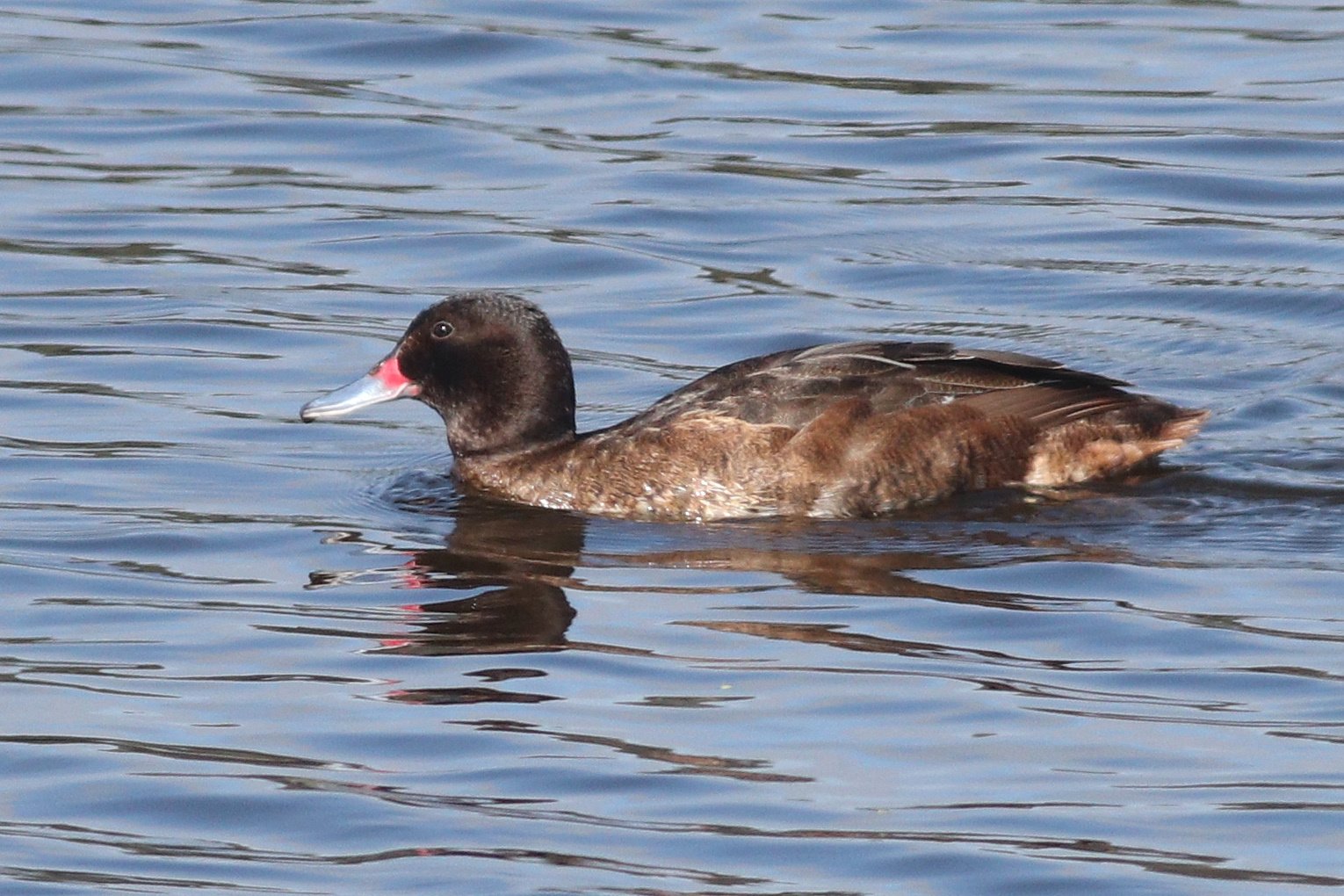
35–40 cm, a small, compact duck with a fairly long, flat bill and a short tail. The male has a black head and a grey bill, in the breeding season with a red patch at the base; the body is brown with fine pale speckling, the belly paler. The female is plain dark brown, with a pale eyebrow, a dark eye-stripe and a pale throat. In flight the wings are plain, without an obvious speculum.
Confusion species
The female Ruddy Duck Oxyura jamaicensis is similar, but has a stiff, often cocked tail, a broader bill and a single dark stripe across the pale cheek. The female Masked Duck Nomonyx dominicus is smaller, with two dark stripes across the face and a stiff tail. Brazilian Teal Amazonetta brasiliensis has a pale patch on the cheek and a green-and-white speculum.
Habitat
Freshwater marshes, lakes and lagoons with plenty of reeds and floating vegetation in the lowlands. It feeds by dabbling and short dives on seeds, aquatic plants and small invertebrates. It lays its eggs in the nests of coots, other ducks, herons and gulls; the host birds incubate them, after which the young leave the nest shortly after hatching.
Where the bird is most at home, classified by the vegetation units of the Andes and the west coast.


Range and movements
In the guide area recorded only as a very rare vagrant, with a few records in the lowlands of south-eastern Bolivia. Not known from Colombia, Ecuador, Peru or the Galápagos. The breeding range lies in Argentina, central Chile, Paraguay, Uruguay and the far south of Brazil.
How and when to look
Records in south-eastern Bolivia concern marshes with many coots and other ducks, the birds on which the Black-headed Duck depends. In such areas, search carefully through flocks of ducks.
Conservation status
Least Concern. In its breeding range the species depends on large marshes with many host birds; drainage and hunting are local threats.
Scientific name
Heteronetta atricapilla | (Merrem, 1841)
Merrem described the species in 1841 as Anas atricapilla; because it was later moved to another genus, the author and year stand in brackets. The genus Heteronetta was introduced in 1866 by Salvadori. The genus name is from Greek heteros, 'different', and netta, 'duck'. From Latin ater, 'black', and capillus, 'hair', so 'black-capped'. The specimen the first description was based on came from Buenos Aires, Argentina.