All species › Waterfowl › Ducks, swans and geese › Mallard
Mallard | Anas platyrhynchos
Wilde eend | Ánade azulón | Pato-real
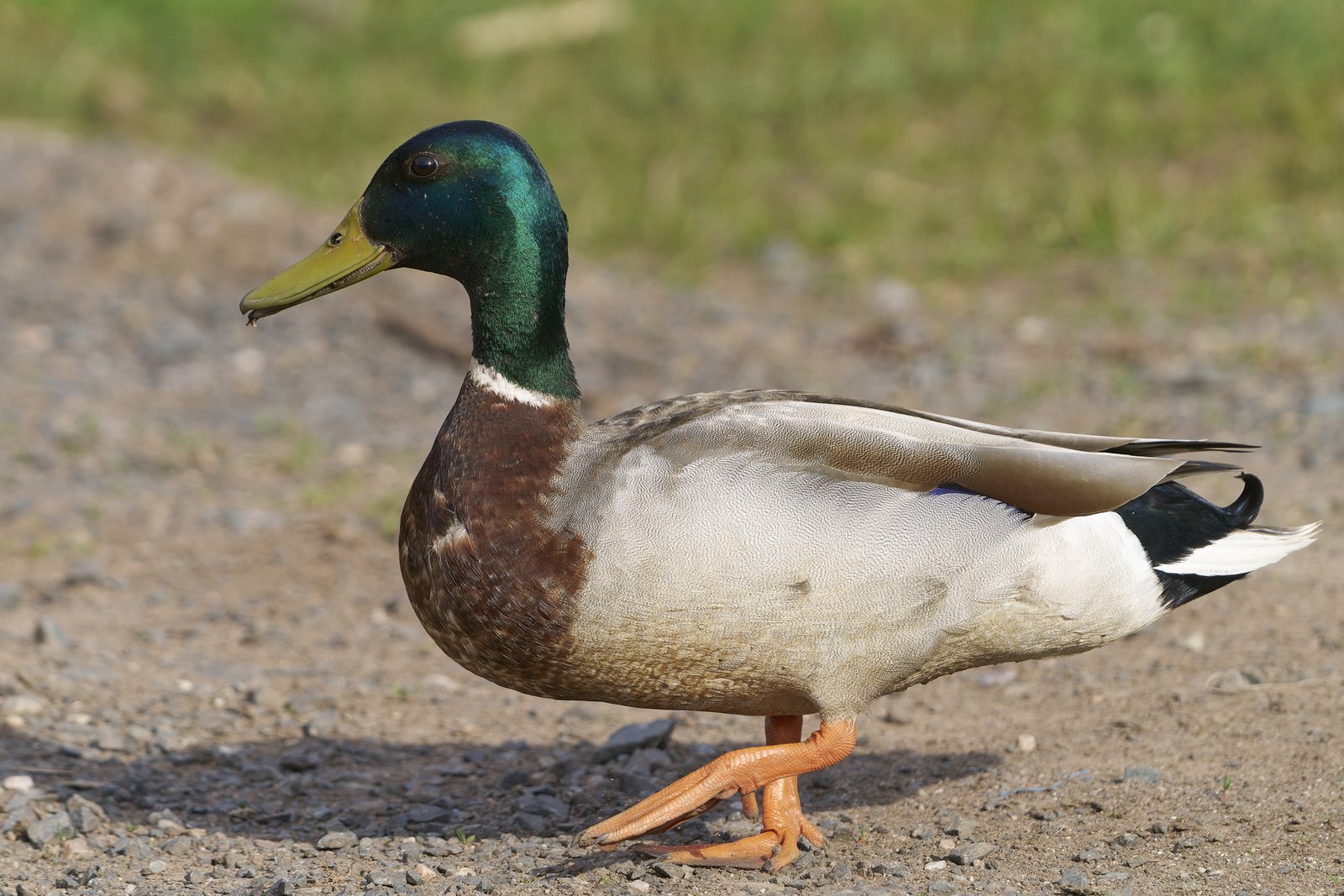
The Mallard is the ancestor of most domestic ducks and occurs naturally across the whole northern hemisphere. In the guide area it is known mainly as a feral or semi-domestic bird in parks, near villages and at fish farms. Wild birds from North America reach the guide area only very rarely.
Voice
The female gives the familiar loud, descending quack, the male a softer, hoarse raeb.
Recording: Petter Westberg — CC BY-NC-SA 4.0 · xeno-canto
Identification
50–65 cm, a large, heavy duck. The male has a glossy green head, a narrow white neck ring, a purplish-brown breast, a grey body, black, curled central tail feathers and a yellow bill. The female is mottled brown, with a dark eye-stripe and an orange bill with a dark patch. Both sexes have a blue speculum bordered white on both sides. Feral birds and hybrids with domestic ducks vary greatly, from all white to dark, and are often heavier.
Confusion species
Females of Gadwall Mareca strepera are smaller, with a white speculum and a narrower bill with orange sides. Yellow-billed Pintail Anas georgica is slimmer and browner, with a yellow bill and a pointed tail. Domestic Muscovy Ducks Cairina moschata have bare red skin around the eye and are larger.
Habitat
Ponds and lakes in parks and villages, fish farms, farm ponds and canals, locally also natural lakes in the lowlands and the Andes. It eats seeds, aquatic plants, invertebrates and food provided by people. Feral birds nest on the ground in shoreline vegetation or in gardens.
Where the bird is most at home, classified by the vegetation units of the Andes and the west coast.


Range and movements
In Colombia, Ecuador, Peru and Bolivia scattered as a feral or domestic bird, mainly around towns and villages; wild winter visitors from North America are very rare and most likely in the north. Not established as a free-living bird on the Galápagos. It occurs naturally in North America, Europe, Asia and North Africa and has been introduced in many places elsewhere.
- Resident
- Winter visitor (c. Oct–Mar)
- Passage (Mar–Apr, Oct–Nov)
- dark = core range, pale = thinly spread
How and when to look
In city parks and at village ponds; with a duck on a remote lake it is worth checking for the clean plumage of a wild bird and for irregularities that point to domestic origin.
Conservation status
Least Concern. In the guide area an introduced species; feral birds can hybridise with native ducks.
Scientific name
Anas platyrhynchos | Linnaeus, 1758
Linnaeus described the species in 1758 and placed it straight away in the genus where it still stands. He introduced the genus Anas in that same work. The genus name comes from Latin anas, 'duck'. The species name combines Greek platus, 'broad', with rhunkhos, 'bill', after the broad bill. The specimen the first description was based on came from Sweden.