All species › Waterfowl › Ducks, swans and geese › Egyptian Goose
Egyptian Goose | Alopochen aegyptiaca
Nijlgans | Ganso del Nilo | Ganso-do-egito
The Egyptian Goose is an African shelduck that is kept as an ornamental bird and has become feral in Colombia. There the birds live mainly around wetlands, lakes and parks on the Bogotá savanna and in the Cauca Valley. In Europe the species has long formed large feral populations.
Voice
The male gives a hoarse, hissing breath, the female a loud, blaring cackle; pairs often call together, also in flight.
Recording: African Bioacoustics Community — CC BY-NC-SA 4.0 · xeno-canto
Identification
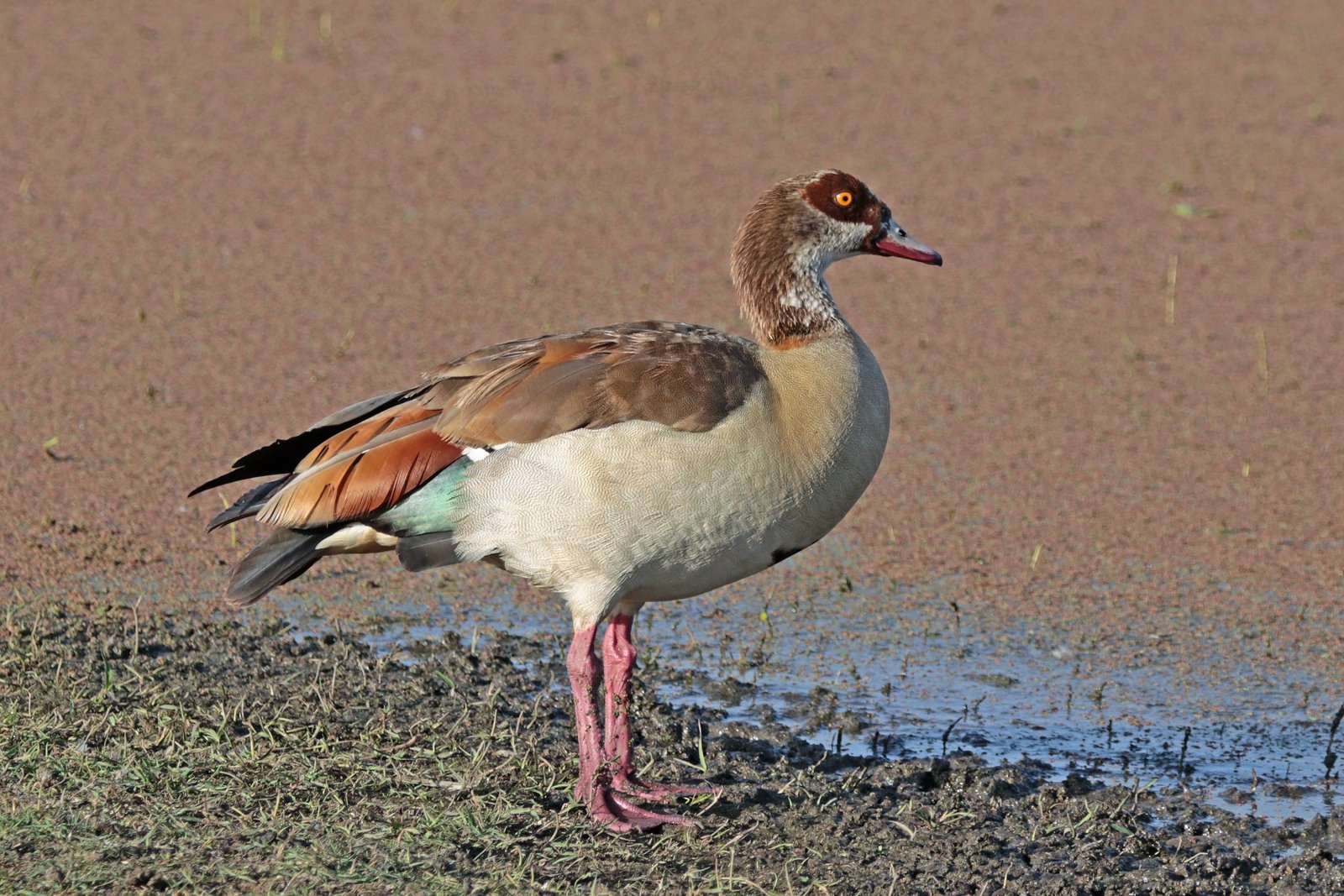
63–73 cm, an upright, long-legged goose with a pink bill and pink legs. The body is greyish brown to rufous brown, finely vermiculated, with a dark chestnut patch around the eye and a small, dark spot in the middle of the breast. The wing coverts are large and white, obvious in flight and often also on perched birds; the flight feathers are black, with a glossy green speculum. The sexes are alike; the male is slightly larger. Juveniles lack the eye and breast patches and have greyish coverts.
Confusion species
Orinoco Goose Neochen jubata has a plain pale head without an eye patch, a chestnut body and no large white patch on the forewing; it lives in the lowlands of the Llanos and Amazonia. Domestic geese, derived from Greylag Goose Anser anser, are heavier, with an orange bill and no white on the wing.
Habitat
Lakes, wetlands, ponds in parks and golf courses and pastures near water, in Colombia mainly on the Bogotá savanna at about 2600 m and in the Cauca Valley at about 1000 m. It grazes on grass and eats seeds, shoots and leaves. In Africa it nests in tree cavities, on buildings or on the ground.
Where the bird is most at home, classified by the vegetation units of the Andes and the west coast.


Range and movements
Introduced in the guide area. Almost all records come from Colombia: the Bogotá savanna in Cundinamarca and the Cauca Valley in Valle del Cauca, with scattered reports elsewhere in the Andes. There are indications of breeding in the wild, but the size of the feral population is unclear. Absent from Ecuador, Peru, Bolivia and the Galápagos. Native to Africa south of the Sahara and the Nile Valley.
- Resident
- dark = core range, pale = thinly spread
How and when to look
Search the wetlands and parks around Bogotá and the lakes and ponds of the Cauca Valley. The birds are often used to people and sit on banks and lawns.
Conservation status
Least Concern. Introduced in the guide area; feral birds may compete with native waterbirds and are regarded as invasive in Colombia.
Scientific name
Alopochen aegyptiaca | (Linnaeus, 1766)
Linnaeus described the species in 1766 as Anas aegyptiaca; because it was later moved to another genus, the author and year stand in brackets. The genus Alopochen was introduced in 1885 by Stejneger. The genus name means 'fox-goose', from Greek alōpēx, 'fox', and chēn, 'goose', after the rusty back. The species name comes from Latin aegyptiacus, 'Egyptian', and refers to Egypt. The specimen the first description was based on came from Egypt.