All species › Woodpeckers and allies › Woodpeckers › Cream-colored Woodpecker
Cream-colored Woodpecker | Celeus flavus
Strogele specht | Carpintero flavo | Pica-pau-amarelo
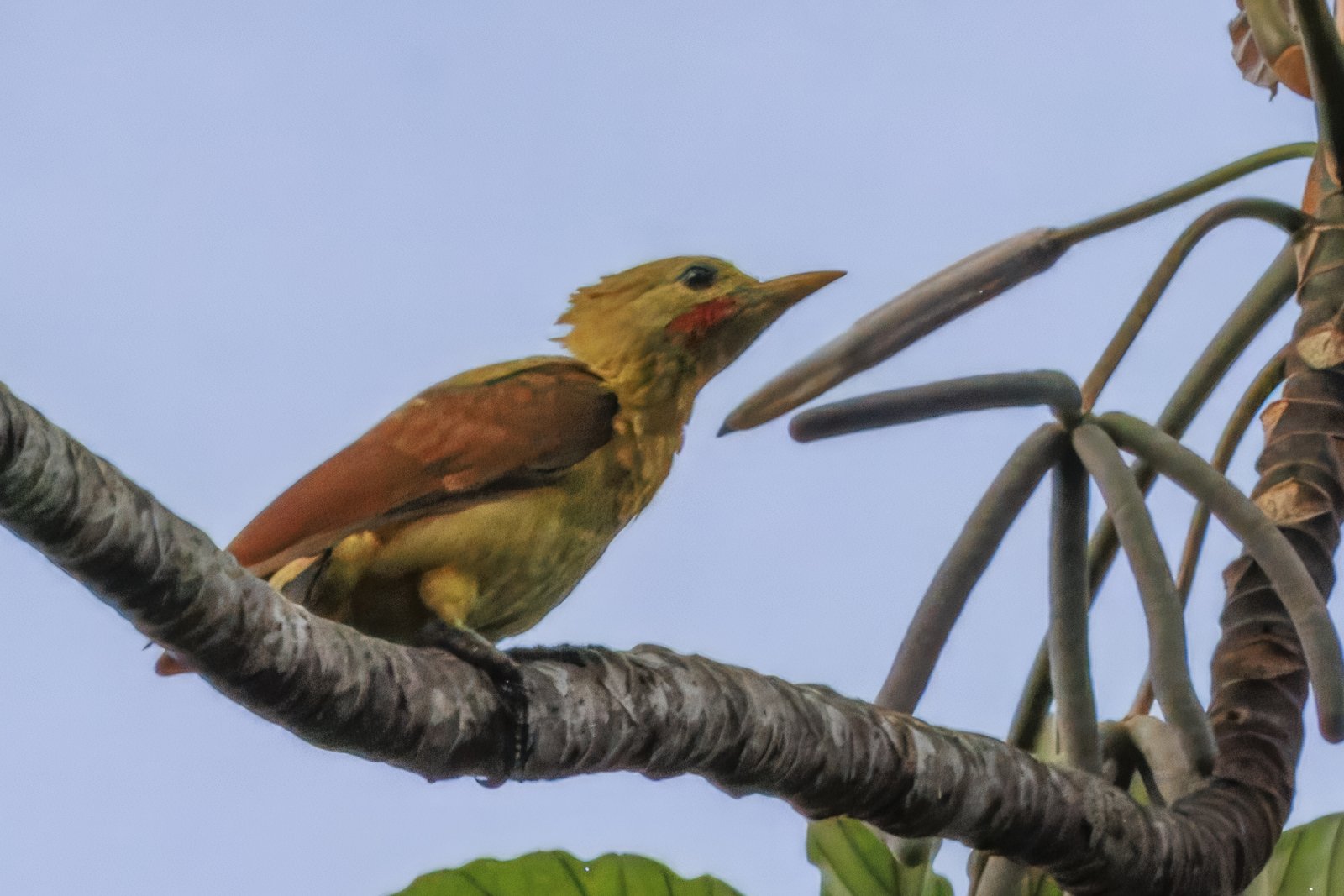
The Cream-colored Woodpecker is a medium-sized Celeus woodpecker of flooded forest and riverine forest in the Amazonian lowlands. The body is almost entirely creamy to straw-yellow, with a long, pointed crest and brown wings. It takes much of its food from the nests of arboreal ants and termites.
Voice
A loud, laughing series of four or five notes falling in pitch, and a short, harsh call. It drums little.
Recording: JAYRSON ARAUJO DE OLIVEIRA — CC BY-NC-SA 4.0 · xeno-canto
Identification
24–26 cm, with a long, pointed crest and a straight, pale yellow bill. Head, crest, back and underparts are creamy to straw-yellow, warmer ochre-yellow in some birds. The wing coverts are brown with pale edges, the flight feathers rufous and the tail blackish brown. The male has a red malar stripe; the female lacks the red.
Confusion species
Pale-crested Woodpecker Celeus lugubris, in eastern Bolivia, also has a pale head and crest, but a dark brown body. Chestnut Woodpecker Celeus elegans is larger and dark chestnut, with only a pale rump. Variable Woodpecker Celeus undatus is smaller and rufous, with black bars or scales and a rufous crest.
Habitat
Várzea, swamp forest, riverine forest along rivers and oxbow lakes, and the edges of tall forest in the lowlands, mostly below 500 m. It keeps to the middle levels and the canopy. It eats ants and termites, which it takes from nests in trees, and also fruit and seeds. It nests in a self-excavated cavity in a tree.
Where the bird is most at home, classified by the vegetation units of the Andes and the west coast.


Range and movements
In Colombia in the lowlands east of the Andes, in Amazonia and in the gallery forests of the llanos. In Ecuador and Peru throughout the Amazonian lowlands. In Bolivia in the northern and central lowlands, from Pando and Beni to La Paz, Cochabamba and Santa Cruz. Absent west of the Andes and from the Galápagos. Outside the guide area in Venezuela, the Guianas and Brazilian Amazonia, with a separate population in eastern Brazil.
- Resident
- dark = core range, pale = thinly spread
How and when to look
Search the crowns of flooded forest from a boat or along the shores of oxbow lakes; the pale colour contrasts with the green canopy. The laughing call often gives the first clue.
Conservation status
Least Concern. In the guide area the species is widespread in the lowlands east of the Andes and tolerates semi-open riverine forest.
Scientific name
Celeus flavus | (Müller, 1776)
Müller described the species in 1776 as Picus flavus; because it was later moved to another genus, the author and year stand in brackets. The genus Celeus was introduced in 1831 by Boie. The genus name comes from Greek keleos, the name for a green woodpecker. The species name comes from Latin flavus, 'yellow', for the cream-yellow plumage. The specimen the first description was based on came from Cayenne, French Guiana.