All species › Woodpeckers and allies › Woodpeckers › Rufous-headed Woodpecker
Rufous-headed Woodpecker | Celeus spectabilis
Oranjekopspecht | Carpintero cabecirrufo | Pica-pau-lindo
The Rufous-headed Woodpecker is a large Celeus woodpecker of western Amazonia, with a rufous head and crest. It lives mainly in Guadua bamboo forest and in scrub and young forest on river islands. Much of its food is taken from hollow bamboo stems and dead wood.
Voice
A loud, nasal, laughing series of a few notes and a short, harsh call, similar to those of other Celeus woodpeckers.
Recording: Juan Freile — CC BY-NC-SA 4.0 · xeno-canto
Identification
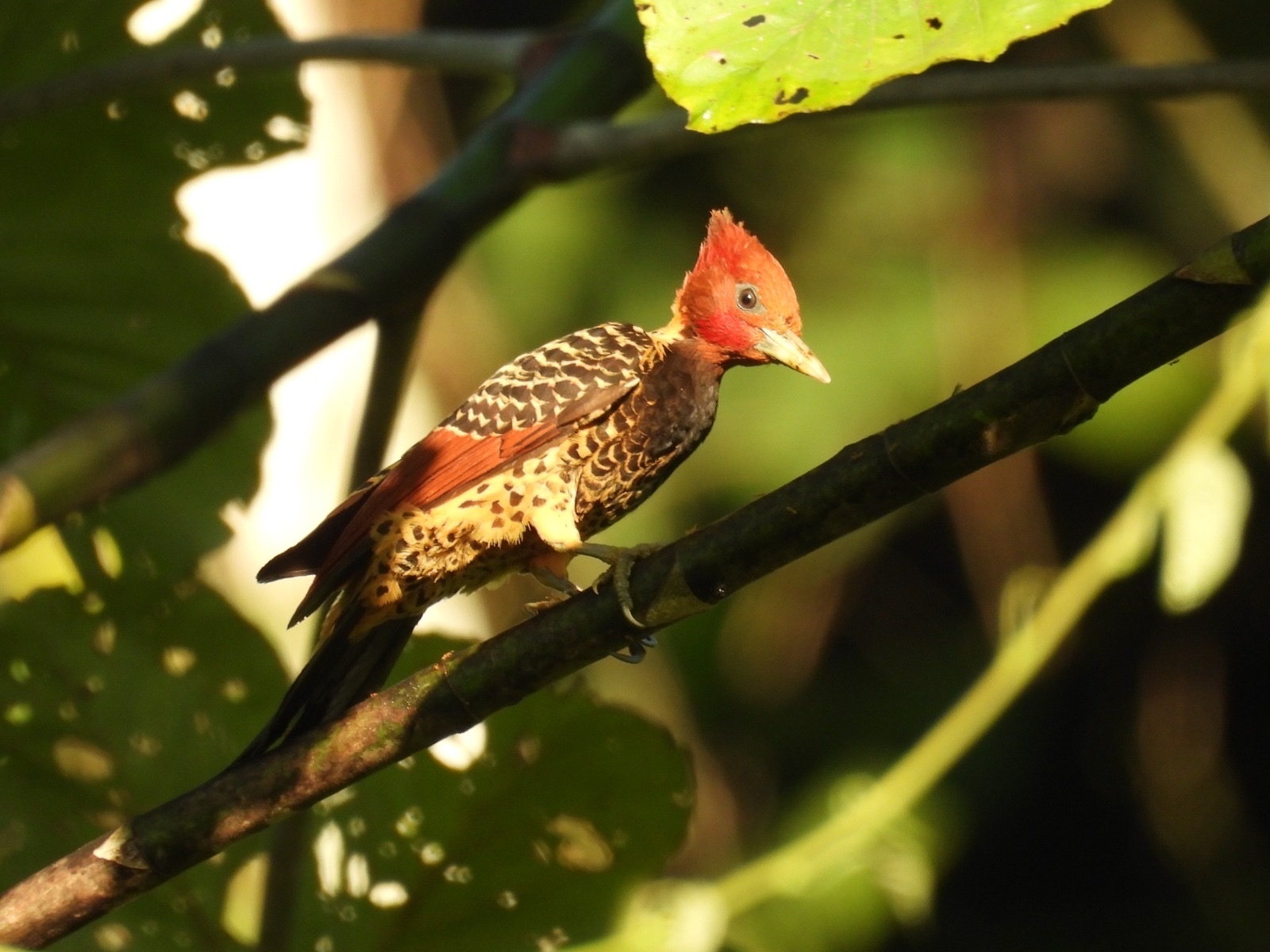
26–28 cm, with a full, rufous crest and a pale, yellowish bill. The head and neck are rufous. The back is creamy yellow with black bars, the rump plain pale yellow. A broad black band crosses the breast; the rest of the underparts is creamy yellow with black spots. The flight feathers are rufous and the tail is black. The male has a red malar stripe; the female lacks the red.
Confusion species
Chestnut Woodpecker Celeus elegans is entirely dark chestnut, without a black breast or barred back. Ringed Woodpecker Celeus torquatus also has a black breast, but a paler, cinnamon head and a rufous back. Cream-colored Woodpecker Celeus flavus is creamy yellow, including the head and crest.
Habitat
Guadua bamboo forest, including bamboo understorey in tall lowland forest, and scrub, Cecropia woodland and young forest on river islands and along rivers, up to about 1000 m in the foothills. It eats ants and their larvae and other insects, often hacked out of bamboo stems. It nests in a cavity in a tree.
Where the bird is most at home, classified by the vegetation units of the Andes and the west coast.


Range and movements
In Colombia only in the south, mainly in Putumayo. In Ecuador in the Amazonian lowlands, mainly along the Napo and Aguarico. In Peru locally along the large rivers of the north and in bamboo forest in the south-east, as in Madre de Dios. In Bolivia only in the north-west. Absent west of the Andes and from the Galápagos. Outside the guide area in western Brazilian Amazonia.
- Resident
- dark = core range, pale = thinly spread
How and when to look
Search bamboo forest in south-eastern Peru and forested river islands in eastern Ecuador. Listen for tapping on bamboo stems and for the nasal call.
Conservation status
Least Concern. The species is local and tied to bamboo forest and river islands, but most of its range lies in little-disturbed lowland forest.
Scientific name
Celeus spectabilis | Sclater & Salvin, 1880
Sclater & Salvin described the species in 1880 and placed it straight away in the genus where it still stands. The genus Celeus was introduced in 1831 by Boie. The genus name comes from Greek keleos, the name for a green woodpecker. The species name comes from Latin spectabilis, 'remarkable, worth seeing'. The specimen the first description was based on came from Sarayacu, Pastaza, Ecuador.