All species › Woodpeckers and allies › Woodpeckers › Chestnut Woodpecker
Chestnut Woodpecker | Celeus elegans
Vaalkuifspecht | Carpintero castaño | Pica-pau-chocolate
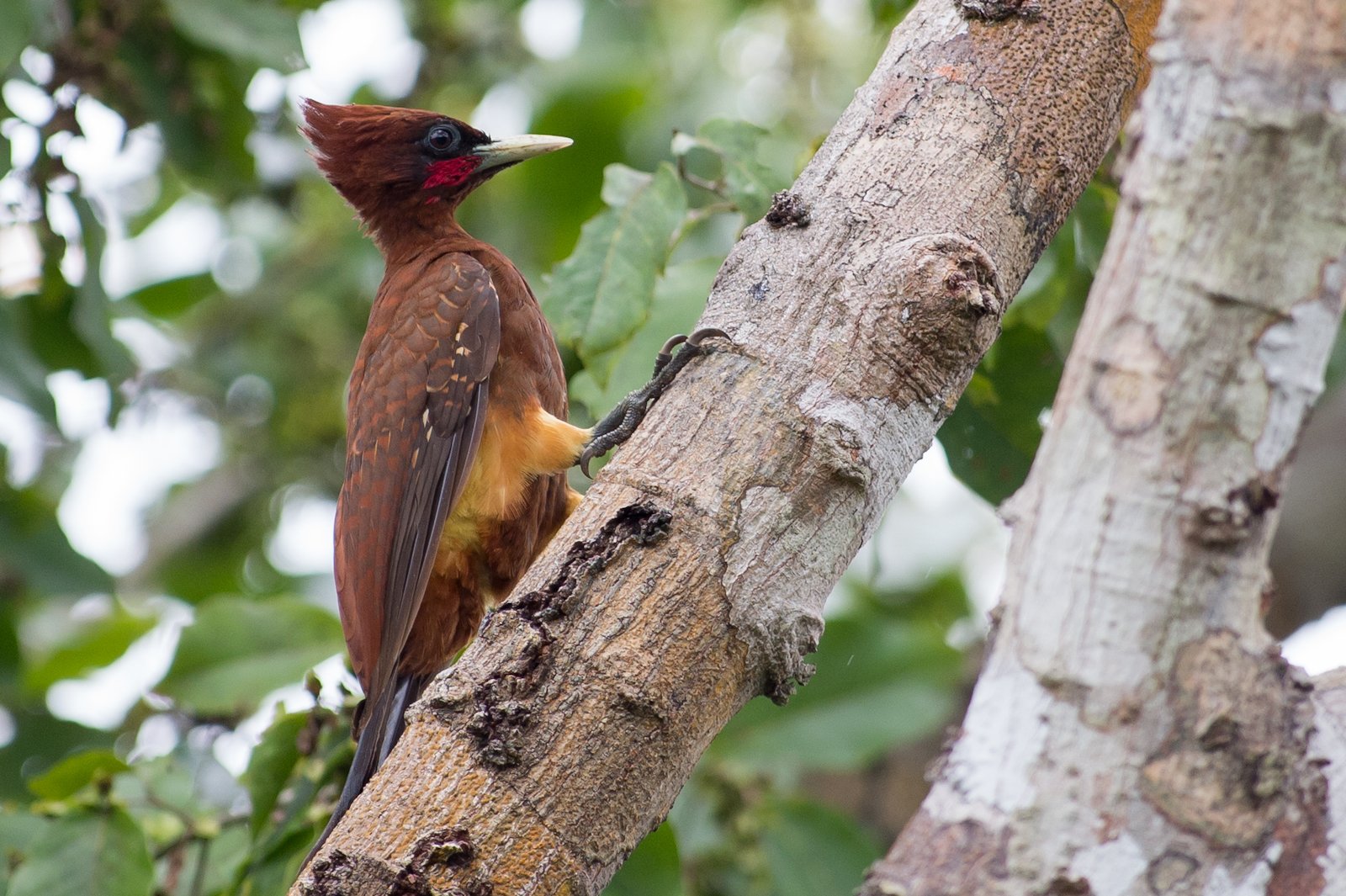
The Chestnut Woodpecker is a large, dark Celeus woodpecker of Amazonia. It is mainly chestnut, with a pale rump. The Dutch name, meaning pale-crested woodpecker, refers to the pale crest of the subspecies in north-eastern South America; in the guide area the crest is as dark as the head.
Voice
A loud, nasal two-syllable call, often followed by a few lower notes, and a short, harsh rattle.
Recording: Mauricio Cuellar Ramirez (@Birding.travel) — CC BY-NC-SA 4.0 · xeno-canto
Identification
27–30 cm, with a full crest and a pale, yellowish bill. The plumage is dark chestnut, with a yellowish to creamy rump and often pale spots or bars on the flanks. The flight feathers are rufous and the tail is blackish brown. The male has a red malar stripe; the female lacks the red.
Confusion species
Rufous-headed Woodpecker Celeus spectabilis has a creamy, barred back and a black breast band. Ringed Woodpecker Celeus torquatus has a paler, cinnamon head and a black breast. Variable Woodpecker Celeus undatus is smaller, with black bars or scales. Lineated Woodpecker Dryocopus lineatus is black and white, with a red crest.
Habitat
Tall humid lowland forest on terra firme and in várzea, forest edges, tall secondary forest and gallery forest, up to about 1000 m. It forages in the middle levels and the canopy. It eats ants and termites and also fruit. It nests in a self-excavated cavity in a tree.
Where the bird is most at home, classified by the vegetation units of the Andes and the west coast.


Range and movements
In Colombia in the lowlands east of the Andes, from the llanos to Amazonia. In Ecuador and Peru throughout the Amazonian lowlands and in the foothills. In Bolivia in the north, in Pando, Beni and La Paz, and locally in Santa Cruz. Absent west of the Andes and from the Galápagos. Outside the guide area in Venezuela, the Guianas, Trinidad and Brazilian Amazonia.
- Resident
- dark = core range, pale = thinly spread
How and when to look
In tall lowland forest, listen for the nasal call and then search the middle levels; birds sometimes join mixed flocks. At flowering or fruiting trees along forest edges they also come lower.
Conservation status
Least Concern. The species is widespread in the guide area, but depends on tall forest and disappears where the forest is cleared.
Scientific name
Celeus elegans | (Müller, 1776)
Müller described the species in 1776 as Picus elegans; because it was later moved to another genus, the author and year stand in brackets. The genus Celeus was introduced in 1831 by Boie. The genus name comes from Greek keleos, the name for a green woodpecker. The species name comes from Latin elegans, 'refined, tasteful'. The specimen the first description was based on came from Cayenne, French Guiana.