All species › Woodpeckers and allies › Woodpeckers › Pale-crested Woodpecker
Pale-crested Woodpecker | Celeus lugubris
Bleekkuifspecht | Carpintero copete pajizo | Pica-pau-louro
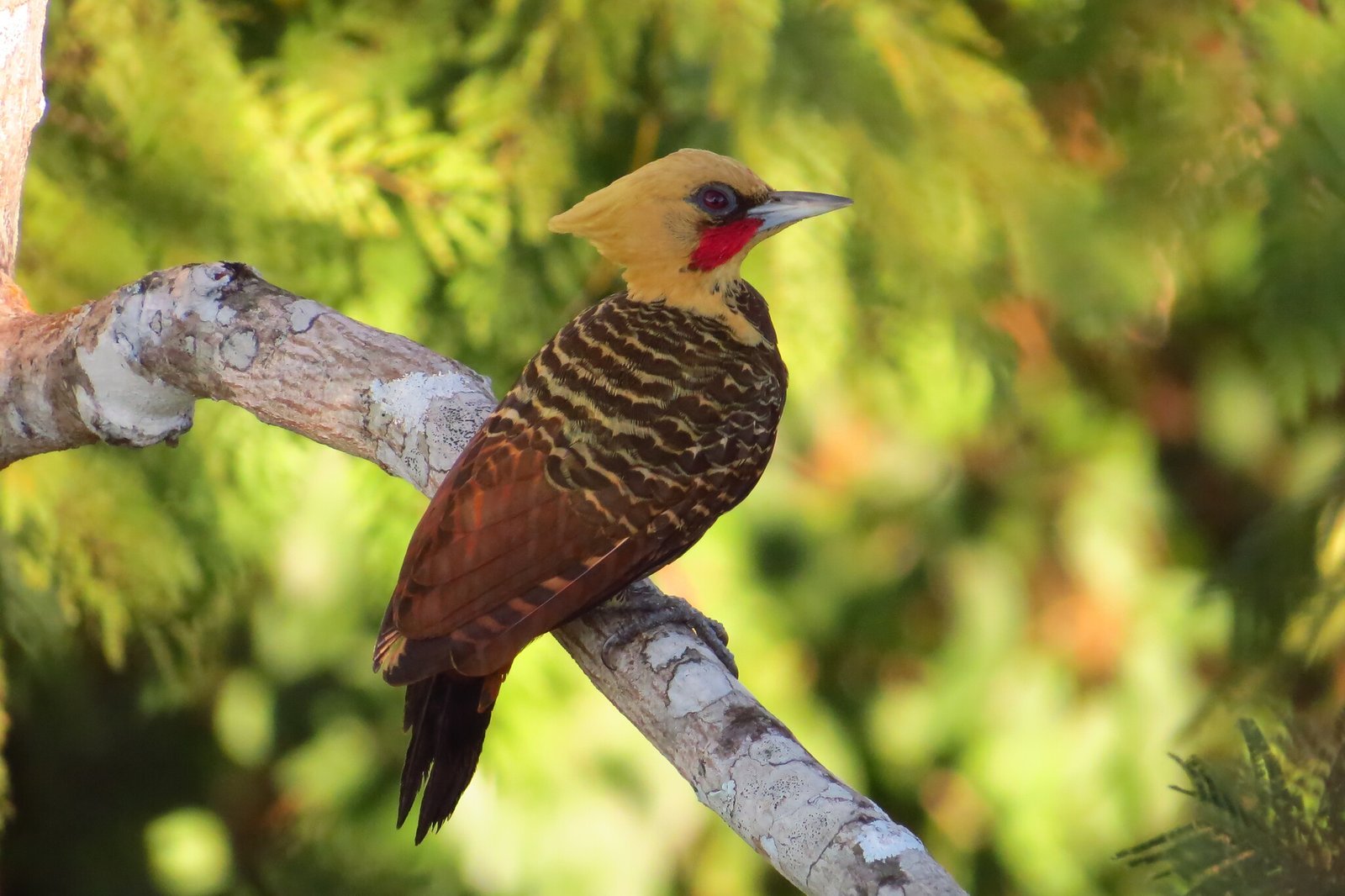
The Pale-crested Woodpecker is a medium-sized Celeus woodpecker of dry forest and savanna in the southern Amazon basin and the Chaco. A pale, straw-yellow head and crest contrast with the dark brown body. In the guide area it occurs only in eastern Bolivia.
Voice
A loud, laughing series of a few notes falling in pitch, and a short, harsh call.
Recording: Cid Espínola — CC BY-NC-SA 4.0 · xeno-canto
Identification
23–26 cm, with a long, pointed crest and a pale, yellowish bill. The head and crest are straw-yellow to pale ochre. The back and wings are dark brown with pale bars, and the rump is pale yellow. The underparts are dark chocolate-brown. The flight feathers are rufous and the tail is blackish brown. The male has a red malar stripe; the female lacks the red.
Confusion species
Cream-colored Woodpecker Celeus flavus also has a pale head and crest, but is entirely creamy yellow, without a dark brown body, and lives mainly in wetter riverine forest. Chestnut Woodpecker Celeus elegans is chestnut, with a dark head and crest. Black-bodied Woodpecker Dryocopus schulzii is larger and black, with a red crest and a white stripe on the neck.
Habitat
Semi-deciduous dry forest, gallery forest, cerrado and woodland islands in seasonally flooded savanna, in the lowlands up to about 1000 m. It forages in the middle levels and the canopy. It eats ants and termites and also fruit. It nests in a self-excavated cavity in a tree.
Where the bird is most at home, classified by the vegetation units of the Andes and the west coast.


Range and movements
In the guide area only in eastern Bolivia, in the lowlands of Beni and Santa Cruz, including the Chiquitania. Absent from Colombia, Ecuador, Peru and the Galápagos. Outside the guide area in south-western Brazil, including the Pantanal, in Paraguay and in north-eastern Argentina.
- Resident
- dark = core range, pale = thinly spread
How and when to look
Search the Chiquitania and the woodland islands in the savannas of eastern Santa Cruz, especially in the early morning when birds call. In gallery forest they often keep to the middle levels.
Conservation status
Least Concern. The dry forest and savannas where the species lives are being converted to farmland on a large scale in eastern Bolivia.
Scientific name
Celeus lugubris | (Malherbe, 1851)
Malherbe described the species in 1851 as Celeopicus lugubris; because it was later moved to another genus, the author and year stand in brackets. The genus Celeus was introduced in 1831 by Boie. The genus name comes from Greek keleos, the name for a green woodpecker. The species name comes from Latin lugubris, 'mournful, in mourning', probably for the dark plumage. The specimen the first description was based on came from Mato Grosso, Brazil.