All species › Passerines › Antpittas › Crescent-faced Antpitta
Crescent-faced Antpitta | Grallaricula lineifrons
Chapmans dwergmierpitta | Ponchito medialuna | Tovaquinha-de-meia-lua
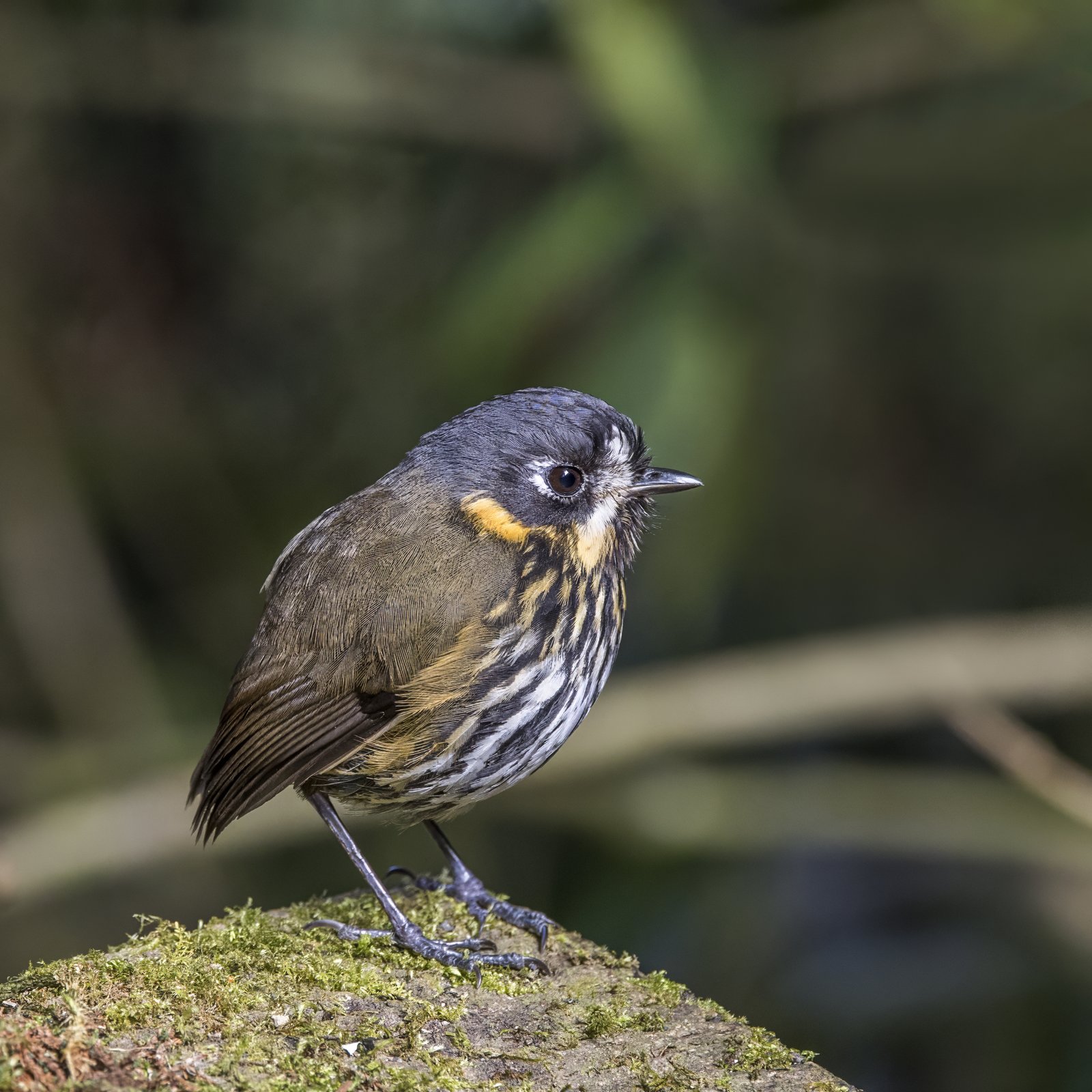
The Crescent-faced Antpitta is a small antpitta of the highest montane forest just below the treeline, with a black face and a large white crescent in front of the eye. The underparts are white to ochre-yellow with black streaks. The species lives locally in the Andes of Colombia and Ecuador and is usually first detected by its rising series of whistles.
Voice
The song is a rising series of piping notes ending in a few shrill notes. Also a soft, descending whistle and a short call, chup.
Recording: Iván Lau — CC BY-NC-SA 4.0 · xeno-canto
Identification
11–12 cm, round and short-tailed. The crown and nape are dark sooty grey, the face is black, with a white crescent running from the forecrown over the lores almost to the throat and a small white spot behind the eye. The upperparts are brownish olive. The underparts are white washed with ochre-yellow and densely streaked black; the undertail coverts are ochre-yellow. The bill is black, the legs blue-grey to purplish grey. The sexes are alike.
Confusion species
No other Grallaricula has a black face with a white crescent. Slaty-crowned Antpitta Grallaricula nana has a grey crown but orange-rufous, unstreaked underparts, and usually lives lower. Tawny Antpitta Grallaria quitensis lives at the same elevation, but is much larger and plain brown and keeps to more open páramo and scrub.
Habitat
The undergrowth of humid cloud forest and elfin forest just below the treeline, almost always above 2900 m and up to about 3700 m. Less tied to bamboo than other Grallaricula antpittas. It forages alone or in pairs, taking insects, spiders and other arthropods from leaves and the leaf litter, and also eats earthworms. The nest is a shallow cup of moss and twigs on a platform, 1.8 to 3.6 m above the ground; both parents build the nest and feed the young.
Where the bird is most at home, classified by the vegetation units of the Andes and the west coast.


Range and movements
In Colombia at scattered sites in the Central Andes, from Quindío southwards, and further south to Nariño. In Ecuador mainly on the eastern slope and in the high Andes, south to Loja. Not confirmed in Peru. Absent from Bolivia and the Galápagos. Does not occur outside the guide area.
- Resident
- dark = core range, pale = thinly spread
How and when to look
Listen early in the morning in dense forest just below the treeline, for example around the Papallacta pass in Ecuador, for the rising series of whistles. At a few sites in Ecuador and Colombia the species comes to feeding stations with earthworms.
Conservation status
Least Concern. High-elevation forest is locally degraded by logging and burning for pasture, also inside protected areas, but the species appears to use degraded and secondary forest as well.
Scientific name
Grallaricula lineifrons | (Chapman, 1924)
Chapman described the species in 1924 as Apocryptornis lineifrons; because it was later moved to another genus, the author and year stand in brackets. The genus Grallaricula was introduced in 1858 by Sclater. The genus name is a diminutive of the genus Grallaria, Modern Latin for 'stilt-walker'. The species name comes from Latin linea, 'line', and frons, 'forehead', after the pale crescent marking on the face. The specimen the first description was based on came from Oyacachi, Napo, Ecuador.