All species › Passerines › Antpittas › Streak-chested Antpitta
Streak-chested Antpitta | Hylopezus perspicillatus
Brilmierpitta | Tororoí pechilistado | Torom-de-peito-estriado
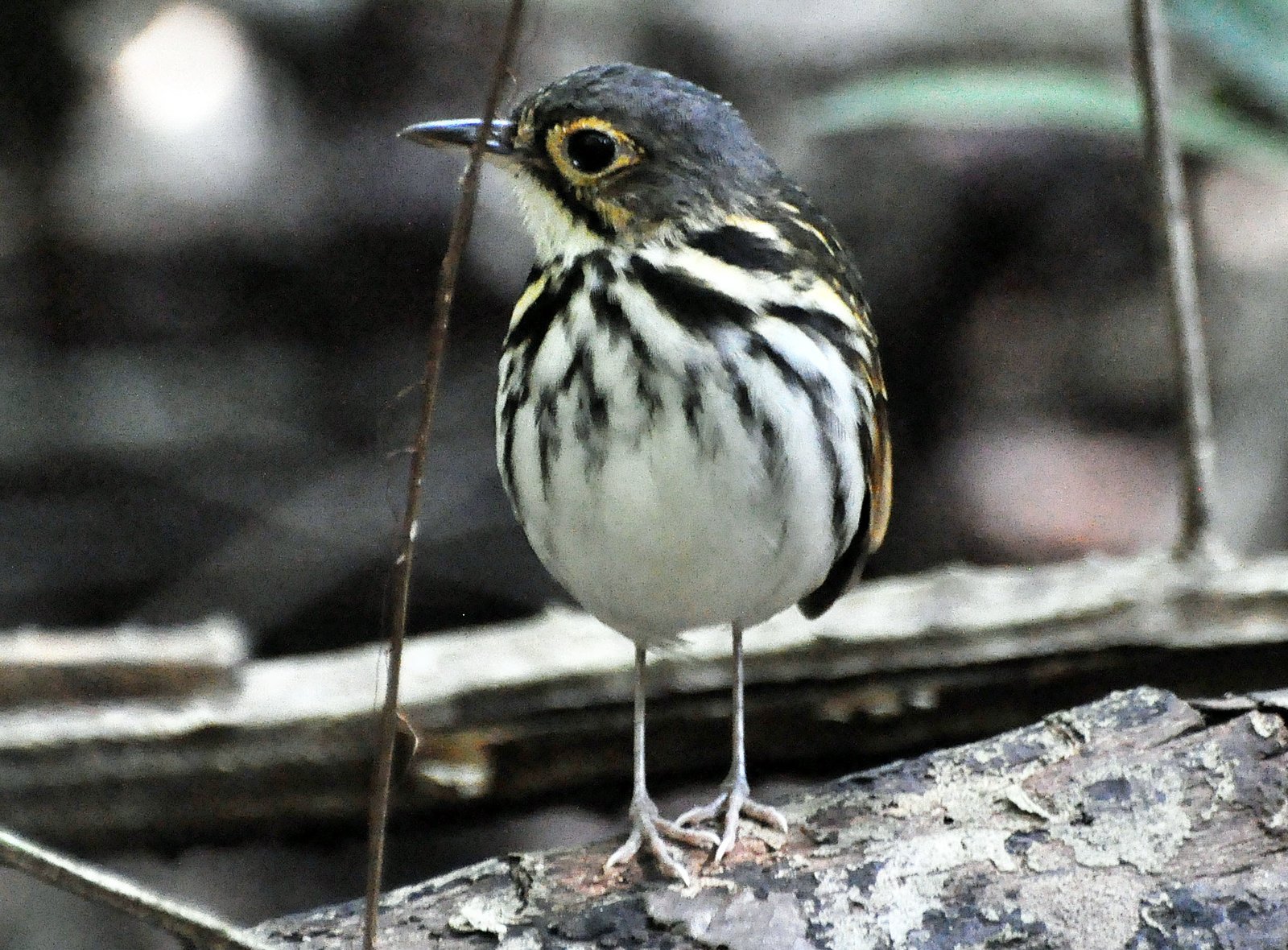
The Streak-chested Antpitta is a small, almost tailless ground bird of humid lowland forest on the Pacific side of Colombia and in north-western Ecuador. Its broad buff eye-ring and black-streaked breast give it its name in several languages. It lives hidden on the forest floor and is usually first noticed by its whistled song.
Voice
The song is a series of six to ten clear whistles that first rise in pitch and volume and then fall and fade, pu pu pu-pu-PU-PU pew pew. A singing bird often repeats the series for a long time from the same spot.
Recording: Sue Riffe — CC BY-NC-SA 4.0 · xeno-canto
Identification
13–14 cm, round and almost tailless on long, pinkish-grey legs. The crown and nape are grey, the upperparts olive-brown. A broad buff eye-ring with pale lores forms spectacles, with a dark malar stripe below. The wing coverts have buff tips forming two rows of spots. The underparts are white with a buff wash across the breast and sharp black streaks on breast and flanks. The sexes are alike; young birds are browner and fluffier.
Confusion species
Thicket Antpitta Myrmothera dives lacks the spectacles and wing spots, and has an almost unstreaked breast with orange-brown flanks. Rufous-crowned Antpitta Pittasoma rufopileatum is larger, with a rufous crown and a broad black eyebrow. Ochre-breasted Antpitta Grallaricula flavirostris is much smaller, with a yellow bill, and perches higher in the understorey. Spotted Antpitta Hylopezus macularius is very similar but occurs only east of the Andes.
Habitat
The floor of humid, tall lowland and foothill forest, including old secondary forest, up to about 1200 m. It hops across the leaf litter, pauses, and searches for insects, spiders and other invertebrates. The nest is a shallow cup of leaves and twigs, low in a shrub or on a stump.
Where the bird is most at home, classified by the vegetation units of the Andes and the west coast.


Range and movements
In Colombia in the humid lowlands along the Pacific coast, from Chocó south to Nariño, and in the north into Antioquia and the middle Magdalena Valley. In Ecuador in the north-west, mainly in Esmeraldas and western Pichincha. Absent from Peru, Bolivia and the Galápagos. Outside the guide area from Honduras to Panama.
- Resident
- dark = core range, pale = thinly spread
How and when to look
Listen in the early morning for the whistled song in large, little-disturbed lowland forests of north-western Ecuador and the Colombian Chocó. A singing bird often stays for minutes low above the ground on a branch or fallen log.
Conservation status
Least Concern. Numbers are declining through the clearance of lowland forest on the Pacific side, and the species disappears from heavily fragmented forest.
Scientific name
Hylopezus perspicillatus | (Lawrence, 1861)
Lawrence described the species in 1861 as Grallaria perspicillata; because it was later moved to another genus, the author and year stand in brackets. The genus Hylopezus was introduced in 1909 by Ridgway. The genus name comes from Ancient Greek hulē, 'forest', and pezos, 'walking'. The species name comes from Modern Latin perspicillatus, 'spectacled', after the pale eye-ring. The specimen the first description was based on came from Panama.