All species › Passerines › Tityras, becards and allies › Crested Becard
Crested Becard | Pachyramphus validus
Kuifbekarde | Anambé grande | Caneleiro-de-chapéu-preto
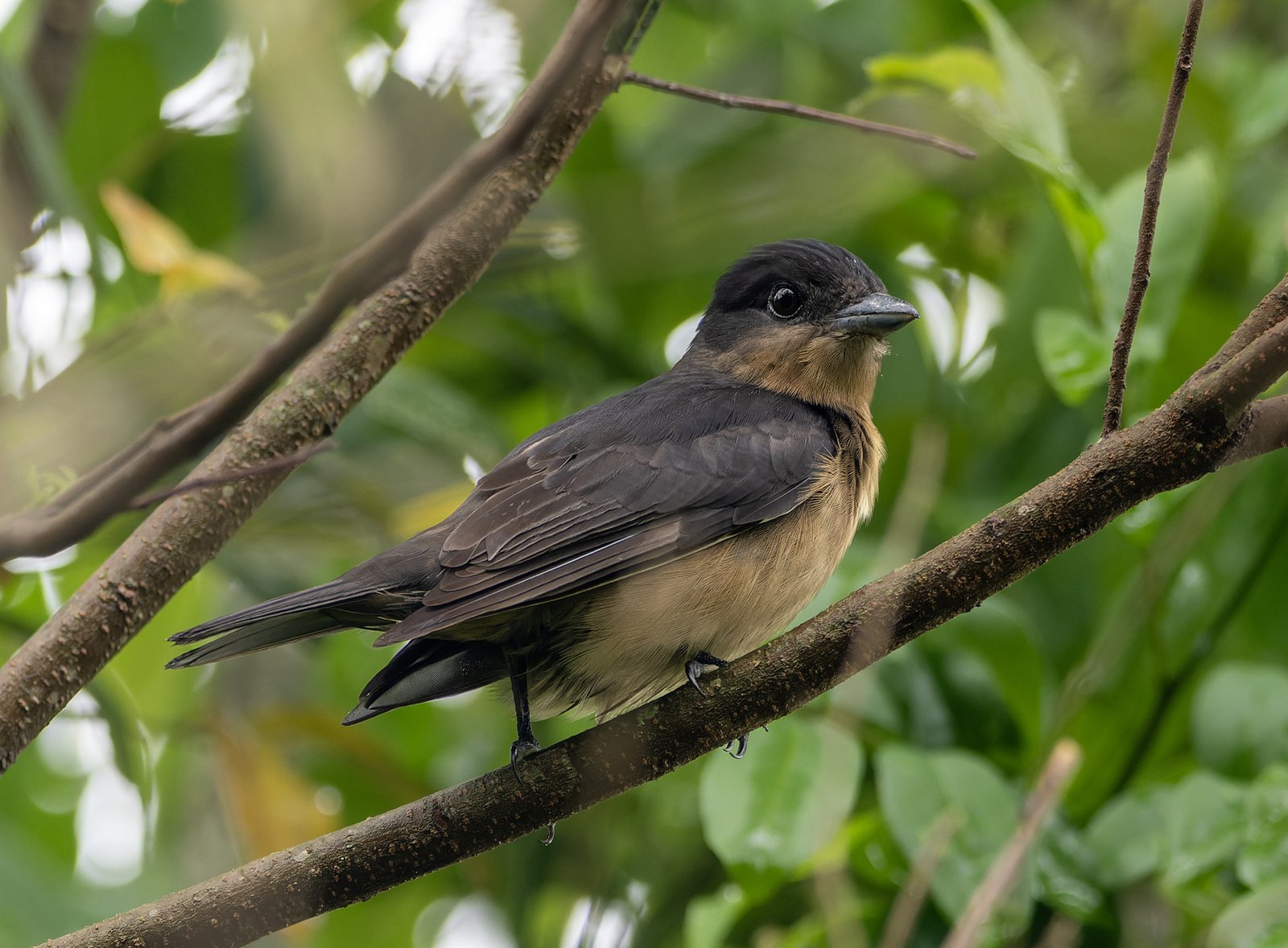
The Crested Becard is the largest becard in the guide area, with a short, bushy crest. In the guide area it lives mainly on the eastern Andean slopes of southern Peru and Bolivia. The male is grey and black, the female largely rufous-brown with a grey cap.
Voice
A series of thin, high whistles and soft, chattering calls.
Recording: JAYRSON ARAUJO DE OLIVEIRA — CC BY-NC-SA 4.0 · xeno-canto
Identification
18–19 cm, with a large head, a short crest and a thick bill. The male has a black crown, dark grey to blackish upperparts and pale grey underparts; sometimes a small white patch shows in the wing. The female has a dark grey cap, rufous-brown upperparts, wings and tail and cinnamon underparts. Young birds resemble the female.
Confusion species
The female Pink-throated Becard Pachyramphus minor also has a grey head and rufous wings, but a grey back as well, and lives in the Amazonian lowlands. White-winged Becard Pachyramphus polychopterus is smaller, and the male has clear white edges to the wings and tail. Chestnut-crowned Becard Pachyramphus castaneus has a chestnut crown with a grey band behind it.
Habitat
Forest edges, semi-open woodland and secondary forest on the eastern Andean slopes and in the semi-humid and dry valleys, roughly between 500 and 2500 m. It searches for insects in the middle and upper levels of the trees, also in mixed flocks, and eats fruit. The nest is a large, globular ball of plant material high in a tree.
Where the bird is most at home, classified by the vegetation units of the Andes and the west coast.


Range and movements
In Peru on the eastern Andean slopes in the south, mainly in Cusco and Puno, locally further north. In Bolivia in the Yungas and Andean valleys of La Paz, Cochabamba, Chuquisaca and Santa Cruz. Absent from Colombia, Ecuador and the Galápagos. Outside the guide area in north-western Argentina; another subspecies lives in eastern and southern Brazil, Paraguay and north-eastern Argentina and is partly migratory.
- Resident
- dark = core range, pale = thinly spread
How and when to look
Search forest edges and roads at middle elevations in the Yungas of Bolivia and southern Peru, where the species travels with mixed flocks.
Conservation status
Least Concern. The species tolerates secondary forest and forest edges, but is local in the guide area.
Scientific name
Pachyramphus validus | (Lichtenstein, 1823)
Lichtenstein described the species in 1823 as Lanius validus; because it was later moved to another genus, the author and year stand in brackets. The genus Pachyramphus was introduced in 1840 by Gray. The genus name comes from Greek pakhus, 'stout, thick', and rhamphos, 'bill'. The species name is Latin validus, 'strong, robust', probably after the heavy build and bill. The specimen the first description was based on came from São Paulo, Brazil.