All species › Passerines › Tityras, becards and allies › White-naped Xenopsaris
White-naped Xenopsaris | Xenopsaris albinucha
Witnektiran | Tijerilla | Tijerila
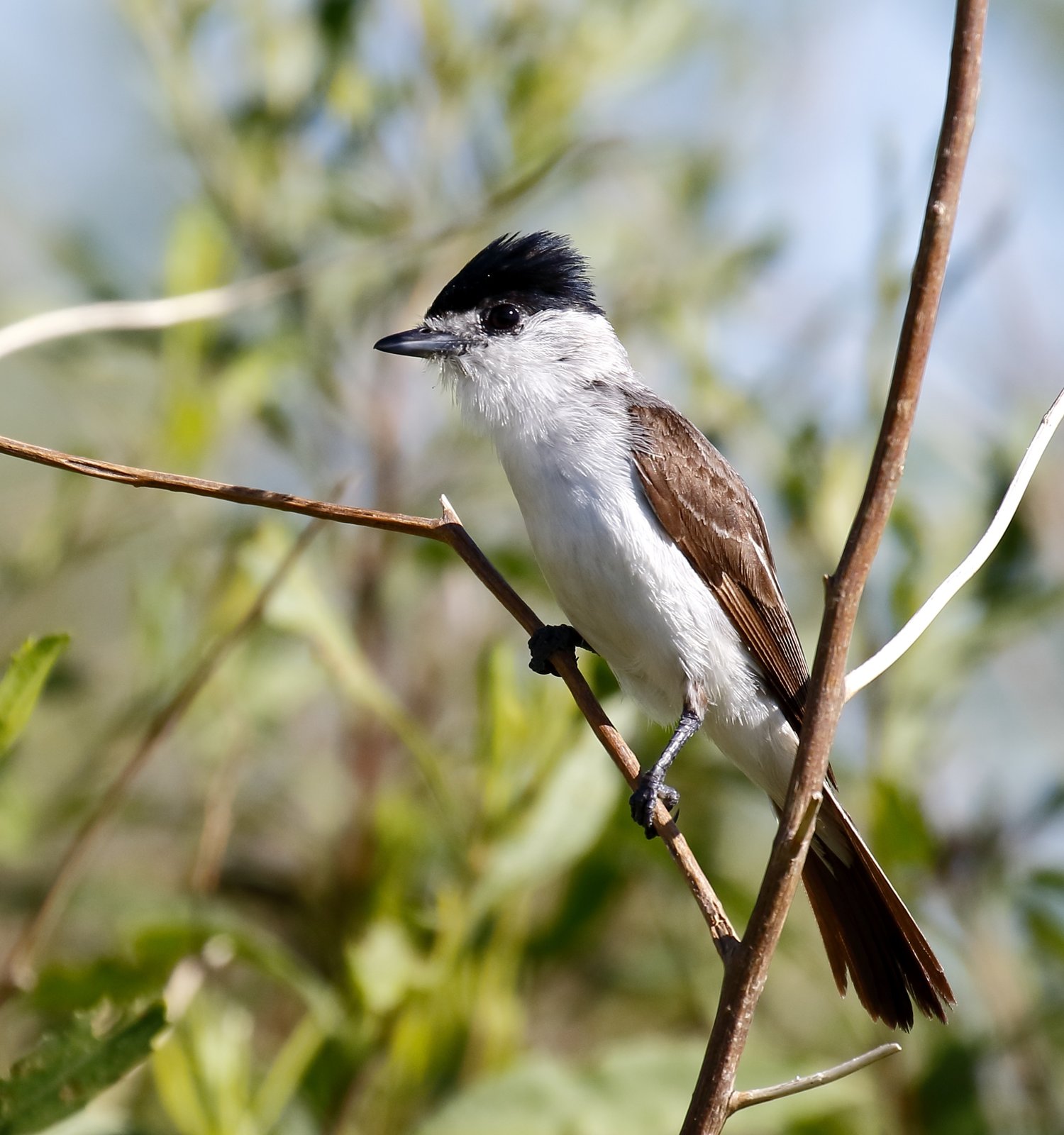
The White-naped Xenopsaris is a small, slender, grey and white bird of semi-open country with trees, related to the becards. Its main range lies in eastern and southern South America; in the guide area it is a rare vagrant, with only a few records in the eastern lowlands.
Voice
A soft, delicate song that does not carry far, mainly in the rainy season. Foraging birds occasionally give a high, rising call.
Recording: JAYRSON ARAUJO DE OLIVEIRA — CC BY-NC-SA 4.0 · xeno-canto
Identification
12–13 cm, slender, with a thin bill and a fairly long tail. The male has a glossy black crown that turns into a white nape at the rear. The back is pale greyish brown, the wings and tail darker, with pale edges to the wing feathers. The underparts are white. The female has a browner crown and somewhat browner-tinged wing edges. Young birds resemble the female.
Confusion species
Females and young of becards, such as White-winged Becard Pachyramphus polychopterus and Cinereous Becard Pachyramphus rufus, are sturdier, with a thicker bill and a larger head; Cinereous Becard has a black crown but no white nape and is greyer below. Small tyrant flycatchers with a dark crown lack the combination of black crown, white nape and wholly white underparts.
Habitat
Semi-open country with scattered trees, riparian woodland, the edges of gallery forest and light woodland, usually near water or damp ground. In the lowlands, up to about 550 m. It takes insects from foliage and in short sallies. The nest is a simple cup in a tree fork.
Where the bird is most at home, classified by the vegetation units of the Andes and the west coast.


Range and movements
Very rare in the guide area: a few records in the eastern lowlands of Bolivia and in Peru, where the species has been known only since 2006. Possibly present in north-eastern Colombia, bordering Venezuela. Absent from Ecuador and the Galápagos. Outside the guide area in Venezuela, Guyana, Brazil, Paraguay, Uruguay and northern Argentina; partly migratory in the south.
How and when to look
There is no regular site in the guide area. In the eastern lowlands of Bolivia, watch for small grey-and-white birds with a black crown in trees near water and in semi-open country.
Conservation status
Least Concern. The range outside the guide area is very large.
Scientific name
Xenopsaris albinucha | (Burmeister, 1869)
Burmeister described the species in 1869 as Pachyrhamphus albinucha; because it was later moved to another genus, the author and year stand in brackets. The genus Xenopsaris was introduced in 1891 by Ridgway. The genus name comes from Greek xenos, 'stranger', and Psaris, an old synonym of Tityra (from Greek psar, 'starling'). The species name comes from Latin albus, 'white', and nucha, 'nape', for the white nape. The specimen the first description was based on came from Río de la Plata near Buenos Aires, Argentina.