All species › Passerines › Tityras, becards and allies › Rose-throated Becard
Rose-throated Becard | Pachyramphus aglaiae
Grote bekarde | Cabezón degollado | Caneleiro-de-garganta-rosada
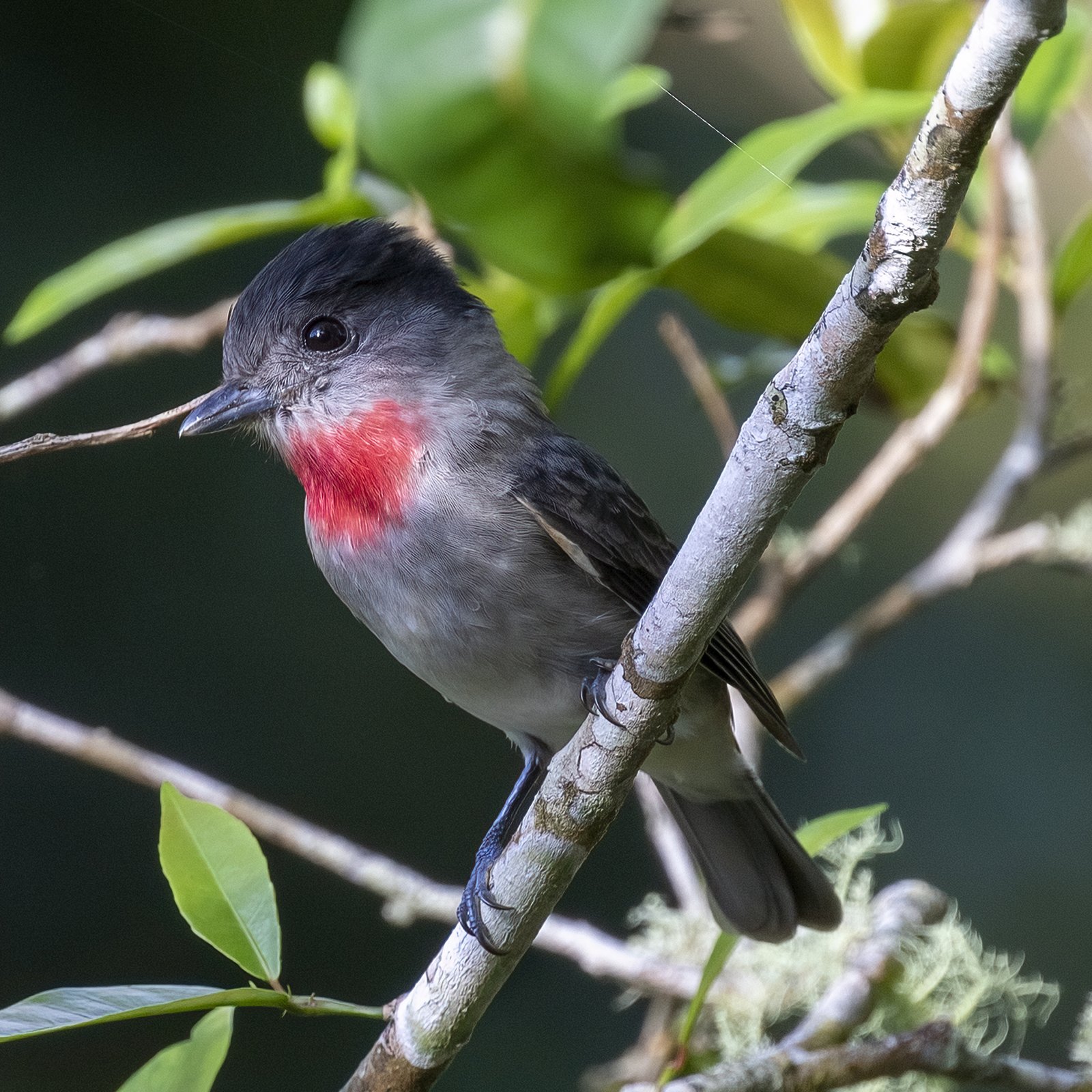
The Rose-throated Becard is a becard of Mexico and Central America, the male of which has a rose-red throat patch. In the guide area it is known only from a few unconfirmed records from Ecuador; its normal range lies far to the north. These records may be based on confusion with other becards.
Voice
A thin, descending whistle, tseeeeeuu, and soft, chattering calls.
Recording: Zsombor Károlyi — CC BY-NC-SA 4.0 · xeno-canto
Identification
16–17 cm, with a large head and a thick bill. The male is dark grey above with a blackish cap and paler grey below, with a rose-red patch on the throat. The female has a dark grey cap, rufous-brown upperparts, cinnamon underparts and a pale collar on the nape. Young birds resemble the female.
Confusion species
The male Pink-throated Becard Pachyramphus minor of Amazonia also has a pink throat patch, but is much darker, almost black; the female has a grey head and back. The female One-colored Becard Pachyramphus homochrous west of the Andes is cinnamon with a darker crown and closely resembles the female Rose-throated Becard. Cinnamon Becard Pachyramphus cinnamomeus is bright cinnamon, with a pale stripe between eye and bill.
Habitat
In its own range open woodland, forest edges, riparian woodland and semi-open country with trees, from sea level into the lower mountains. It feeds mainly on insects picked from leaves, and some fruit. The nest is a large, hanging ball of plant material, often high on a branch.
Where the bird is most at home, classified by the vegetation units of the Andes and the west coast.


Range and movements
In the guide area only a few records from Ecuador, which are unconfirmed. No records known from Colombia, Peru, Bolivia or the Galápagos. Outside the guide area from southern Arizona and Texas through Mexico to Costa Rica; northern birds move south in winter.
How and when to look
A pink-throated becard west of the Andes calls for good photographs and a careful comparison with One-colored Becard and other becards.
Conservation status
Least Concern. The species occupies a large range and tolerates partly cleared landscapes.
Scientific name
Pachyramphus aglaiae | (de Lafresnaye, 1839)
De Lafresnaye described the species in 1839 as Pachyrhynchus Aglaiae; because it was later moved to another genus, the author and year stand in brackets. The genus Pachyramphus was introduced in 1840 by Gray. The genus name comes from Greek pakhus, 'stout, thick', and rhamphos, 'bill'. The species name honours Aglaé Brelay, wife of the French wholesale merchant, naturalist and collector Charles Brelay (1792–1857). The specimen the first description was based on came from Xalapa, Veracruz, Mexico.