All species › Passerines › Sharpbill › Sharpbill
Sharpbill | Oxyruncus cristatus
Scherpsnavel | Picoagudo | Araponga-do-horto
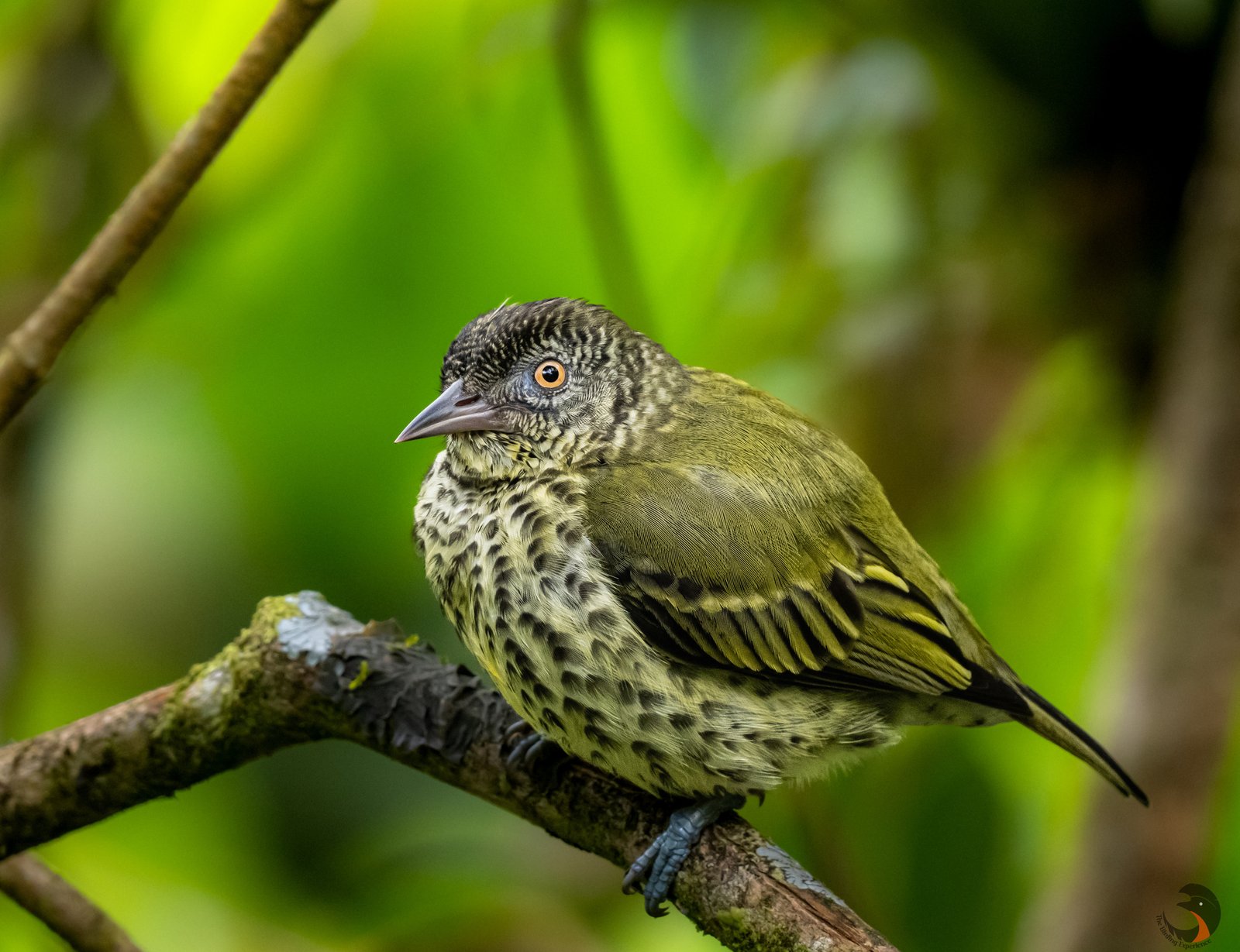
The Sharpbill is the only species in its family: a stocky, green, spotted passerine with a straight, sharply pointed, conical bill. It lives high in the canopy of humid foothill and lower montane forest and often joins mixed flocks of tanagers. Its distribution is highly fragmented, from Costa Rica to south-eastern Brazil.
Voice
The song is a long, descending, buzzing trill of one to two seconds, zzzzzzrrrrr, given from the treetops and recalling an insect. It is repeated at long intervals.
Recording: Marcelo J Feliti — CC BY-NC-SA 4.0 · xeno-canto
Identification
16–17 cm, with a pointed, conical bill and a short tail. The upperparts are olive-green, the wings darker with pale edges. The face is white with fine black scaling and dots. On the crown lies a narrow red to orange crest, bordered black on each side, which is usually held flat. The underparts are whitish to pale yellow and densely marked with black drop-shaped spots. The sexes are similar; young birds lack the red crest.
Confusion species
Females of Green-and-black Fruiteater Pipreola riefferii and other fruiteaters of the genus Pipreola are also green with pale, streaked underparts, but have a red or orange bill and legs and no dotted face. Andean Laniisoma Laniisoma buckleyi is yellow below with black scaling and has a plain face. Spotted tanagers of the genus Tangara are smaller, with a short bill and more colour on the head and wings.
Habitat
The canopy and edges of humid foothill and lower montane forest, in the guide area roughly between 500 and 1700 m, mainly on ridges and slopes. It eats fruit and insects; it pries open curled dead leaves and clumps of moss with its pointed bill to extract invertebrates. It often forages in mixed flocks high in the trees.
Where the bird is most at home, classified by the vegetation units of the Andes and the west coast.


Range and movements
Colombia: very locally in the north-west, in Córdoba, Antioquia and Chocó. Ecuador: on the east slope in the south-east, in Zamora-Chinchipe and Morona-Santiago, including the Cordillera del Cóndor. Peru: scattered and local on the east slope and in isolated ridges in the lowlands, from San Martín to Cusco and Madre de Dios. Bolivia: locally in the Yungas of La Paz. Absent from the Galápagos. Outside the guide area in Costa Rica and Panama, the tepuis of Venezuela and the Guianas, and in south-eastern Brazil and Paraguay.
- Resident
- dark = core range, pale = thinly spread
How and when to look
On forested ridges in the foothills, listen for the buzzing trill from the treetops and follow mixed tanager flocks. Most records come from the Cordillera del Cóndor in Ecuador, the hills of San Martín in Peru and the Yungas of La Paz.
Conservation status
Least Concern. The species is widespread but occurs in the guide area only locally and in small numbers; it depends on intact foothill forest, which is being cleared in many places.
Scientific name
Oxyruncus cristatus | Swainson, 1821
Swainson described the species in 1821 and placed it straight away in the genus where it still stands. The genus Oxyruncus was introduced in 1820 by Temminck. The genus name comes from Greek oxus, 'sharp' or 'pointed', and rhunkhos, 'bill'. The species name is Latin cristatus, 'crested'. The specimen the first description was based on came from Brazil.