All species › Passerines › Royal flycatchers and allies › Tropical Royal Flycatcher
Tropical Royal Flycatcher | Onychorhynchus coronatus
Tropische kroontiran | Mosquero real | Maria-leque
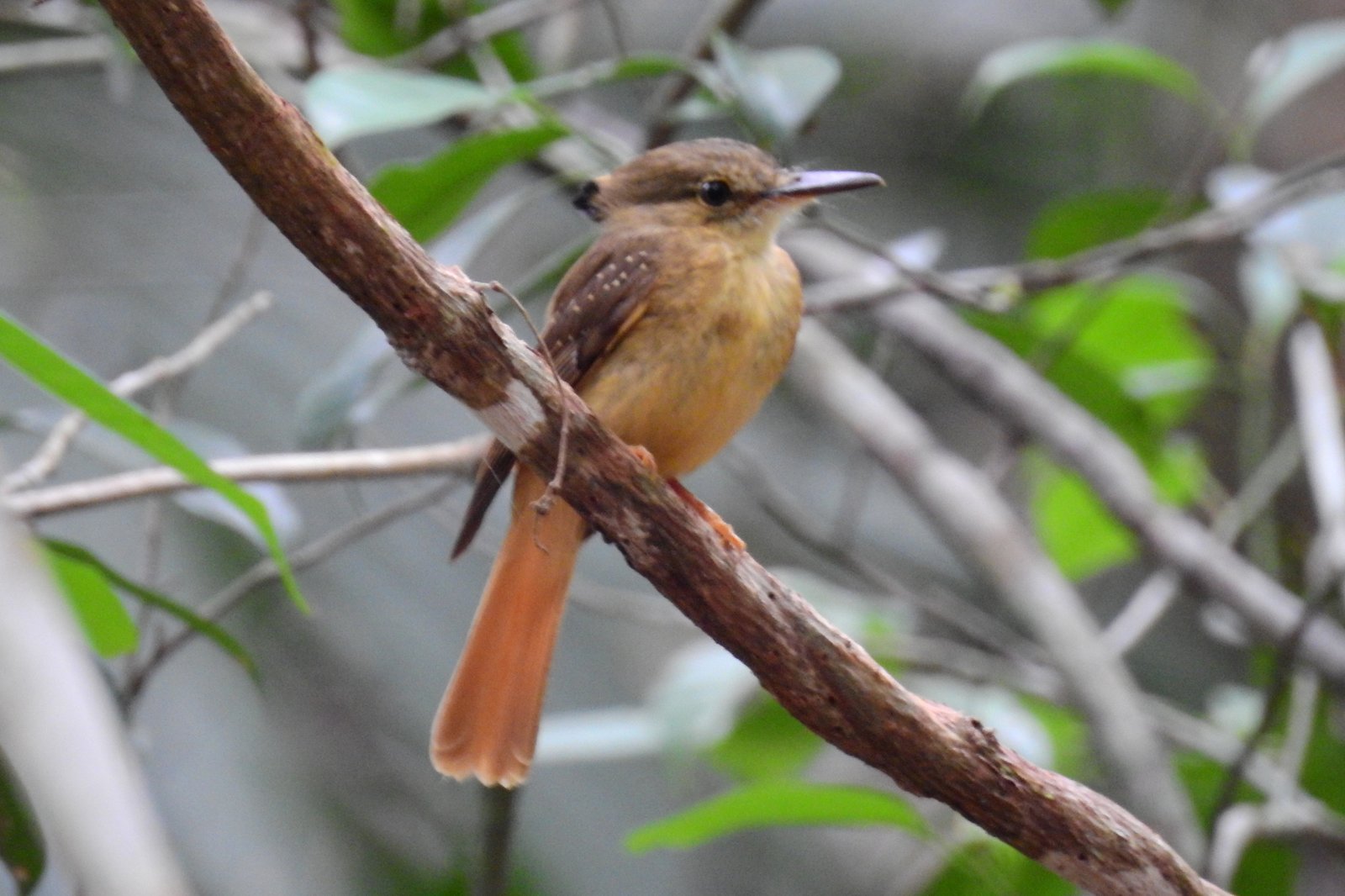
The Tropical Royal Flycatcher is a brown flycatcher with a long, broad, flat bill and a crest that lies flat backwards at rest, giving the head a hammer shape. When excited it spreads the crest into a half-fan of red or orange with black and steel-blue tips. It builds a hanging nest up to two metres long over streams.
Voice
A loud, two-noted whistle, pree-oh or kee-yoo, repeated at intervals, often from the understorey along a stream. Also short, sharp calls.
Recording: JAYRSON ARAUJO DE OLIVEIRA — CC BY-NC-SA 4.0 · xeno-canto
Identification
16–17 cm, with a long, broad, flat bill and a long crest that usually projects as a point behind the head. The upperparts are brown, with small buff spots on the wing-coverts; the rump and tail are rufous to cinnamon. The throat is pale, the underparts buff to pale brown, with fine dark barring on the breast. The spread crest is scarlet in the male and yellow-orange in the female, always with black and blue tips. The form of western Ecuador and Peru (occidentalis) is paler and more cinnamon.
Confusion species
Ruddy-tailed Flycatcher Terenotriccus erythrurus also has a rufous tail, but is much smaller, with a small bill and no crest. Ochraceous Attila Attila torridus in the west is larger and uniformly ochre, with a hooked bill. Species of Myiobius are smaller, with a bright yellow rump and a black tail.
Habitat
The lower and middle storeys of humid lowland forest, mainly along streams and rivers, and várzea; in the west also semi-humid and deciduous forest. From the lowlands to about 1000 m. It catches insects in short sallies from a perch. The nest is a long, loosely hanging structure of plant fibres and leaves, attached to a branch or vine over water.
Where the bird is most at home, classified by the vegetation units of the Andes and the west coast.


Range and movements
Colombia: in the north, the north-west and the Magdalena Valley, and in the east in Amazonia as far as Guainía. Ecuador: in the west, from Manabí and Guayas to El Oro and Loja (occidentalis), and in the eastern lowlands. Peru: in Tumbes (occidentalis) and in the lowlands east of the Andes. Bolivia: in the lowlands of the north and east. Absent from the Galápagos. Outside the guide area from Mexico to Panama, in Venezuela, the Guianas and Amazonian Brazil, and in the Atlantic Forest of south-eastern Brazil.
- Resident
- dark = core range, pale = thinly spread
How and when to look
Search along shady streams in lowland forest and look for the long hanging nest over the water; the birds are often nearby. In western Ecuador it occurs in forest remnants in the coastal hills of Guayas and El Oro.
Conservation status
Not Evaluated in this treatment. The Red List divides the species into four species; of these, the western form (occidentalis) of Ecuador and Peru is listed as Vulnerable owing to the loss of dry and semi-humid forest, while the Amazonian form is of Least Concern.
Scientific name
Onychorhynchus coronatus | (Müller, 1776)
Müller described the species in 1776 as Muscicapa coronata; because it was later moved to another genus, the author and year stand in brackets. The genus Onychorhynchus was introduced in 1810 by Fischer von Waldheim. The genus name comes from Greek onux, 'nail', and rhunkhos, 'bill'. The species name is Latin coronatus, 'crowned', for the large colourful crest. The specimen the first description was based on came from Cayenne, French Guiana.