All species › Passerines › Royal flycatchers and allies › Ruddy-tailed Flycatcher
Ruddy-tailed Flycatcher | Terenotriccus erythrurus
Roodstaarttiran | Mosquerito colirrojo | Papa-moscas-uirapuru
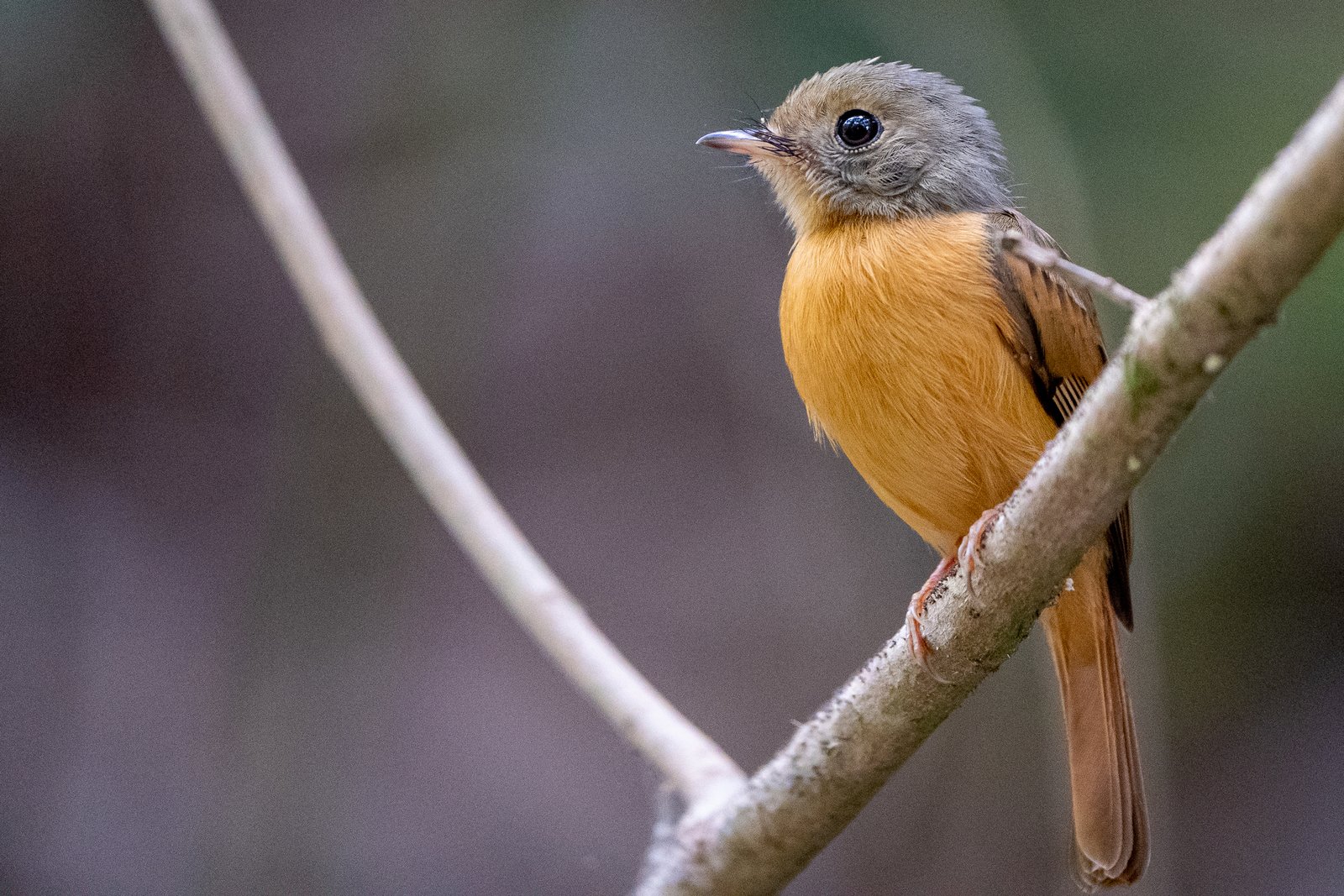
The Ruddy-tailed Flycatcher is one of the smallest flycatchers in the guide area: a round little bird with large dark eyes, a cinnamon breast and a rufous tail. It lives in the understorey of humid lowland forest on both sides of the Andes. A characteristic habit is the rapid lifting of both wings over the back.
Voice
A high, thin, sharp pseet or tsee-tseet, repeated at intervals, and a rapid series of high chipping notes.
Recording: JAYRSON ARAUJO DE OLIVEIRA — CC BY-NC-SA 4.0 · xeno-canto
Identification
10 cm, with a large, round head, large dark eyes and a small, broad bill. The head and back are greyish olive-brown; the wings are dark with broad rufous edges, and the rump and tail bright rufous. The throat and breast are cinnamon, the belly paler buff. The sexes are alike.
Confusion species
Cinnamon Neopipo Neopipo cinnamomea is similarly coloured, but has a greyer head with a concealed yellow crown stripe and a less rufous tail. Females of the Myiobius species have a yellow rump and a black tail. Tropical Royal Flycatcher Onychorhynchus coronatus is much larger, with a long, flat bill and a crest.
Habitat
The lower and middle storeys of humid lowland forest and older secondary forest, often near gaps and edges inside the forest, from the lowlands to about 1200 m. It catches small insects in short sallies from a thin perch, also in mixed flocks. The nest is a pear-shaped hanging ball of plant fibres with a side entrance.
Where the bird is most at home, classified by the vegetation units of the Andes and the west coast.


Range and movements
Colombia: in the Pacific lowlands, the north, the Magdalena Valley and Amazonia. Ecuador: in the west, mainly in the north, and in the eastern lowlands. Peru: in the lowlands and foothills east of the Andes. Bolivia: in the lowlands of the north and centre, south to Santa Cruz. Absent from the Galápagos. Outside the guide area from southern Mexico to Panama, and in Venezuela, the Guianas and Amazonian Brazil.
- Resident
- dark = core range, pale = thinly spread
How and when to look
In the understorey of lowland forest, look for a small bird with a rufous tail that lifts both wings over its back; it often perches quietly on a thin twig two to five metres up.
Conservation status
Least Concern. The species is widespread and also occurs in older secondary forest.
Scientific name
Terenotriccus erythrurus | (Cabanis, 1847)
Cabanis described the species in 1847 as M[yiobius] erythrurus; because it was later moved to another genus, the author and year stand in brackets. The genus Terenotriccus was introduced in 1905 by Ridgway. The genus name comes from Greek terenos, 'soft' or 'delicate', and trikkos, an unidentified small bird, used in ornithology for tyrant flycatchers. The species name comes from Greek eruthros, 'red', and -ouros, '-tailed'. The specimen the first description was based on came from Cayenne, French Guiana.