All species › Passerines › Royal flycatchers and allies › Tawny-breasted Myiobius
Tawny-breasted Myiobius | Myiobius villosus
Borsteltiran | Mosquerito pechileonado | Assanhadinho-de-peito-fulvo
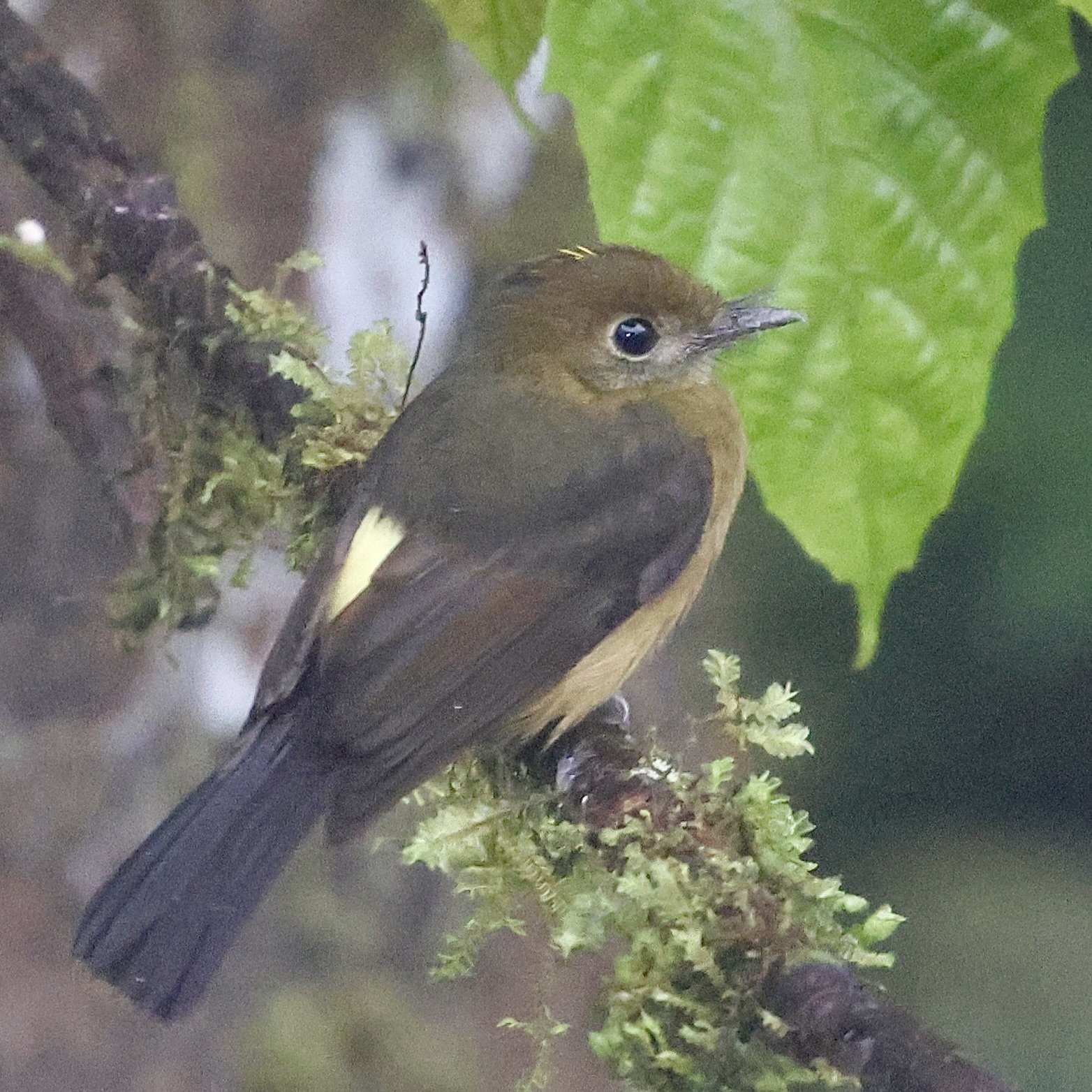
The Tawny-breasted Myiobius is the largest and darkest Myiobius, a bird of humid forest in the foothills and lower montane zone of the Andes. Like its relatives it has a bright yellow rump against a black tail and moves restlessly through the understorey with drooped wings and a fanned tail. Long, stiff bristles surround the base of the bill.
Voice
A sharp, short psit or tsik, often repeated while foraging.
Recording: Andrew Spencer — CC BY-NC-SA 3.0 · xeno-canto
Identification
13–14 cm, with a broad, flat bill surrounded by long bristles. The upperparts are dark olive-brown, the rump bright yellow and the tail black. The throat is pale yellow; the breast and flanks are deep tawny, the belly yellow. The male has a concealed yellow crown patch, which is smaller or absent in the female.
Confusion species
Whiskered Myiobius Myiobius barbatus is smaller, with a paler, yellowish to olive breast, and usually lives lower. Black-tailed Myiobius Myiobius atricaudus is smaller and paler buff below, and lives mainly in the lowlands. Ornate Flycatcher Myiotriccus ornatus also has a yellow rump, but a grey head with a white spot in front of the eye and a rufous or olive tail.
Habitat
The understorey and middle storey of humid foothill and lower montane forest, often along streams and in ravines, roughly between 600 and 2000 m. It follows mixed flocks and catches small flying insects, which it flushes by hopping about with a fanned tail and drooped wings.
Where the bird is most at home, classified by the vegetation units of the Andes and the west coast.


Range and movements
Colombia: in the foothills and lower montane zone of all three Andean ranges and the Serranía de Perijá. Ecuador: on both slopes of the Andes, locally in the west. Peru: on the east slope along the whole length of the country, from Cajamarca and Amazonas to Puno. Bolivia: in the Yungas of La Paz. Absent from the Galápagos. Outside the guide area in eastern Panama and western Venezuela.
- Resident
- dark = core range, pale = thinly spread
How and when to look
Search foothill forest along streams at 800–1500 m and follow mixed flocks in the understorey; watch for the yellow rump of a bird hopping about with a fanned tail.
Conservation status
Least Concern. The species is tied to intact foothill forest, a zone that is being cleared in many places.
Scientific name
Myiobius villosus | Sclater, 1860
Sclater described the species in 1860 and placed it straight away in the genus where it still stands. The genus Myiobius was introduced in 1839 by Gray. The genus name comes from Greek muia, 'fly', and bios, 'life', meaning 'living on flies'. The species name is Latin villosus, 'hairy' or 'shaggy'. The specimen the first description was based on came from Nanegal, Pichincha, Ecuador.