All species › Passerines › Royal flycatchers and allies › Whiskered Myiobius
Whiskered Myiobius | Myiobius barbatus
Geelstuittiran | Mosquerito bigotillo | Assanhadinho
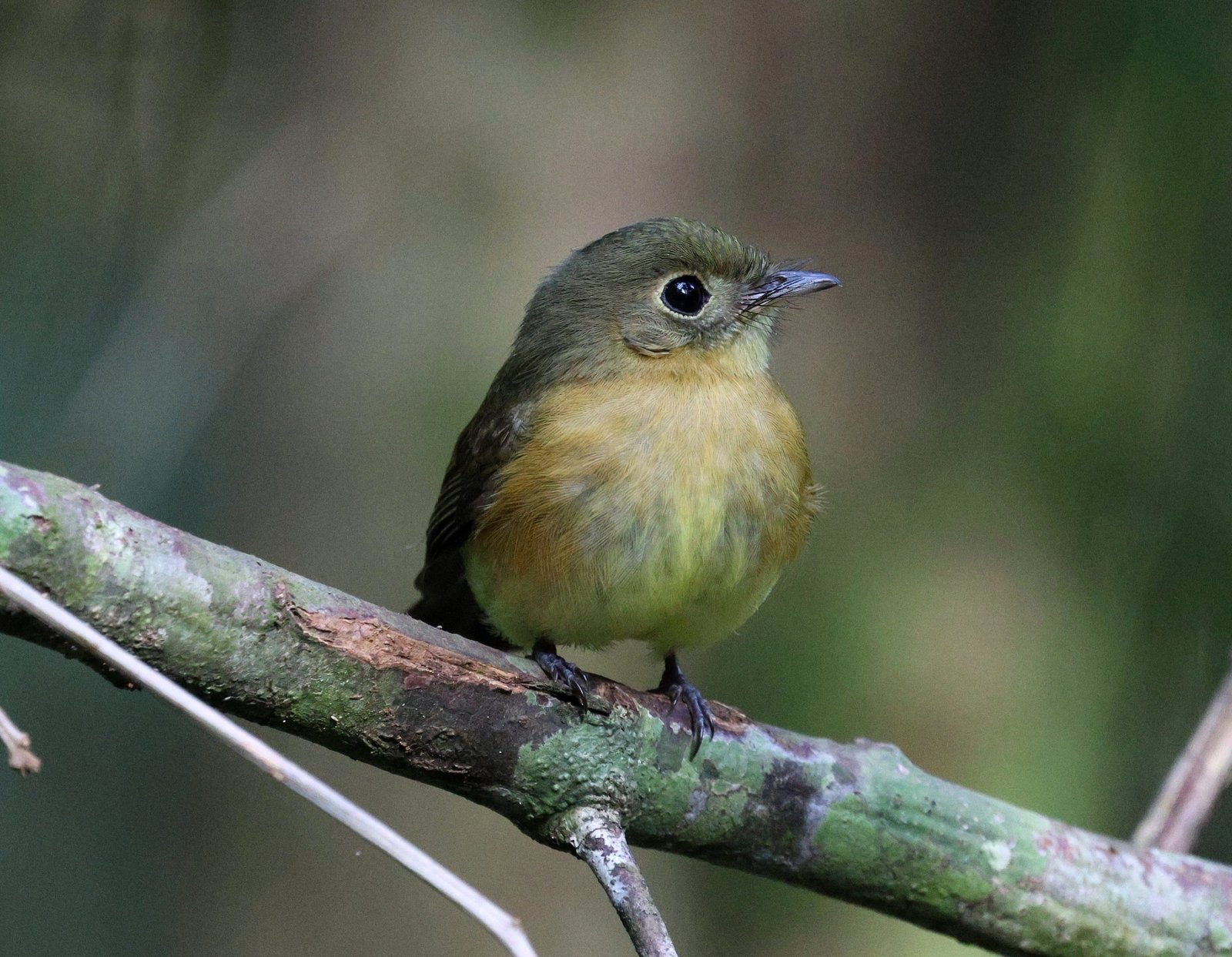
The Whiskered Myiobius is a small, active flycatcher with a bright yellow rump and a black tail, which hops through the understorey with drooped wings and a fanned tail. It is a regular member of mixed flocks in humid lowland forest. The birds west of the Andes are sometimes treated as a separate species (Myiobius sulphureipygius).
Voice
A sharp, dry psit or tsik, often repeated while foraging.
Recording: Dante Buzzetti — CC BY-NC-SA 4.0 · xeno-canto
Identification
12–13 cm, with a broad, flat bill with long bristles. The upperparts are olive-green, the rump bright yellow and the tail black. The throat is pale yellow; the breast is olive to pale ochre, warmer tawny in birds west of the Andes; the belly is yellow. The male has a concealed yellow crown patch, which the female lacks.
Confusion species
Black-tailed Myiobius Myiobius atricaudus is very similar, but has a paler, more uniform buff breast and a smaller crown patch; in the field voice and habitat help. Tawny-breasted Myiobius Myiobius villosus is larger and darker, with a deep tawny breast, and lives higher in the foothills. Ornate Flycatcher Myiotriccus ornatus has a grey head with a white spot in front of the eye.
Habitat
The lower and middle storeys of humid lowland forest and older secondary forest, mainly on terra firme, from the lowlands to about 1000 m. It catches small flying insects, which it flushes with its fanned tail and drooped wings. The nest is a hanging, pear-shaped structure of fibres with an entrance at the bottom, often over a stream.
Where the bird is most at home, classified by the vegetation units of the Andes and the west coast.


Range and movements
Colombia: in the Pacific lowlands and the north-west (western form), and in the east in Amazonia as far as Guainía and Vaupés. Ecuador: in the western lowlands, mainly in the north, and in the eastern lowlands. Peru: in the lowlands east of the Andes. Bolivia: only a few records from the far north (Pando). Absent from the Galápagos. Outside the guide area from southern Mexico to Panama (western form), and in Venezuela, the Guianas, Amazonian Brazil and the Atlantic Forest of Brazil.
- Resident
- dark = core range, pale = thinly spread
How and when to look
Follow mixed flocks in the understorey of lowland forest and watch for the yellow rump of a bird hopping to and fro with a fanned tail.
Conservation status
Least Concern. The species is widespread, but disappears where the forest is cleared.
Scientific name
Myiobius barbatus | (Gmelin, 1789)
Gmelin described the species in 1789 as Muscicapa barbata; because it was later moved to another genus, the author and year stand in brackets. The genus Myiobius was introduced in 1839 by Gray. The genus name comes from Greek muia, 'fly', and bios, 'life', meaning 'living on flies'. The species name is Latin barbatus, 'bearded', for the bristles at the base of the bill. The specimen the first description was based on came from Cayenne, French Guiana.