All species › Waterfowl › Ducks, swans and geese › Crested Duck
Crested Duck | Lophonetta specularioides
Andeseend | Pato crestón | Pato-crestado
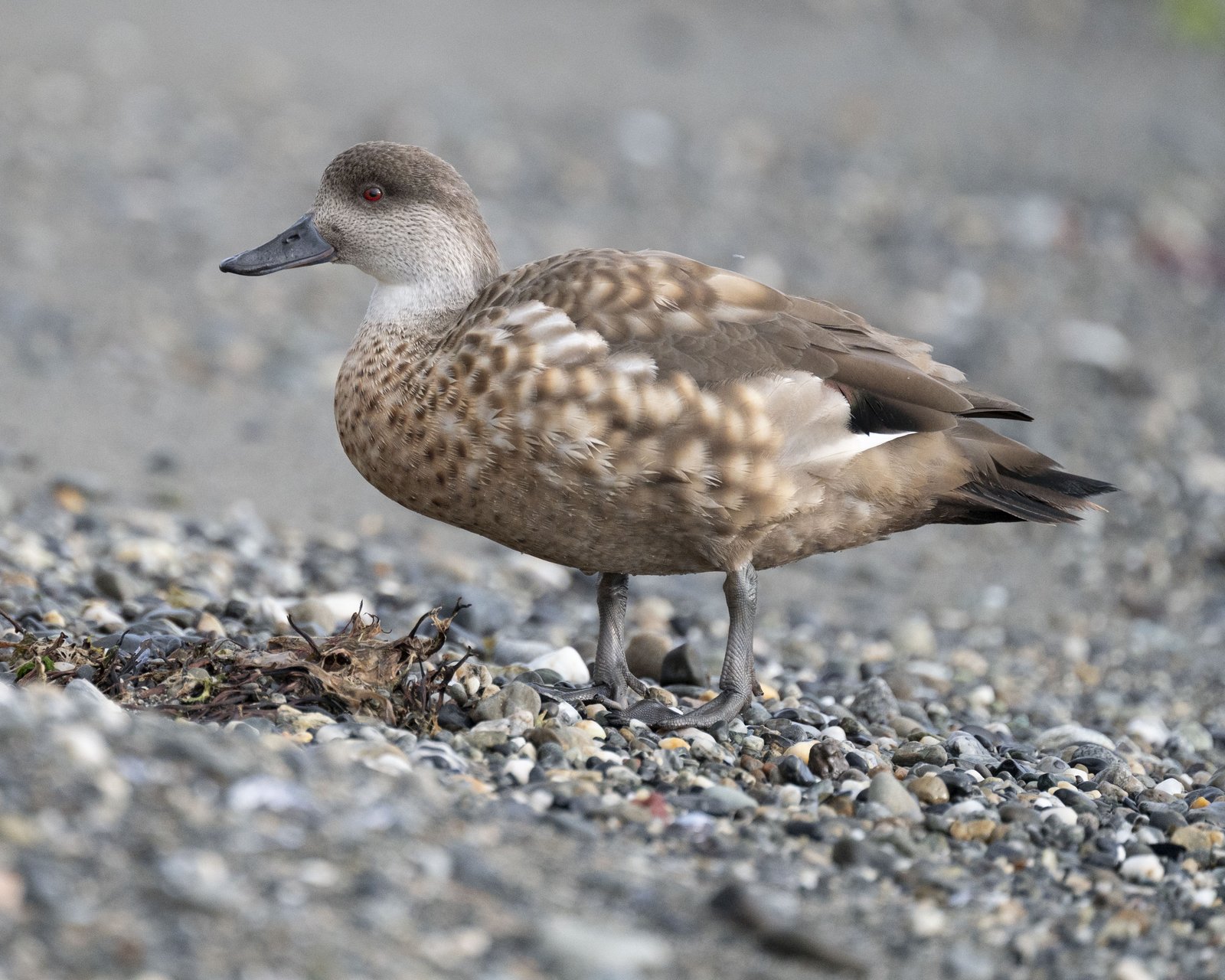
The Crested Duck is a large, grey-brown duck of the lakes and bogs of the high Andes. It is related to the dabbling ducks but placed in a genus of its own, with a long, pointed tail and a glossy, coppery speculum. Pairs defend their territory fiercely against other waterbirds.
Voice
The male gives a hoarse, squeaky whistle, the female a harsh, barking quack, often in series. Pairs often call together, especially during disputes with other birds of their kind.
Recording: Bernabe Lopez-Lanus — CC BY-NC-SA 3.0 · xeno-canto
Identification
51–61 cm, with a fairly long neck, a short crest drooping at the back of the head and a long, pointed tail. The plumage is grey-brown, with dark spots on the breast and flanks and a darker back. The head is pale grey with a darker crown and a dark area around the eye; the eye is red to orange. The bill is dark, bluish grey to blackish. The speculum is glossy copper-red to purple, with a white trailing edge. The sexes are alike; the female is slightly smaller. Young birds are duller, with a dark eye.
Confusion species
Yellow-billed Pintail Anas georgica is smaller and slimmer, with a yellow bill, a pale brown head without a crest and a brown speculum. Yellow-billed Teal Anas flavirostris is much smaller, with a yellow bill and a speckled head. Puna Teal Spatula puna has a black cap, creamy-white cheeks and a large, pale blue bill.
Habitat
Lakes, lagoons, bogs (bofedales) and slow streams in the puna and on the altiplano, mostly between 3500 and 5000 m; also at salt lakes. It eats mainly invertebrates, as well as algae and aquatic plants, feeding in shallow water and on muddy shores. The nest is on the ground, hidden in grass or under a tussock, often some distance from water.
Where the bird is most at home, classified by the vegetation units of the Andes and the west coast.


Range and movements
In Peru in the high Andes, southwards along the Andes from the north of the country, most numerous in the centre and south. In Bolivia on the altiplano and in the western Andes. Absent from Colombia, Ecuador and the Galápagos. Outside the guide area in northern Chile and north-western Argentina; another subspecies lives in Patagonia and Tierra del Fuego.
- Resident
- dark = core range, pale = thinly spread
How and when to look
On lakes and bofedales of the puna, such as around Lake Titicaca and on the high plateaus of Junín, Cusco and Puno. The birds often sit on open shores and by small pools.
Conservation status
Least Concern (LC). The species is widespread in the puna; it is hunted locally, and overgrazing and water extraction degrade bogs.
Scientific name
Lophonetta specularioides | (King, 1828)
King described the species in 1828 as Anas specularioides; because it was later moved to another genus, the author and year stand in brackets. The genus Lophonetta was introduced in 1914 by Riley. The genus name is from Greek lophos, 'crest', and netta, 'duck'. The species name means 'resembling specularis', after the Spectacled Duck (Anas specularis), named for the wing speculum. The specimen the first description was based on came from Strait of Magellan, Chile.