All species › Waterfowl › Ducks, swans and geese › Andean Goose
Andean Goose | Chloephaga melanoptera
Andesgans | Ganso andino | Ganso-andino
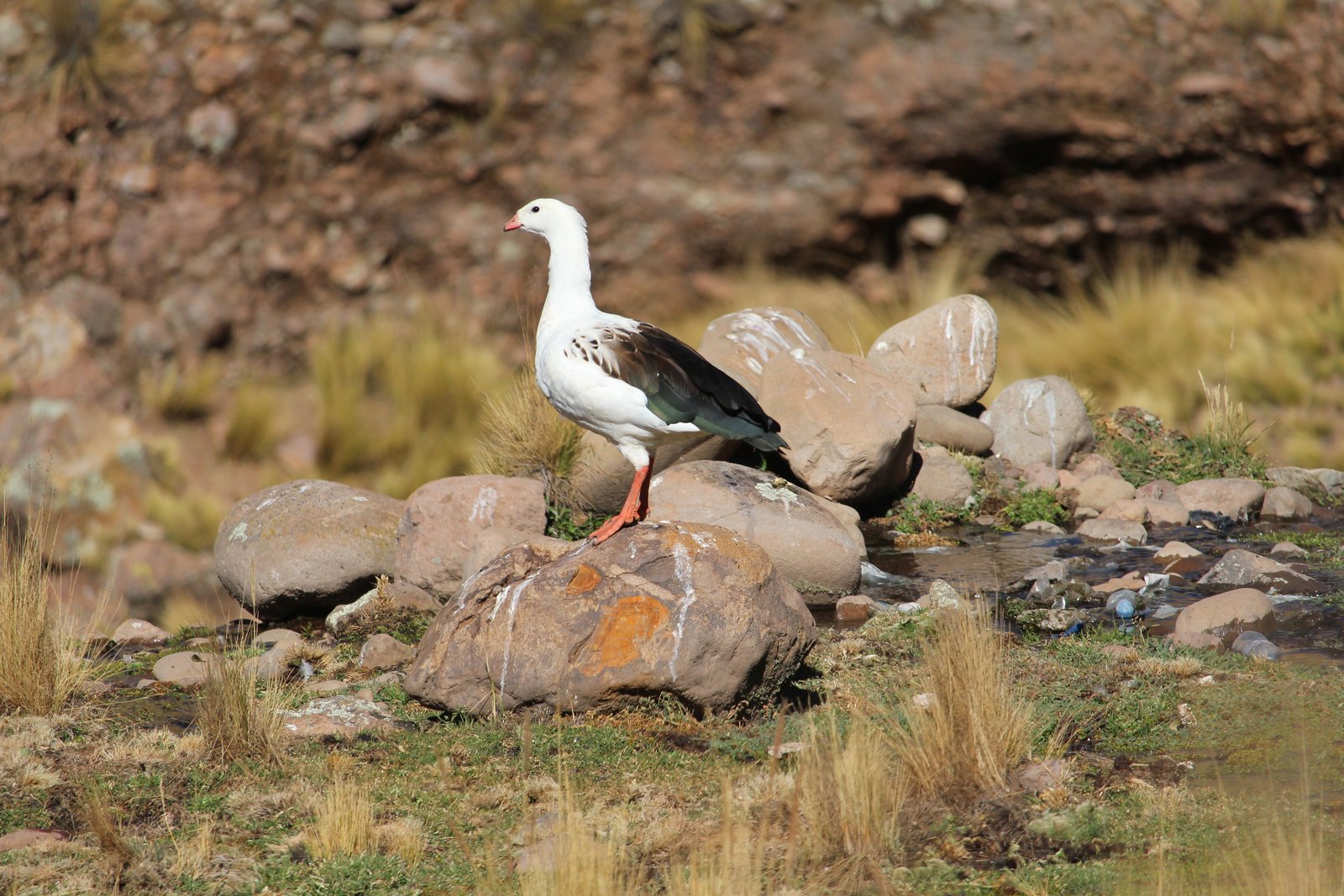
The Andean Goose is a large, white goose with black wings of the high central Andes. It lives in pairs or small groups at lakes and in wet grassland and bogs on the puna, well above 3500 m. Pairs fiercely defend their territory in the breeding season.
Voice
The male gives a high, whistling call, the female a low, harsh cackle or growl; pairs often call together in territorial disputes.
Recording: Barry Edmonston — CC BY-NC-SA 4.0 · xeno-canto
Identification
75–80 cm, a stocky goose with a short, pink to red bill and orange-red legs. The head, neck, body and most of the wing coverts are white. The primaries, the tail and a band of scapulars and greater coverts are black, with a green and purple gloss. In flight the wing appears white with a black trailing edge and black tip. The sexes are alike; the male is clearly larger. Juveniles have a greyish-brown wash on the head and body and less gloss on the wing.
Confusion species
White domestic geese, derived from Greylag Goose Anser anser, are larger, with a longer, orange bill and no black on the wings; they usually stay near villages. Andean Gull Chroicocephalus serranus is much smaller and slimmer, with a dark hood in breeding plumage and a thin bill, and flies on narrow, pointed wings.
Habitat
Wet grassland, bogs (bofedales) and lake shores on the puna, mostly between 3500 and 5000 m. It grazes short grasses and other plants of wet ground. The nest is on the ground, often on a slope or among rocks, not far from water. After the breeding season birds sometimes gather in flocks.
Where the bird is most at home, classified by the vegetation units of the Andes and the west coast.


Range and movements
In Peru in the Andes of the centre and south of the country, locally further north. In Bolivia in the western highlands and on the altiplano. Absent from Colombia, Ecuador and the Galápagos. Outside the guide area in northern and central Chile and western Argentina.
- Resident
- dark = core range, pale = thinly spread
How and when to look
Pairs and small groups are often seen grazing in bofedales and along lakes on the puna, for example around Lake Titicaca and on the altiplano. The white plumage stands out at long range against the green bogs.
Conservation status
Least Concern. The species is hunted locally and is affected by disturbance and by grazing and drainage of bogs.
Scientific name
Chloephaga melanoptera | (Eyton, 1838)
Eyton described the species in 1838 as Anser melanopterus; because it was later moved to another genus, the author and year stand in brackets. The genus Chloephaga was introduced in 1838 by Eyton. The genus name is from Ancient Greek khloē, 'grass', and -phagos, '-eating'. From Greek melas, 'black', and pteron, 'wing', so 'black-winged'. The specimen the first description was based on came from Lake Titicaca, Peru/Bolivia.