All species › Waterfowl › Ducks, swans and geese › Brazilian Teal
Brazilian Teal | Amazonetta brasiliensis
Amazonetaling | Pato brasileño | Ananaí
The Brazilian Teal is a small, warm brown duck of fresh waters in the open lowlands east of the Andes. Pairs stay together all year and often call in flight. The birds regularly perch on branches and dead trunks above the water.
Voice
The male gives a high, piercing whistled tuwee, the female a lower, rough quack. Both often call in flight and when flushed.
Recording: JAYRSON ARAUJO DE OLIVEIRA — CC BY-NC-SA 4.0 · xeno-canto
Identification
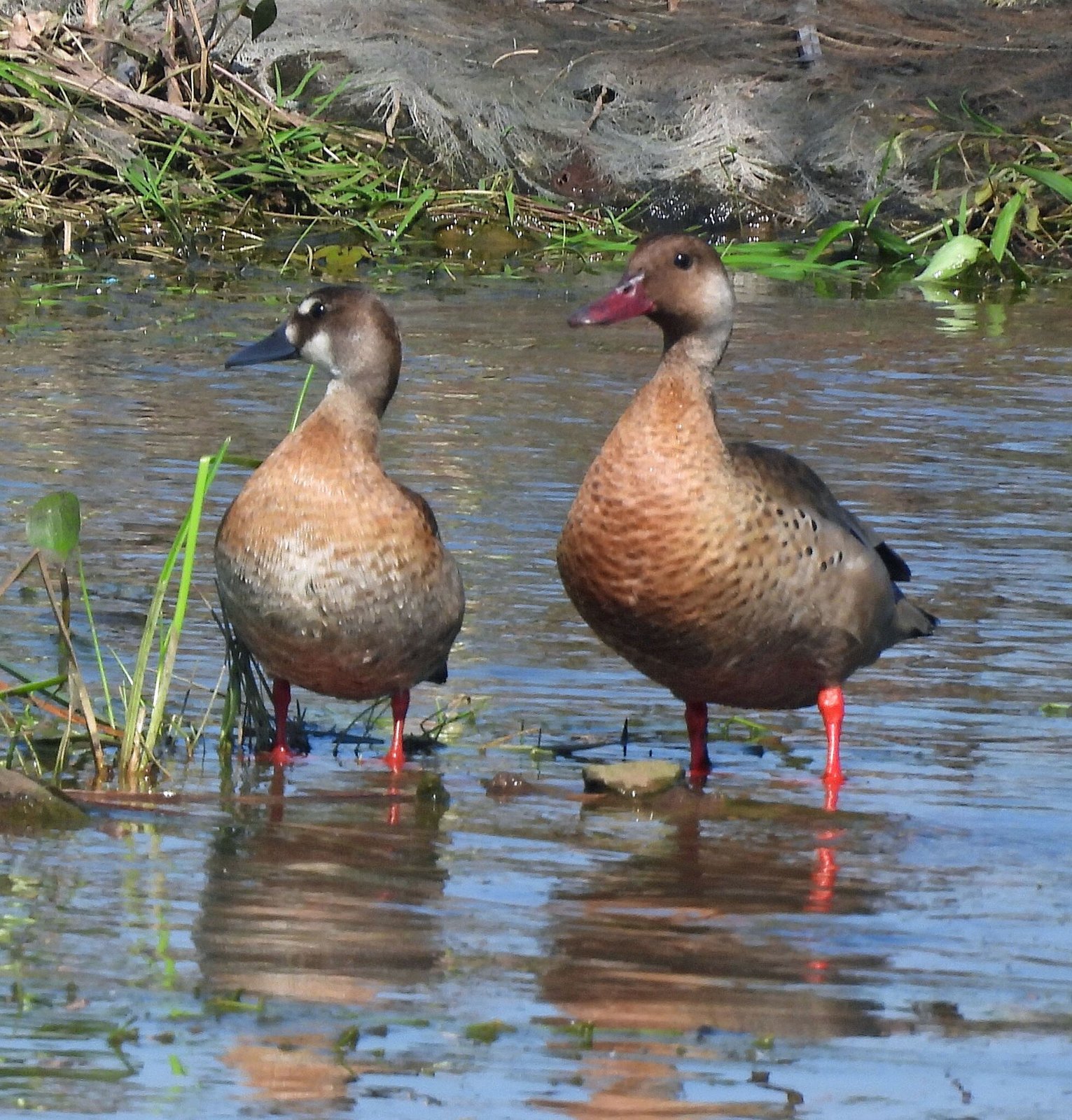
35–40 cm, with a fairly large, rounded head. The plumage is brown, with a darker back and a finely spotted breast. The male has a red bill, red legs and pale grey sides to the head and neck. The female has a dark grey bill, duller legs and white spots on the head: at the base of the bill, above the eye and behind the eye. In flight a glossy blue-green speculum and a conspicuous white triangle on the secondaries.
Confusion species
Ringed Teal Callonetta leucophrys is smaller; the male has grey flanks, a black stripe on the nape and a chestnut back, the female a white eyebrow and a white cheek spot. The female Masked Duck Nomonyx dominicus has a stiff tail and two dark stripes across the pale head. Silver Teal Spatula versicolor has a black cap, creamy-white cheeks and a blue bill with a yellow base.
Habitat
Ponds, lagoons, marshes, flooded savannas, oxbow lakes and rice fields in the lowlands, mostly below 500 m; mainly fresh water with dense vegetation nearby. It eats seeds, roots, leaves and fruits of aquatic plants and invertebrates; it dabbles in shallow water and also walks on land. The nest is on the ground in dense vegetation, sometimes in a cavity; both parents tend the young.
Where the bird is most at home, classified by the vegetation units of the Andes and the west coast.


Range and movements
In Colombia in the eastern llanos, in the Orinoco basin. In Peru local in the Amazonian lowlands, mainly in the east and south-east. In Bolivia common in the lowlands of the north and east, especially in the savannas of the Beni and in Santa Cruz. In Ecuador at most very rare; absent from the Galápagos. Outside the guide area in Venezuela, the Guianas, much of Brazil, Paraguay, Uruguay and north-eastern Argentina.
- Resident
- dark = core range, pale = thinly spread
How and when to look
In the savannas of the Beni and the llanos of Colombia pairs are often seen on roadside pools. The male's whistled call gives the birds away even in flight.
Conservation status
Least Concern (LC). The species locally uses rice fields and cattle ponds and appears to be expanding its range in parts of South America.
Scientific name
Amazonetta brasiliensis | (Gmelin, 1789)
Gmelin described the species in 1789 as Anas brasiliensis; because it was later moved to another genus, the author and year stand in brackets. The genus Amazonetta was introduced in 1929 by Boetticher. The genus name combines Amazon (the Amazon region) with Greek nētta, 'duck'. The species name refers to Brazil, not necessarily the type locality. The specimen the first description was based on came from Northeastern Brazil.