All species › Waterfowl › Ducks, swans and geese › Orinoco Goose
Orinoco Goose | Neochen jubata
Orinocogans | Ganso del Orinoco | Pato-corredor
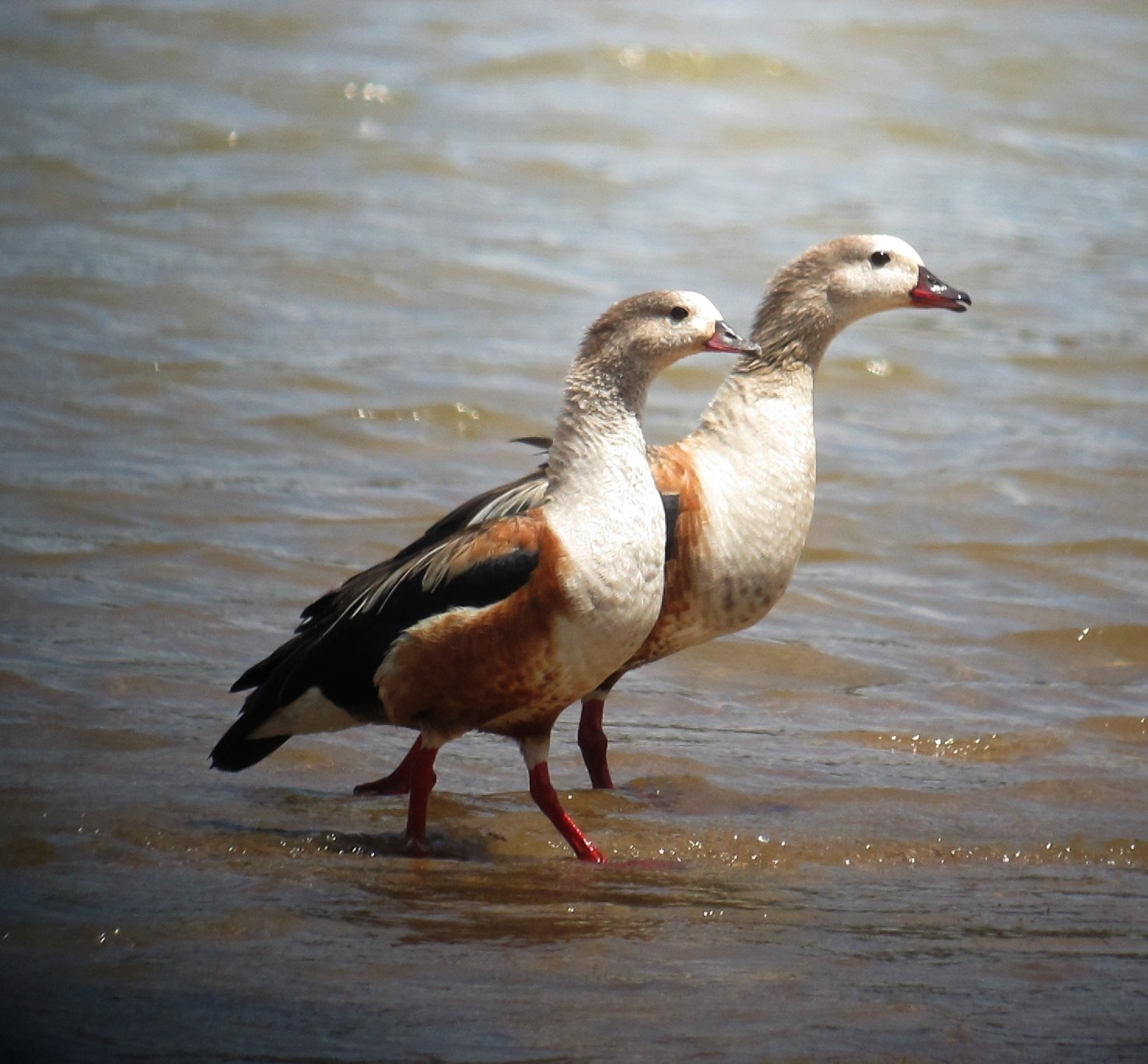
The Orinoco Goose is a medium-sized, upright goose of sandbars on large lowland rivers and of wet savannas. With its pale head and neck and chestnut body, it is the only native goose of the Amazonian and Orinoco lowlands. It grazes on banks and nests in tree cavities.
Voice
The male gives a high, whistling call, the female a lower, hoarse cackle; pairs often call together, especially when disturbed.
Recording: JAYRSON ARAUJO DE OLIVEIRA — CC BY-NC-SA 4.0 · xeno-canto
Identification
61–67 cm, with a fairly long neck and long legs. The head, neck and breast are pale greyish buff; on the neck the feathers form fine furrows. The back, flanks and belly are warm chestnut. The wings are blackish with a green gloss, with a white speculum that is obvious in flight. The bill is black with pink or red, the legs are orange-red. The sexes are alike; the male is larger. Juveniles are paler and duller.
Confusion species
Egyptian Goose Alopochen aegyptiaca, introduced in parts of Colombia, has a dark patch around the eye and a dark spot on the breast, and large white wing coverts. Fulvous Whistling Duck Dendrocygna bicolor is smaller, uniform tawny, with a grey bill and a white band on the rump. Muscovy Duck Cairina moschata is black with white wing patches.
Habitat
Sandbars and banks of large, slow lowland rivers, wet savannas, marshes and lake edges, often near forest, mostly below 500 m. It grazes on grass and other waterside plants and also takes seeds and invertebrates. The nest is in a tree cavity, sometimes some distance from water.
Where the bird is most at home, classified by the vegetation units of the Andes and the west coast.


Range and movements
In Colombia mainly in the Llanos of Arauca, Casanare, Meta and Vichada, scarce in Amazonia. In Ecuador very rare, with only a few records in the eastern lowlands. In Peru in the Amazonian lowlands of the south-east, mainly in Madre de Dios, rare elsewhere. In Bolivia in the northern lowlands, mainly in the savannas of Beni and the adjacent lowlands of La Paz, Pando and Santa Cruz. Absent from the Galápagos. Outside the guide area in Venezuela, the Guianas, Brazil, Paraguay and north-eastern Argentina.
- Resident
- dark = core range, pale = thinly spread
How and when to look
In the dry season, search sandbars along large rivers as they emerge; pairs then often stand upright at the water's edge. In the savannas of Beni and the Llanos of Casanare they are also seen in wet grassland.
Conservation status
Least Concern, but the population is fragmented and has declined locally through hunting and disturbance along rivers.
Scientific name
Neochen jubata | (Spix, 1825)
Spix described the species in 1825 as Anser jubatus; because it was later moved to another genus, the author and year stand in brackets. The genus Neochen was introduced in 1918 by Oberholser. The genus name is from Greek neos, 'new', and khēn, 'goose'. Latin jubata means 'maned', after the elongated neck feathers. The specimen the first description was based on came from Praia das Onças, Solimões River, Brazil.