All species › Waterfowl › Ducks, swans and geese › American Wigeon
American Wigeon | Mareca americana
Amerikaanse smient | Silbón americano | Piadeira-americana
The American Wigeon is a North American duck with a short, blue-grey bill that eats much green plant matter besides seeds. A small proportion of the birds winter as far as northern South America. In the guide area it is a scarce winter visitor, almost only in Colombia.
Voice
The male gives a whistled, three-part whee-WHEW-whew, the middle part highest; the female a low, grating quack.
Recording: Stanislas Wroza — CC BY-NC-SA 4.0 · xeno-canto
Identification
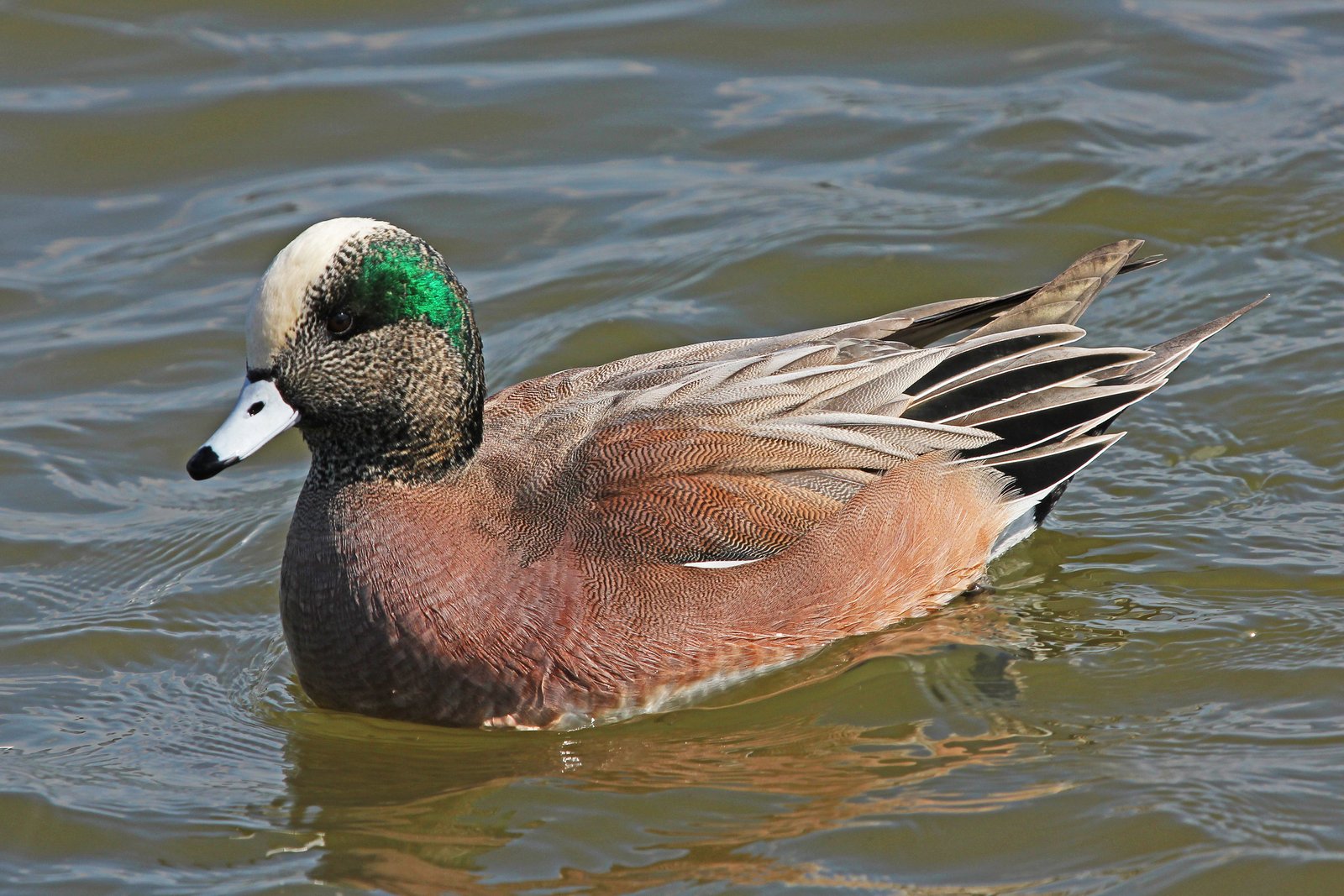
45–56 cm, a medium-sized duck with a round head, a short, blue-grey bill with a black tip and a fairly pointed tail. The male has a white crown and forehead, a broad green band behind the eye, grey-speckled sides of the head and pinkish-brown flanks and breast; behind the flank a white patch sits in front of the black undertail. The female is greyish brown, with a greyer head, a dark patch around the eye and orange-brown flanks. The male has a large white patch on the forewing, conspicuous in flight; both sexes have a white belly.
Confusion species
Gadwall Mareca strepera, a very rare vagrant, has a longer, narrower bill, a steeper forehead and a white speculum. Chiloe Wigeon Mareca sibilatrix, a vagrant from the south, has a white face with a black nape glossed green, a black-and-white scaled breast and a dark bill. Females of Blue-winged Teal Spatula discors are smaller, with a longer, dark bill.
Habitat
Freshwater lakes, marshes, lagoons and flooded grassland, in the lowlands and on Andean lakes to about 3000 m. It eats aquatic plants, seeds and grasses, and sometimes grazes on shores. It does not breed in the guide area.
Where the bird is most at home, classified by the vegetation units of the Andes and the west coast.


Range and movements
In Colombia a scarce winter visitor, mainly in the Caribbean lowlands and on lakes of the Eastern Andes. In Ecuador rare. In Peru and Bolivia absent or only a very rare visitor. Absent from the Galápagos. It breeds in northern North America and winters south to Central America, the Caribbean islands and northern South America.
- Winter visitor (c. Oct–Mar)
- dark = core range, pale = thinly spread
How and when to look
From November to March on lakes in northern Colombia, usually among flocks of Blue-winged Teal; the male's whistling and white crown stand out.
Conservation status
Least Concern. The population is large, but declined in North America during the last century through the loss of wetlands in the breeding areas.
Scientific name
Mareca americana | (Gmelin, 1789)
Gmelin described the species in 1789 as Anas americana; because it was later moved to another genus, the author and year stand in brackets. The genus Mareca was introduced in 1824 by Stephens. The genus name is from the Portuguese word marreco, 'small duck'. The species name refers to America, not necessarily the type locality. The specimen the first description was based on came from Louisiana and New York, United States.