All species › Waterfowl › Ducks, swans and geese › Masked Duck
Masked Duck | Nomonyx dominicus
Maskerstekelstaart | Pato enmascarado | Marreca-de-bico-roxo
The Masked Duck is a small, shy stiff-tailed duck that keeps hidden among the floating plants of marshes. It lives in tropical lowlands from Mexico to Argentina, but occurs everywhere in scattered locations and in fluctuating numbers. Unlike most stiff-tailed ducks it can take off almost vertically from the water.
Voice
Mostly silent. In display the male gives a soft, repeated kirri-kirroo and clucking sounds; the female a soft quack.
Recording: Fernando Igor de Godoy — CC BY-NC-SA 4.0 · xeno-canto
Identification
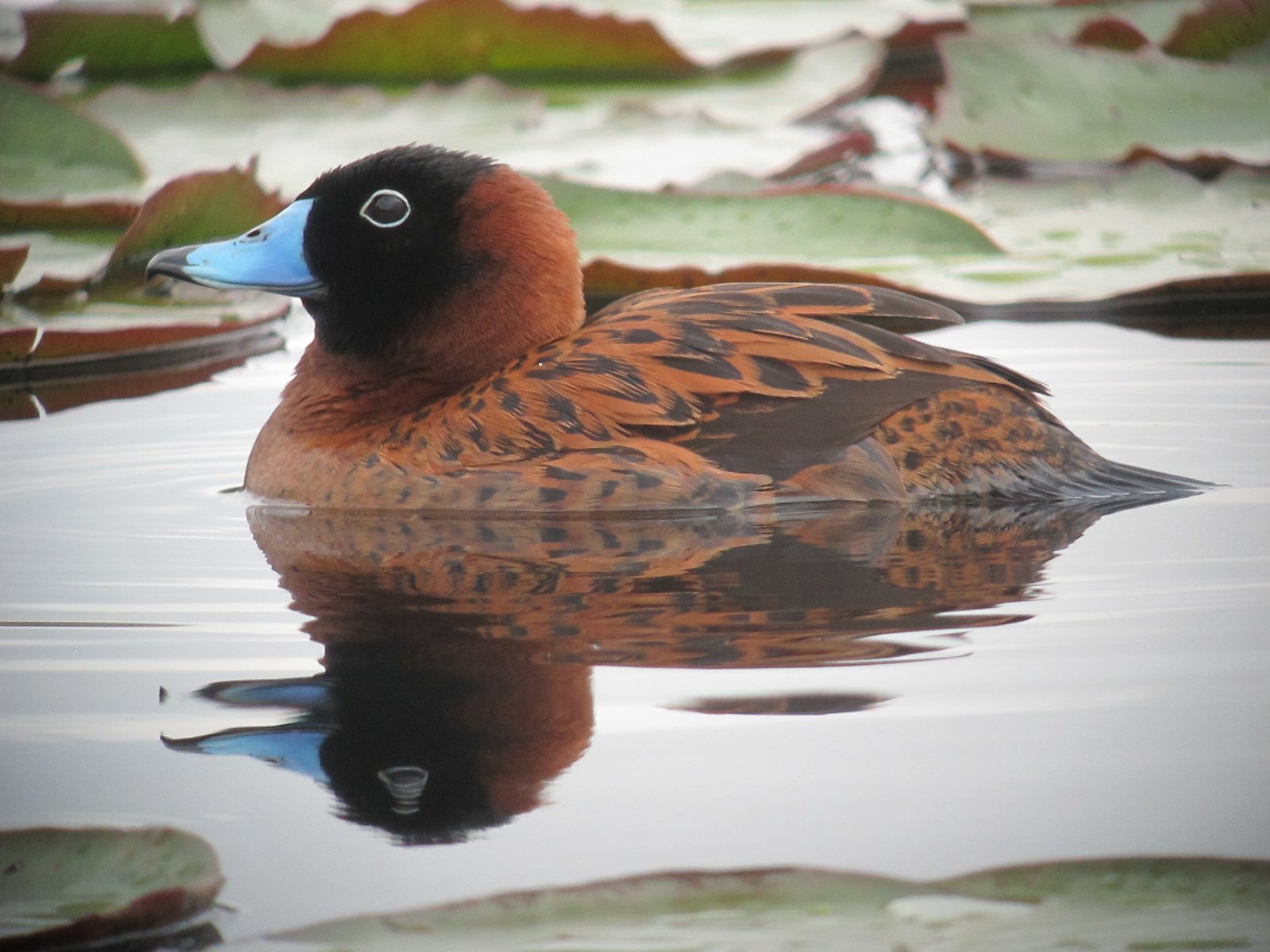
30–36 cm, with a short, broad bill and a long, stiff, black tail that is often held cocked. The breeding male is rufous with black spots on the back and flanks, with a black face and a bright blue bill. The female and non-breeding male are brown, with a pale head marked by two dark horizontal stripes: one through the eye and one across the cheek. In flight a white patch on the wing is visible.
Confusion species
Ruddy Duck Oxyura jamaicensis is larger; the male has a chestnut body and a black head, the female has a single dark stripe across the cheek and no white in the wing, and the species lives mainly on Andean lakes. Least Grebe Tachybaptus dominicus is equally small and dives in similar pools, but has a thin, pointed bill, a yellow eye and no visible tail.
Habitat
Freshwater marshes, ponds, overgrown lakes and rice fields with dense floating and emergent vegetation, mainly in the lowlands, locally higher in Andean valleys. It dives for seeds, roots and leaves of aquatic plants and for small invertebrates. The nest is in dense vegetation over or close to water.
Where the bird is most at home, classified by the vegetation units of the Andes and the west coast.


Range and movements
In Colombia scattered in the lowlands and the Cauca and Magdalena valleys, locally higher in the Andes. In Ecuador mainly in the western lowlands, rarer in the east. In Peru scattered, both in the west and in the Amazonian lowlands. In Bolivia rare and local in the eastern lowlands. Absent from the Galápagos. Outside the guide area from the southern United States and the Caribbean through Central America to Venezuela, the Guianas, Brazil and northern Argentina.
- Resident
- dark = core range, pale = thinly spread
How and when to look
Look for marshes with plenty of floating plants and scan the edges of open water patiently in the early morning. Birds swim low in the water and when disturbed tend to dive or hide rather than fly.
Conservation status
Least Concern. The range is fragmented and numbers fluctuate strongly; the loss of marshes is the main threat.
Scientific name
Nomonyx dominicus | (Linnaeus, 1766)
Linnaeus described the species in 1766 as Anas dominica; because it was later moved to another genus, the author and year stand in brackets. The genus Nomonyx was introduced in 1880 by Ridgway. The genus name comes from Greek nomos, 'customary, usual', and onux, 'nail'. Ridgway (1880) separated the species from Erismatura (Oxyura) because the nail at the bill tip is of normal form. The species name dominicus refers to Santo Domingo (Hispaniola), not necessarily the type locality; Linnaeus based it on Brisson's description of a bird from that island. The specimen the first description was based on came from Santo Domingo, Hispaniola.