All species › Waterfowl › Ducks, swans and geese › Muscovy Duck
Muscovy Duck | Cairina moschata
Muskuseend | Pato real | Pato-do-mato
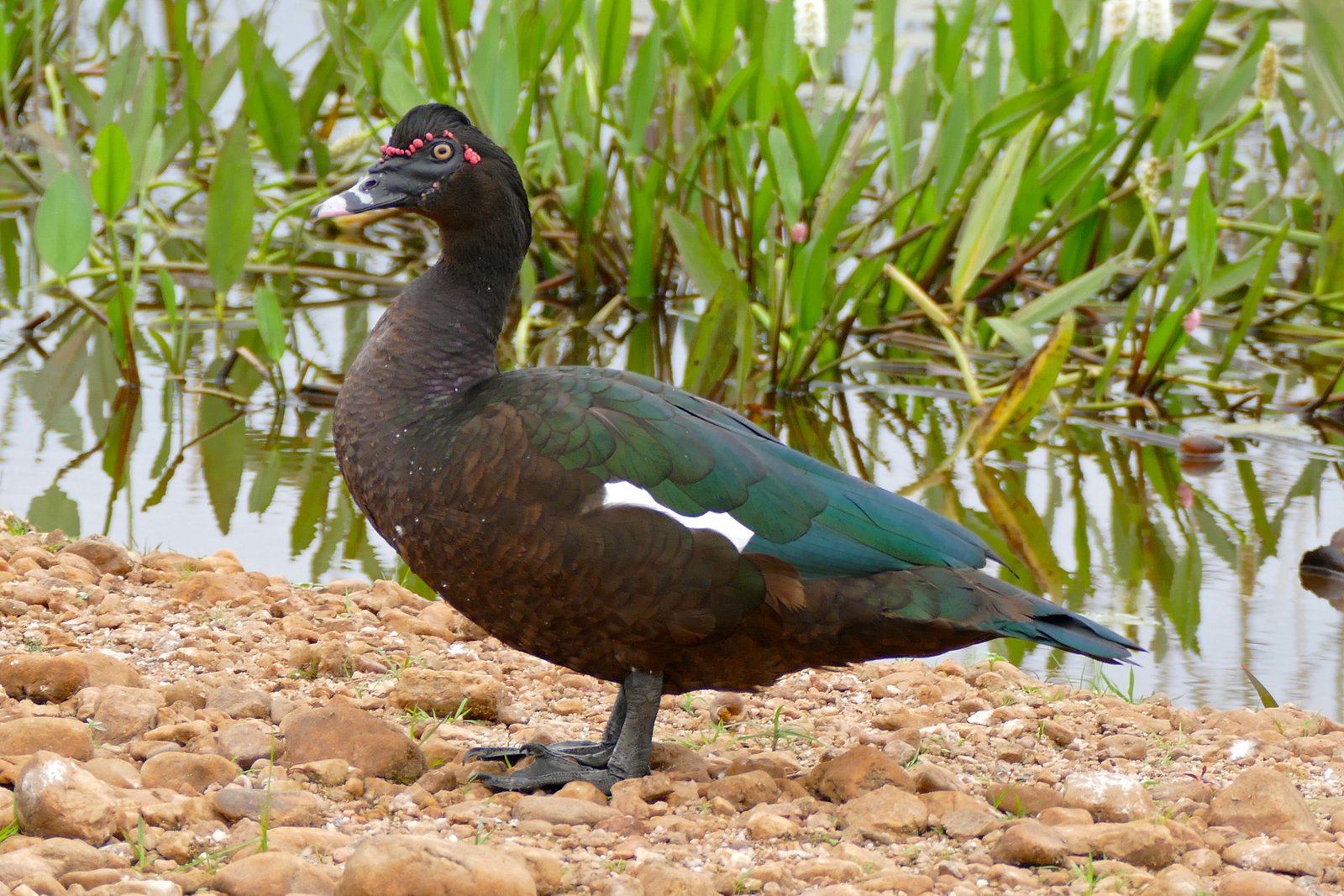
The Muscovy Duck is a large, black, forest-dwelling duck of lowland rivers and swamps. Wild birds are wary, often perch high in trees and nest in tree cavities. The species is also the ancestor of the domestic Muscovy, which is kept near houses and on farms throughout the guide area.
Voice
Usually silent. The male gives a soft hiss or squeak, the female a weak, short quack, mainly when flushed.
Recording: Jorge Leitão — CC BY-NC-SA 4.0 · xeno-canto
Identification
66–84 cm; the male is much larger and heavier than the female. Wild plumage is black, with a green and purple gloss on the back and wings. The forewing has a large white patch that is obvious in flight and sometimes visible as a white spot on perched birds. The male has a short crest, a knob at the base of the bill and bare, blackish skin around the eye; the bill is black with a pale band. The female is smaller, without a knob. Juveniles are duller brownish black, with little or no white on the wing. Domestic and feral birds are often pied or white and have red, warty skin around the bill.
Confusion species
Domestic and feral Muscovies show white in the plumage, red, warty skin on the head and are often heavier; hybrids with wild birds occur. Comb Duck Sarkidiornis sylvicola has a white head and neck speckled with black and a white belly. Neotropic Cormorant Nannopterum brasilianum also perches in waterside trees, but has a thin, hooked bill and no white on the wing.
Habitat
Forested rivers, oxbow lakes, swamps, swamp forest and mangroves in the lowlands, mostly below 1000 m. It feeds on the water and on banks, taking seeds, roots and leaves of aquatic plants, as well as insects, crustaceans and small fish. It rests and roosts in trees. The nest is in a tree cavity, sometimes high above the ground.
Where the bird is most at home, classified by the vegetation units of the Andes and the west coast.


Range and movements
In Colombia in the lowlands west and east of the Andes, in the Caribbean lowlands, the Magdalena Valley, the Llanos and Amazonia. In Ecuador in the eastern lowlands and, locally and scarcely, in the west. In Peru in the Amazonian lowlands and in the far north-west. In Bolivia in the northern and eastern lowlands. Not native to the Galápagos. Outside the guide area from Mexico to northern Argentina; domestic and feral birds occur worldwide.
- Resident
- dark = core range, pale = thinly spread
How and when to look
Wild birds are mainly seen along forested rivers and oxbow lakes in Amazonia, often early in the morning and in the evening as they fly between roosts and feeding areas. In flight the white wing patches are a good feature.
Conservation status
Least Concern. The wild population is declining locally through hunting, loss of riverside forest and interbreeding with domestic birds.
Scientific name
Cairina moschata | (Linnaeus, 1758)
Linnaeus described the species in 1758 as Anas moschata; because it was later moved to another genus, the author and year stand in brackets. The genus Cairina was introduced in 1822 by Fleming. The genus name means 'of Cairo'; it goes back to Aldrovandi and the mistaken belief that these ducks came from Egypt. Latin moschata means 'musky'; Anas moschata literally means 'musk duck'. The specimen the first description was based on came from Brazil.