All species › Parrots › African and New World parrots › Crimson-bellied Parakeet
Crimson-bellied Parakeet | Pyrrhura perlata
Karmozijnbuikparkiet | Cotorra ventrirroja | Tiriba-de-barriga-vermelha
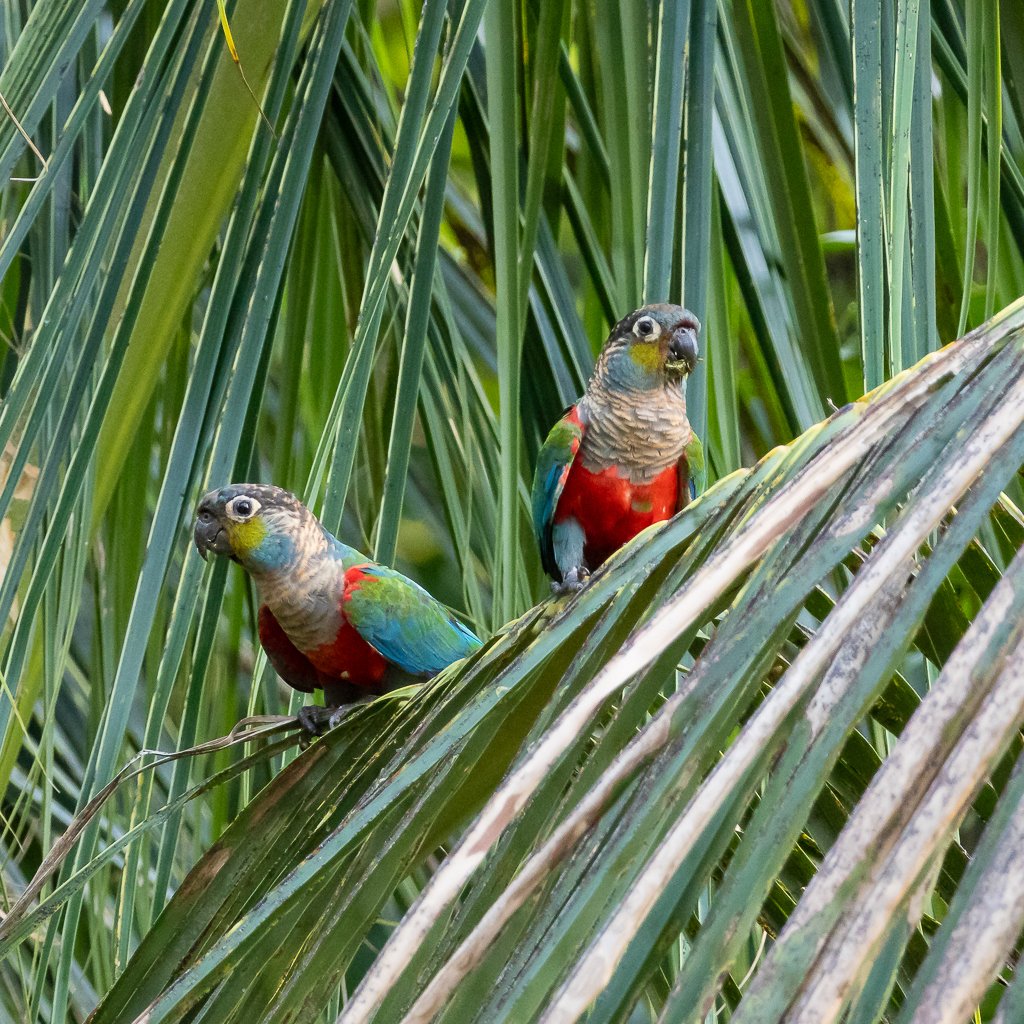
The Crimson-bellied Parakeet is a Pyrrhura parakeet with a bright red belly and blue cheeks, with its main range in Brazilian Amazonia south of the Amazon. The guide area touches only the western edge of that range, in north-eastern Bolivia. Groups move fast and noisily through the canopy and along forest edges.
Voice
Shrill, grating calls, in flight often rapidly repeated by the whole group, such as a harsh kreek-kreek. Perched groups make softer, chattering sounds.
Recording: Andrew Spencer — CC BY-NC-SA 3.0 · xeno-canto
Identification
24 cm, slim, with a long, graduated tail. The head is dark greyish brown, the upper cheek golden green and the lower cheek turquoise blue. The throat and breast are greyish brown with pale scaling. The belly and upper flanks are bright red, the lower flanks and undertail coverts bluish green. The back and wings are green, the primaries black and cobalt blue; the underwing coverts are red. The tail is reddish brown above. There is a bare, pale ring around the eye. The sexes are alike; juveniles have a mostly green belly.
Confusion species
Green-cheeked Parakeet Pyrrhura molinae has green rather than blue cheeks and only a small reddish-brown belly patch; it lives mainly further west and south in Bolivia. Santarem Parakeet Pyrrhura amazonum and Painted Parakeet Pyrrhura picta have a pale ear patch, a smaller red belly patch and no red on the underwing.
Habitat
Canopy and edges of humid lowland terra firme rainforest and secondary forest, also drier forest in the transition to Chiquitano dry forest, up to about 600 m. It eats fruit, seeds and flowers. It lives in groups of ten to twenty birds. The nest is in a tree cavity.
Where the bird is most at home, classified by the vegetation units of the Andes and the west coast.


Range and movements
In Bolivia only in the north-east, east of the Mamoré, in Beni and northern Santa Cruz. Absent from Colombia, Ecuador, Peru and the Galápagos. Outside the guide area in Brazilian Amazonia south of the Amazon, in Rondônia, Mato Grosso, Amazonas and Pará.
- Resident
- dark = core range, pale = thinly spread
How and when to look
Search along forest edges and clearings in the forest of north-eastern Santa Cruz, for example in and around Noel Kempff Mercado; groups give themselves away by their shrill calls in flight.
Conservation status
Least Concern, after earlier being listed as Vulnerable. Numbers are declining due to deforestation for cattle ranching and soy cultivation in southern Amazonia; it is also hunted locally.
Scientific name
Pyrrhura perlata | (Spix, 1824)
Spix described the species in 1824 as Aratinga perlatus; because it was later moved to another genus, the author and year stand in brackets. The genus Pyrrhura was introduced in 1856 by Bonaparte. The genus name comes from Greek purrhos, 'flame-coloured', and oura, 'tail'. Modern Latin perlatus, 'pearly, pearled', from Medieval Latin perla, 'pearl'; probably after the scaly breast pattern. The specimen the first description was based on came from Amazon River, Brazil.