All species › Parrots › African and New World parrots › Short-tailed Parrot
Short-tailed Parrot | Graydidascalus brachyurus
Kortstaartpapegaai | Loro colicorto | Curica-verde
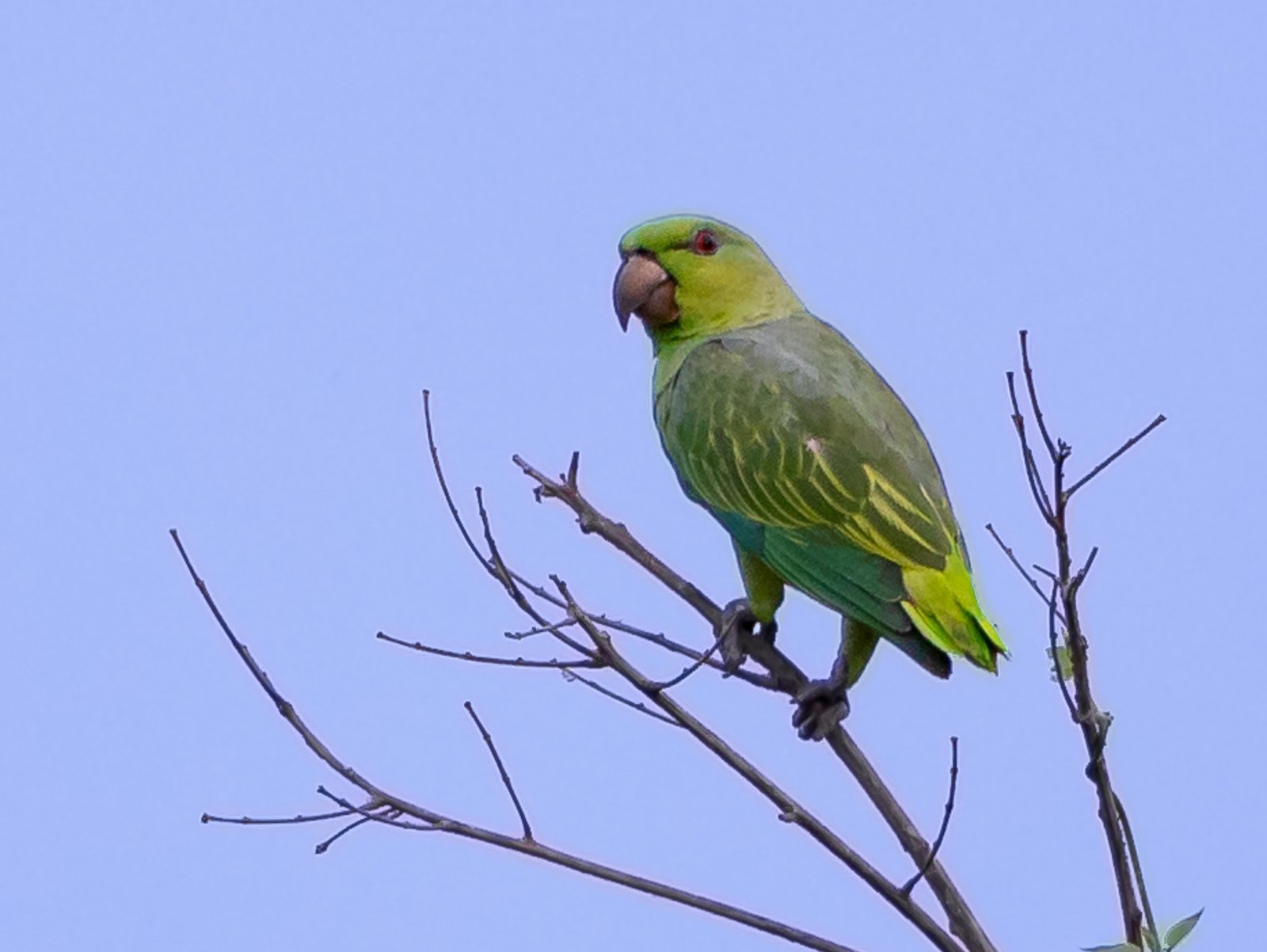
The Short-tailed Parrot is a stocky, almost entirely green parrot with a very short tail, the only species in the genus Graydidascalus. It lives along the large rivers of Amazonia, in flooded forest and on river islands, where it often occurs in noisy flocks. Flocks fly low over the water with fast, shallow wingbeats.
Voice
A shrill, sharp call such as kreek-kreek, repeated in flight; flocks keep up a continuous, shrill chatter.
Recording: JAYRSON ARAUJO DE OLIVEIRA — CC BY-NC-SA 4.0 · xeno-canto
Identification
24 cm, with a large head, a heavy, dark bill and a very short, square tail. The plumage is grass green, slightly more yellowish below, with a dark grey patch behind the eye. The tail feathers are red at the base, which is rarely visible. The sexes are alike. Juveniles are duller.
Confusion species
Amazons of the genus Amazona are larger, with a longer tail and coloured markings on the head and wing, such as the orange speculum of Orange-winged Amazon Amazona amazonica. Blue-headed Parrot Pionus menstruus has a blue head and red undertail coverts. Orange-cheeked Parrot Pyrilia barrabandi has a black head with an orange cheek patch. White-winged Parakeet Brotogeris versicolurus is smaller, with a pointed tail and white and yellow patches in the wing.
Habitat
Flooded forest (várzea), river islands with Cecropia and other young forest, banks and forest edges along large rivers, also gardens and plantations near riverside villages, in the lowlands up to roughly 300 m. It eats fruit and seeds in the canopy and moves in flocks from one feeding tree to the next. It nests in tree cavities.
Where the bird is most at home, classified by the vegetation units of the Andes and the west coast.


Range and movements
In Colombia in the far south-east, mainly along the Amazon. In Ecuador locally in the eastern lowlands, along the Napo and other large rivers. In Peru along the large rivers of the north-east, such as the Amazon, Napo, Marañón and Ucayali. Absent from Bolivia and the Galápagos. Outside the guide area along the Amazon and its tributaries in Brazil, as far as the mouth.
- Resident
- dark = core range, pale = thinly spread
How and when to look
From a boat on the Amazon near Iquitos or Leticia; in the morning and evening flocks fly low over the river between islands and banks. Note the stocky shape and very short tail.
Conservation status
Least Concern. The species is often common along the large rivers and tolerates young and disturbed riverine forest; no clear threats are known.
Scientific name
Graydidascalus brachyurus | (Temminck & Kuhl, 1820)
Temminck & Kuhl described the species in 1820 as Psittacus brachyurus; because it was later moved to another genus, the author and year stand in brackets. The genus Graydidascalus was introduced in 1854 by Bonaparte. The genus name honours the British zoologist George Robert Gray (1808–1872), combined with Greek didaskalos, 'teacher, master'. The species name comes from Greek brakhus, 'short', and oura, 'tail'. The specimen the first description was based on came from Upper Amazonia.