All species › Parrots › African and New World parrots › Red-shouldered Macaw
Red-shouldered Macaw | Diopsittaca nobilis
Roodschouderara | Guacamayo noble | Maracanã-pequena
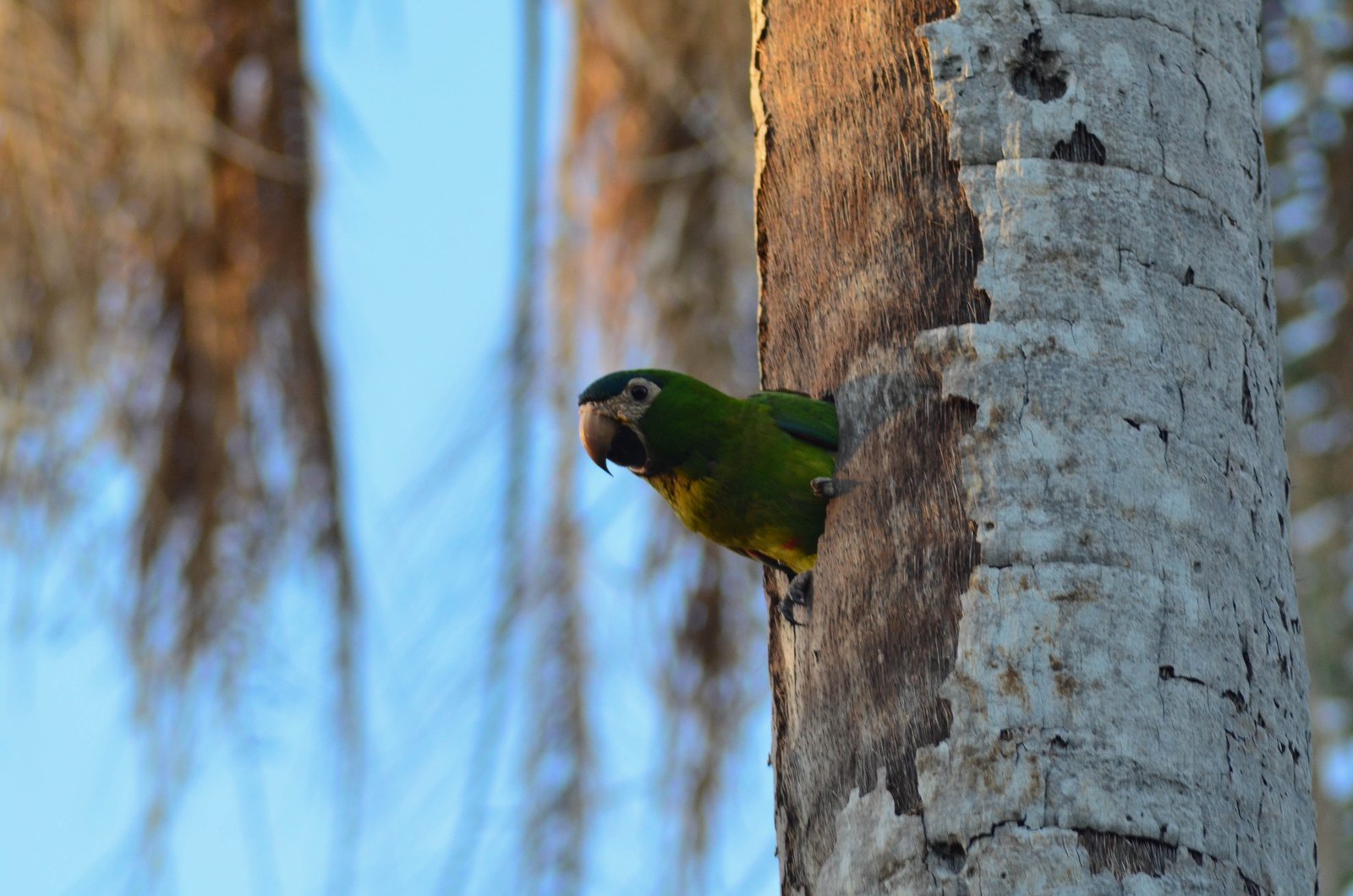
The Red-shouldered Macaw is the smallest macaw, hardly larger than a big parakeet, and the only member of the genus Diopsittaca. Like the large macaws it has bare, white facial skin. It lives in savanna with palms and forest edges and occurs in the guide area only along its eastern margin.
Voice
High, shrill and harsh screeches, such as a repeated kree-ak; higher and less raucous than in the large macaws.
Recording: Fabrício Grigolin — CC BY-NC-SA 4.0 · xeno-canto
Identification
30–35 cm, with a long, pointed tail. The plumage is green, with a blue forecrown. The bare facial skin around the eye and lores is white. The bend of the wing, the leading edge of the wing and the underwing coverts are red; the flight feathers and tail are olive-yellow below. Northern birds have an all-black bill; in southern birds, which occur in Peru and Bolivia, the upper mandible is pale horn and the birds are slightly larger. The sexes are alike; juveniles lack red on the leading edge of the wing and have no blue on the crown.
Confusion species
Chestnut-fronted Macaw Ara severus is larger, with a chestnut forehead, a longer tail that is rufous below and a dark bill. Red-bellied Macaw Orthopsittaca manilatus is larger, with yellow facial skin and a maroon belly patch, and lives mainly in palm swamps. White-eyed Parakeet Psittacara leucophthalmus lacks bare white facial skin and has a red and yellow underwing. Golden-collared Macaw Primolius auricollis has a black forehead and a yellow nape band.
Habitat
Savanna with palms, especially moriche palm (Mauritia), gallery forest, forest edges and semi-open country with scattered trees, in the lowlands. It feeds on seeds, fruit, flowers and nectar. It nests in cavities in dead palms and trees, sometimes in termite nests.
Where the bird is most at home, classified by the vegetation units of the Andes and the west coast.


Range and movements
In Peru only in the far south-east, in the savannas of the Pampas del Heath (Madre de Dios). In Bolivia in the savannas of the north and east (Beni, Santa Cruz). In Colombia at most in the extreme east, on the border with Venezuela. Absent from Ecuador and the Galápagos. Outside the guide area in Venezuela, the Guianas and much of Brazil.
- Resident
- dark = core range, pale = thinly spread
How and when to look
In Bolivia in the savannas of Noel Kempff Mercado and in the palm savannas of the Beni, where flocks fly between roosts and feeding areas in the morning and evening.
Conservation status
Not Evaluated in the taxonomic arrangement followed here. It is common over much of its range, and the species tolerates semi-open country; at the edges of its range, as in Peru, it is scarce and local.
Scientific name
Diopsittaca nobilis | (Linnaeus, 1758)
Linnaeus described the species in 1758 as Psittacus nobilis; because it was later moved to another genus, the author and year stand in brackets. The genus Diopsittaca was introduced in 1912 by Ridgway. The genus name comes from Greek dios, 'divine, noble', and psittakē, 'parrot', echoing the species name nobilis. The species name is Latin nobilis, 'noble, renowned'. The specimen the first description was based on came from Suriname.