All species › Cuckoos › Cuckoos › Dark-billed Cuckoo
Dark-billed Cuckoo | Coccyzus melacoryphus
Kleine mangrovekoekoek | Cuclillo piquioscuro | Papa-lagarta-acanelado
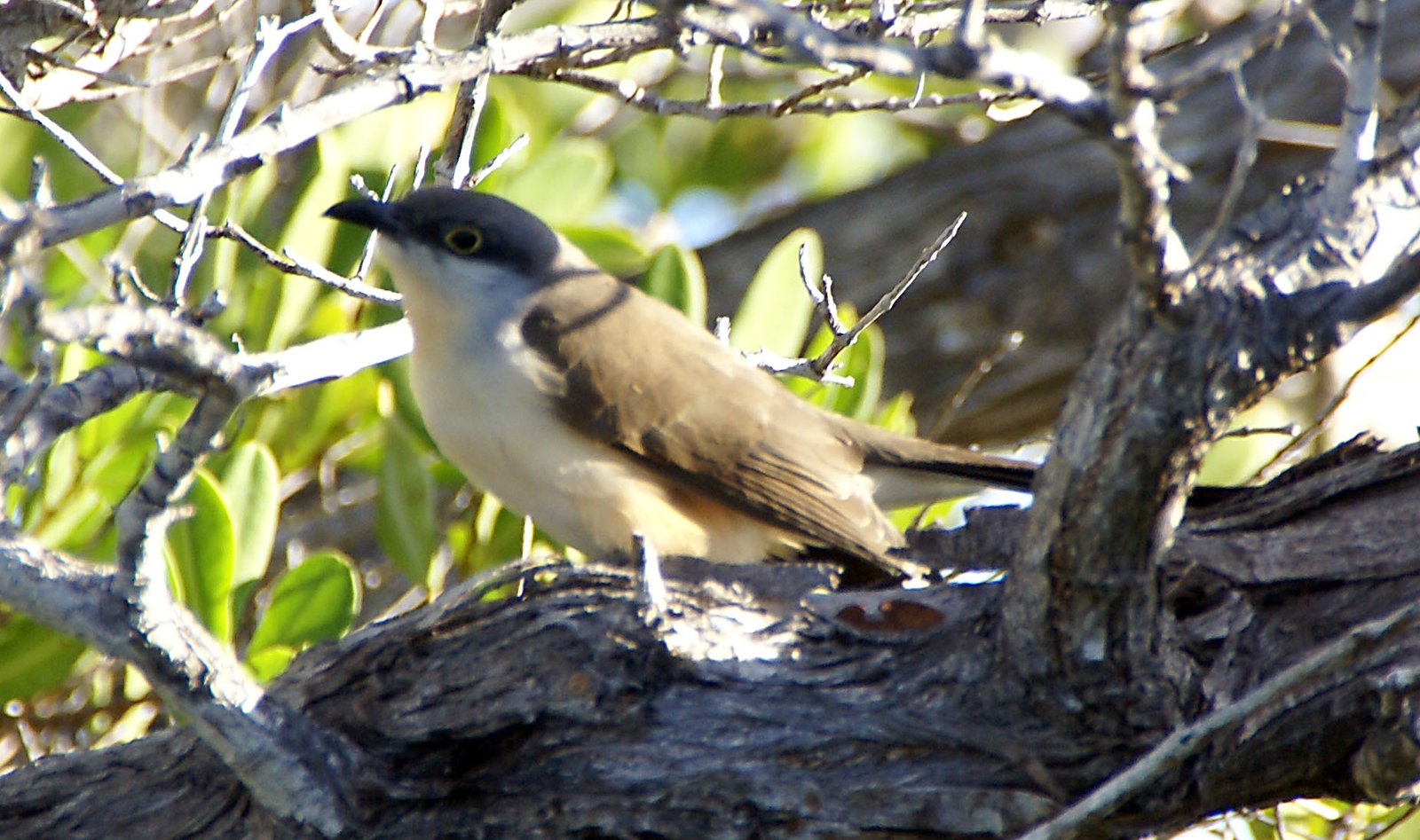
The Dark-billed Cuckoo is a slender, unobtrusive cuckoo with a black bill and warm ochre underparts. The guide area holds both residents, among others in the arid west and on the Galápagos, and migrants from southern South America that move to Amazonia in the southern winter. Despite its Dutch name it is not tied to mangroves.
Voice
A slow series of hollow, cooing notes, kow-kow-kow, often preceded by a fast rattle, ka-ka-ka-ka. Calls mainly in the breeding season and is usually silent at other times.
Recording: Franco Vushurovich — CC BY-NC-SA 4.0 · xeno-canto
Identification
26–29 cm, with a long, graduated tail. The upperparts are grey-brown, the crown greyer. Behind the eye a blackish mask covers the ear coverts, bordered below by a narrow grey band on the side of the neck. The throat, breast and belly are uniformly pale ochre to sandy. The underside of the tail is black with large white tips. The bill is entirely black; the wings show no rufous. The sexes are alike; juveniles are paler and have smaller, less sharply defined tail tips.
Confusion species
Mangrove Cuckoo Coccyzus minor has a yellow lower mandible, a whiter throat and a more contrasting black mask; in the guide area only on the Caribbean coast of Colombia. Grey-capped Cuckoo Coccyzus lansbergi has a dark grey cap, warmer rufous-brown upperparts and deep cinnamon underparts, without a pale band along the mask. Yellow-billed Cuckoo Coccyzus americanus and Pearly-breasted Cuckoo Coccyzus euleri are white below and have a yellow lower mandible. Ash-colored Cuckoo Coccycua cinerea is smaller and greyer, with a red iris and small tail tips.
Habitat
Dry forest, thorn scrub, forest edges, riparian woodland, secondary growth and shrubs in open country, from sea level to about 1500 m; as a migrant also in Amazonian river-edge vegetation and on river islands. On the Galápagos in the arid and more humid zones with trees and shrubs. It feeds mainly on caterpillars and other large insects, which it searches for slowly among the foliage. It builds its own loose nest of twigs in a shrub or tree.
Where the bird is most at home, classified by the vegetation units of the Andes and the west coast.


Range and movements
In Colombia mainly as an austral migrant in the eastern lowlands, locally also in other parts of the country. In Ecuador resident in the arid west, where it breeds in the rainy season, and a winter visitor in the east. In Peru resident in the northwest and along the western slope, a winter visitor in the Amazonian lowlands. In Bolivia a breeding bird in the south and east, in the southern winter also further north. On the Galápagos resident on most of the larger islands. Outside the guide area it breeds south to northern Argentina and Uruguay; in the southern winter it reaches Venezuela and the Guianas.
- Resident
- Summer visitor (c. Apr–Sep)
- Winter visitor (c. Oct–Mar)
- Passage (Mar–Apr, Oct–Nov)
- dark = core range, pale = thinly spread
How and when to look
In western Ecuador and northwestern Peru in the rainy season (January–May), when it calls in dry forest and scrub. On the Galápagos in shrubs and trees in the arid zone, for example on Santa Cruz.
Conservation status
Least Concern. Common and widespread; it also occurs in disturbed, semi-open vegetation.
Scientific name
Coccyzus melacoryphus | Vieillot, 1817
Vieillot described the species in 1817 and placed it straight away in the genus where it still stands. The genus Coccyzus was introduced in 1816 by Vieillot. The genus name comes from Greek kokkuzō, 'to cry cuckoo'. The species name melacoryphus comes from Greek melas, 'black', and koruphē, 'crown', after the dark crown. The specimen the first description was based on came from Paraguay.