All species › Cuckoos › Cuckoos › Black-bellied Cuckoo
Black-bellied Cuckoo | Piaya melanogaster
Zwartbuikkoekoek | Cuco ventrinegro | Chincoã-de-bico-vermelho
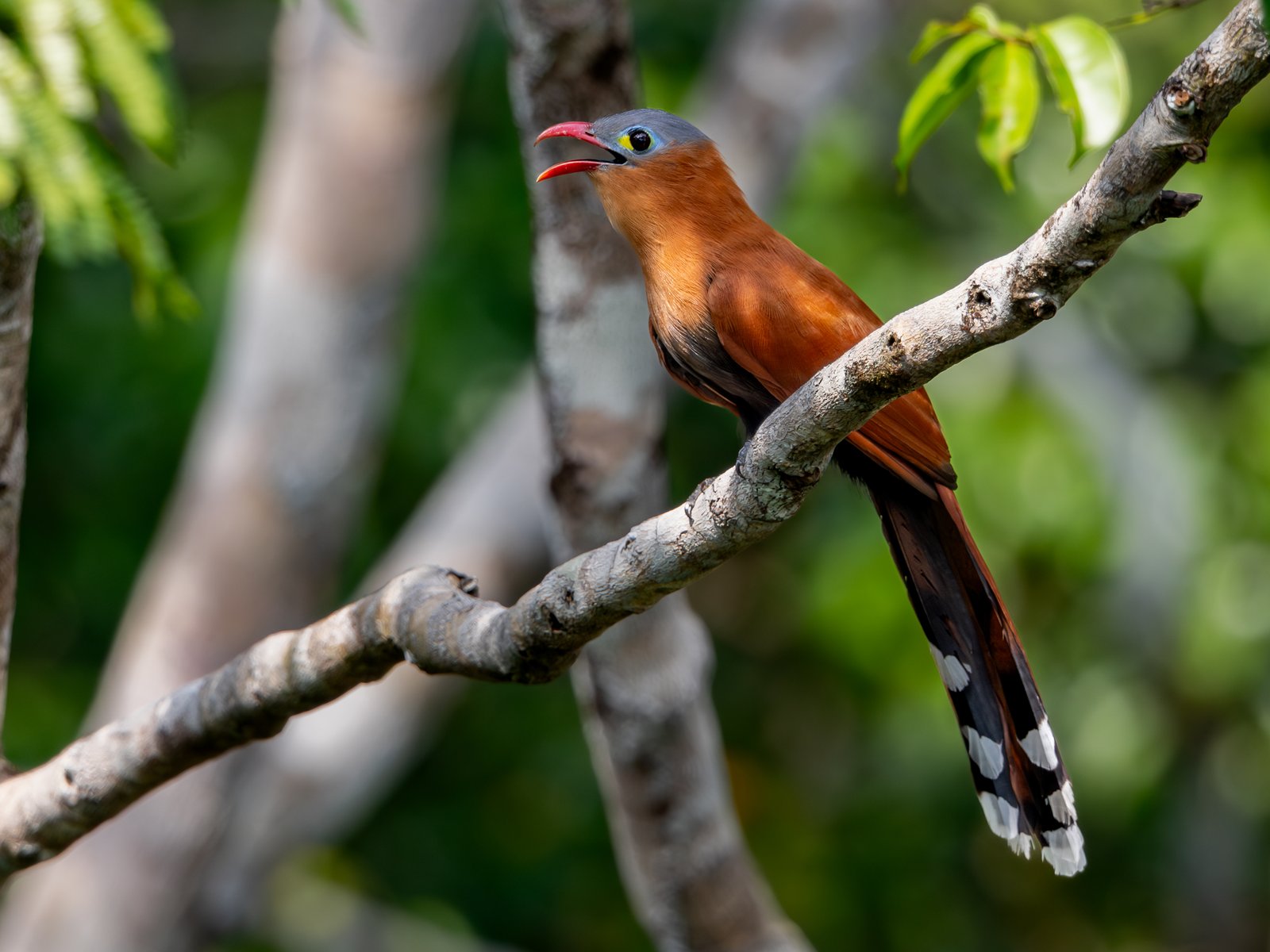
The Black-bellied Cuckoo is a long-tailed cuckoo of the Amazonian rainforest, related to the much more widespread Squirrel Cuckoo. It lives high in the canopy of undisturbed lowland forest, where it runs and hops along branches like a squirrel. Unlike the Squirrel Cuckoo it has a black belly and a grey crown.
Voice
A series of sharp, repeated notes and a dry rattle, similar to those of the Squirrel Cuckoo; also a two-noted kee-weep. Calls less often than the Squirrel Cuckoo.
Recording: Robert S. Ridgely — CC BY-NC-SA 4.0 · xeno-canto
Identification
38–41 cm, more than half of which is tail. The crown is grey; the back, wings and upper side of the tail are rufous. The throat and breast are cinnamon, the belly and undertail coverts black. The underside of the long, graduated tail is black with broad white tips. The bill is red; in front of the eye is a small yellow bare spot, and the bare skin around the eye is reddish. The sexes are alike; juveniles are duller, with a darker bill.
Confusion species
Common Squirrel Cuckoo Piaya cayana is larger, with a yellow-green bill, a rufous head without a grey crown and a grey rather than black belly. Little Cuckoo Coccycua minuta is much smaller, entirely rufous with a shorter tail, and lives in low vegetation near water.
Habitat
The canopy and middle levels of humid terra firme forest, locally also flooded forest and tall forest edges, mainly below 700 m. It searches quietly among the foliage for large insects, especially caterpillars, and other invertebrates, and often joins mixed canopy flocks. The nest is a loose cup of twigs in a tree; breeding behaviour is poorly known.
Where the bird is most at home, classified by the vegetation units of the Andes and the west coast.


Range and movements
In Colombia in the Amazonian and Orinoco lowlands in the east. In Ecuador in the eastern lowlands. In Peru in the Amazonian lowlands, mainly in the north. In Bolivia at most very locally in the north; its occurrence there is uncertain. Outside the guide area in southern Venezuela, the Guianas and Brazilian Amazonia.
- Resident
- dark = core range, pale = thinly spread
How and when to look
In the canopy of terra firme forest in eastern Ecuador and northern Peru, for example from canopy towers and walkways; look for the red bill and black belly in mixed canopy flocks.
Conservation status
Least Concern. It depends on large tracts of undisturbed lowland forest and is therefore sensitive to deforestation, but it is widespread over a large area.
Scientific name
Piaya melanogaster | (Vieillot, 1817)
Vieillot described the species in 1817 as Cuculus melanogaster; because it was later moved to another genus, the author and year stand in brackets. The genus Piaya was introduced in 1830 by Lesson. The genus name comes from Piaye, the Cayenne Creole name for the squirrel cuckoo, meaning 'devil bird'. The species name comes from Greek melas, 'black', and gastēr, 'belly'. The specimen the first description was based on came from Cayenne, French Guiana.