All species › Cuckoos › Cuckoos › Common Squirrel Cuckoo
Common Squirrel Cuckoo | Piaya cayana
Eekhoornkoekoek | Cuclillo canela | Alma-de-gato
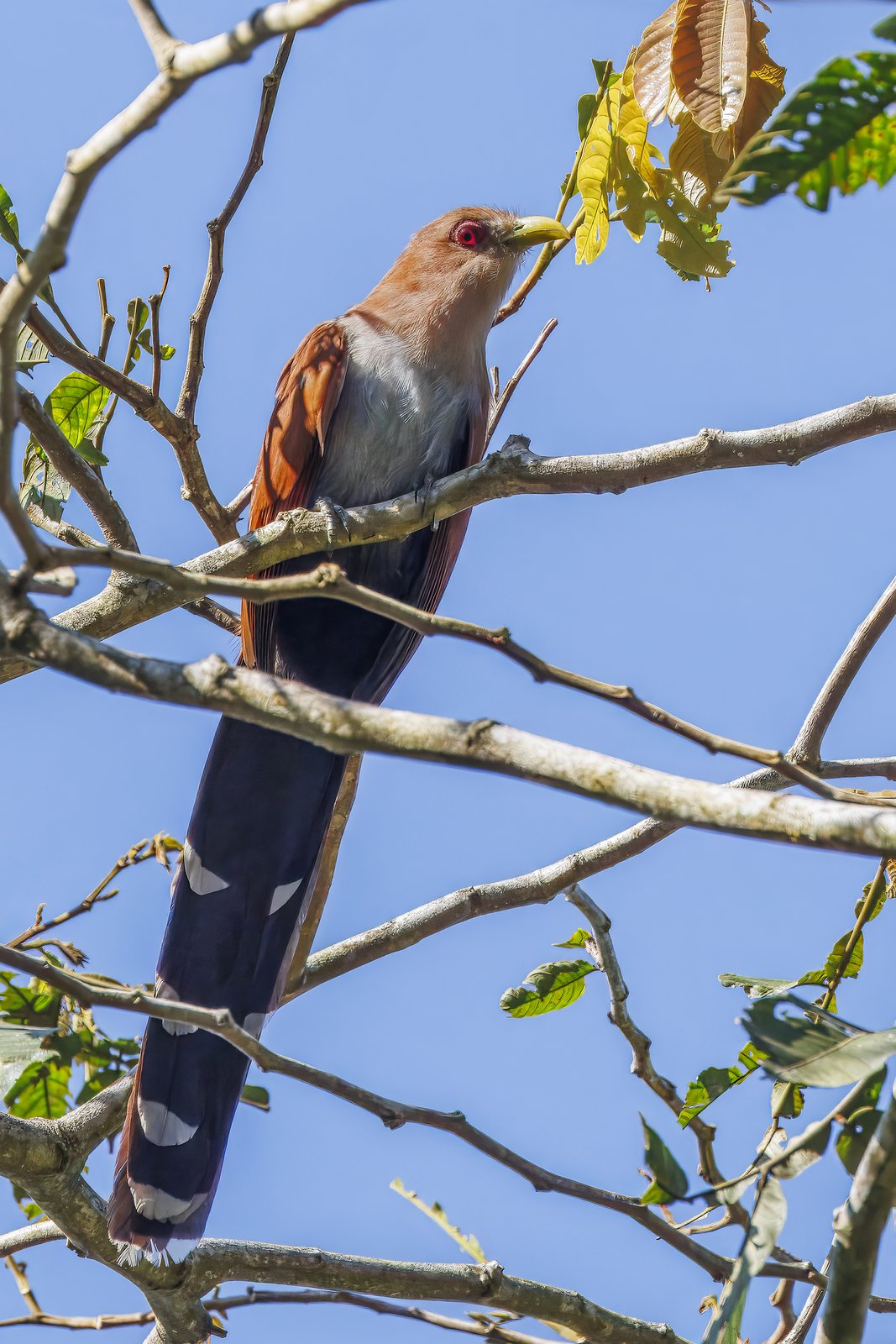
The Common Squirrel Cuckoo is a large, rufous cuckoo with a very long tail that moves through the branches with hops and short runs, like a squirrel. It is one of the most widespread cuckoos of the guide area and occurs from the lowlands into the lower montane forests. It raises its own young.
Voice
A loud, sharp keep followed by a descending wheeoo, and a rapid series wheep-wheep-wheep. When disturbed a dry, rattling kek-kek-kek.
Recording: Jacob Wijpkema — CC BY-NC-SA 4.0 · xeno-canto
Identification
41–46 cm, more than half of which is tail. Head and upperparts are chestnut; throat and breast paler rufous, the belly grey and the undertail coverts blackish. The tail is rufous above, black below with large white tips to the graduated feathers. The bill is yellowish green; the iris is red, and the bare skin around the eye is red or yellowish green depending on the subspecies. The sexes are alike; juveniles have a greyer bill and a dark iris.
Confusion species
Black-bellied Cuckoo Piaya melanogaster is smaller, with a red bill, a grey crown, a yellow and blue patch of bare skin around the eye and a black belly. Little Cuckoo Coccycua minuta is much smaller, darker rufous, with a shorter tail, and lives in low riverside vegetation.
Habitat
Forest edges, secondary forest, the canopy and middle storey of humid and semi-dry forest, gallery forest, plantations and wooded gardens, from the lowlands to about 2500 m. Eats large insects, including hairy caterpillars, grasshoppers and wasps, and sometimes small lizards. The nest is a shallow structure of twigs and leaves in a tree.
Where the bird is most at home, classified by the vegetation units of the Andes and the west coast.


Range and movements
In Colombia, Ecuador, Peru and Bolivia widespread in the lowlands and on both slopes of the Andes, including the dry Tumbesian region of southwestern Ecuador and northwestern Peru. Absent from the high Andes, the coastal desert of central and southern Peru and the Galápagos. Outside the guide area from Mexico to northern Argentina and Uruguay; the birds of western Mexico are now treated as a separate species.
- Resident
- dark = core range, pale = thinly spread
How and when to look
At forest edges and along roads through forest, where it often perches in the open and then glides from tree to tree. It regularly joins mixed-species flocks.
Conservation status
Least Concern and widespread. It does well in secondary forest, forest fragments and planted trees.
Scientific name
Piaya cayana | (Linnaeus, 1766)
Linnaeus described the species in 1766 as Cuculus cayanus; because it was later moved to another genus, the author and year stand in brackets. The genus Piaya was introduced in 1830 by Lesson. The genus name comes from Piaye, the Cayenne Creole name for the squirrel cuckoo, meaning 'devil bird'. The species name refers to Cayenne in French Guiana. The specimen the first description was based on came from Cayenne, French Guiana.