All species › Cuckoos › Cuckoos › Ash-colored Cuckoo
Ash-colored Cuckoo | Coccycua cinerea
Asgrauwe koekoek | Cuclillo ceniciento | Papa-lagarta-cinzento
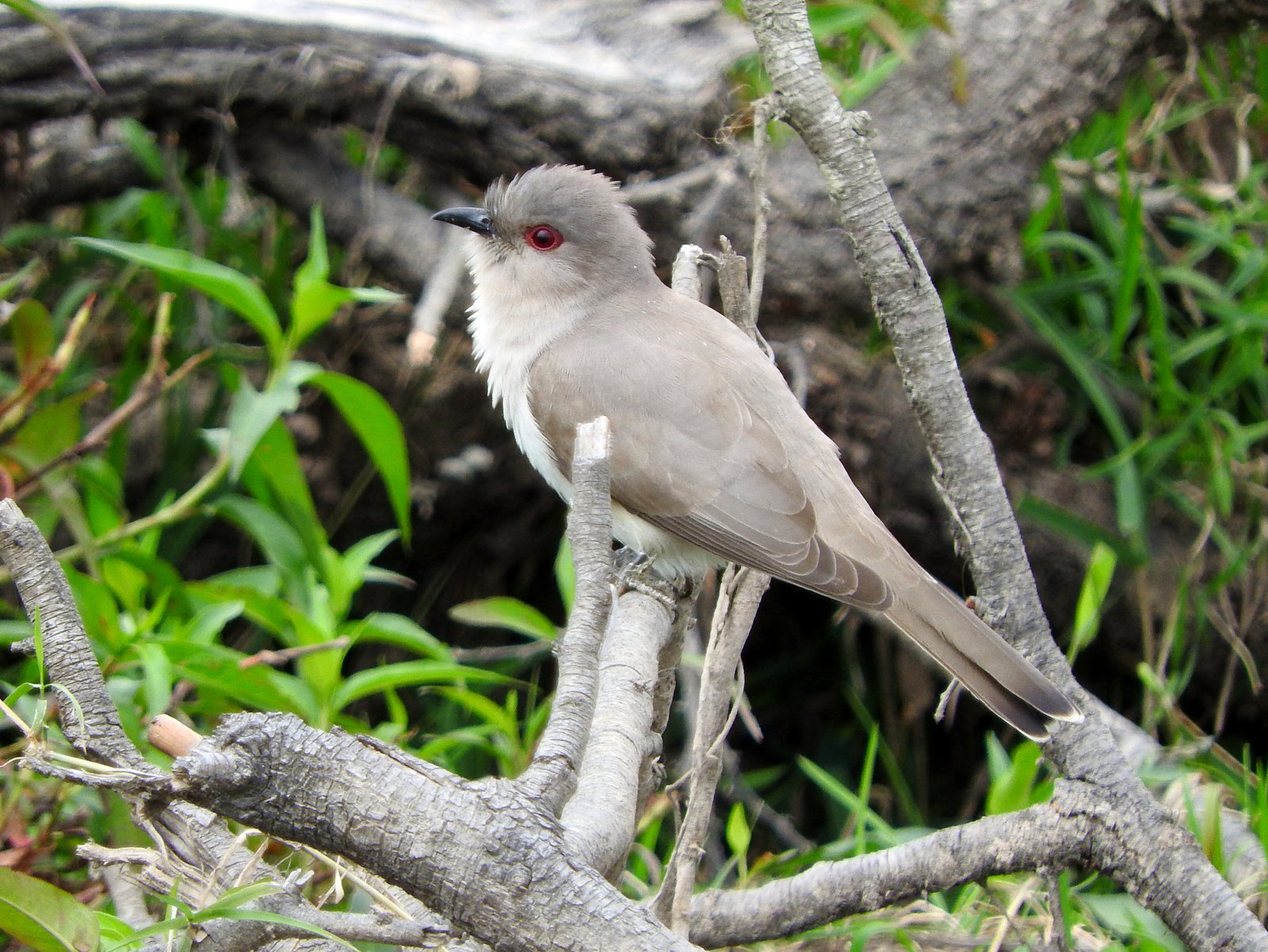
The Ash-colored Cuckoo is a small grey cuckoo that breeds in southern South America and migrates north in the austral winter. In the guide area it is mainly a winter visitor and passage migrant in the lowlands of Bolivia and Peru. It lives inconspicuously in the foliage of forest edges and scrub.
Voice
Usually silent on the wintering grounds. On the breeding grounds a series of clear, plaintive whistles, fyew fyew fyew, and a soft chuk.
Recording: Bernabe Lopez-Lanus — CC BY-NC-SA 3.0 · xeno-canto
Identification
21–23 cm, slender, with a long, graduated tail. The upperparts are grey, the wings slightly browner grey. Throat and breast are pale grey, merging into a white belly and undertail coverts. The tail is dark grey with narrow white tips. The bill is black; the iris and eye-ring are red. The sexes are alike; juveniles are browner, with a brownish iris.
Confusion species
Pearly-breasted Cuckoo Coccyzus euleri is larger, browner above, with a yellow lower mandible and large white tail spots. Dark-billed Cuckoo Coccyzus melacoryphus has a black mask and buff underparts. Dwarf Cuckoo Coccycua pumila of northern Colombia has a rufous throat and breast.
Habitat
Forest edges, scrub, gallery forest, young growth on river islands and in várzea, savanna with groves and dry forest, mainly in the lowlands below 1000 m. Searches the foliage for caterpillars and other insects.
Where the bird is most at home, classified by the vegetation units of the Andes and the west coast.


Range and movements
In Bolivia as a winter visitor and passage migrant in the lowlands, mainly in Beni and Santa Cruz; it may breed locally in the southeast. In Peru as a winter visitor in the southeastern lowlands, scarcer to the north. In Colombia only a rare winter visitor in the far southeast. Not known from Ecuador or the Galápagos. Outside the guide area it breeds in Argentina, Uruguay, Paraguay and southern Brazil; it also winters in Amazonian Brazil.
- Winter visitor (c. Oct–Mar)
- Passage (Mar–Apr, Oct–Nov)
- dark = core range, pale = thinly spread
How and when to look
In the austral winter (June to September) along forest edges and rivers in the lowlands of Bolivia and southeastern Peru. It often sits still for long periods in the foliage.
Conservation status
Least Concern. The breeding and wintering ranges are large; little is known about trends.
Scientific name
Coccycua cinerea | (Vieillot, 1817) (GBIF: Coccyzus cinereus)
Vieillot described the species in 1817 as Coccyzus cinereus; because it was later moved to another genus, the author and year stand in brackets. The genus Coccycua was introduced in 1830 by Lesson. The genus name is a portmanteau of the genus names Coccyzus (cuckoo) and Coua (coua). The species name cinerea comes from Latin cinereus, 'ash-grey'. The specimen the first description was based on came from Paraguay.