All species › Cuckoos › Cuckoos › Dwarf Cuckoo
Dwarf Cuckoo | Coccycua pumila
Dwergkoekoek | Cuclillo enano | Papa-lagarta-anão
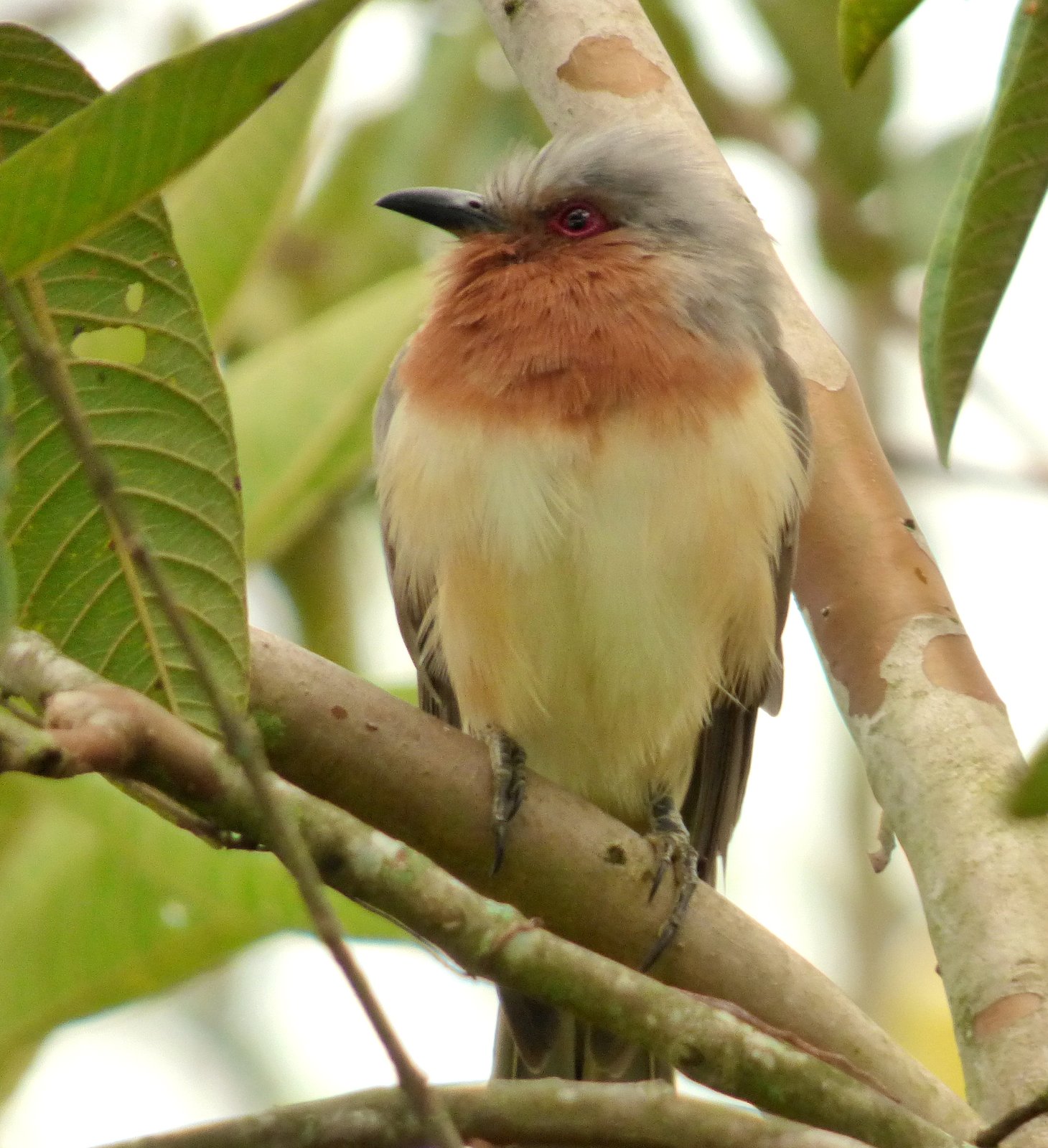
The Dwarf Cuckoo is the smallest cuckoo of the guide area, a compact grey-brown bird with a rufous throat and breast. It lives in open, dry landscapes with scattered trees in northern Colombia and Venezuela. It raises its own young and moves with the rains outside the breeding season.
Voice
A rolling, rattling trrrr and a series of plaintive, slightly descending whistles, mainly in the rainy season.
Recording: Cristian Rodas — CC BY-NC-SA 4.0 · xeno-canto
Identification
20–21 cm, with a relatively short tail for a cuckoo. The upperparts are grey-brown, the head greyer. Throat and breast are rufous, the belly dirty white to pale grey. The tail is dark grey with white tips, visible mainly from below. The bill is black and short; the iris and eye-ring are red. The sexes are alike; juveniles have a grey throat and a dark iris.
Confusion species
Ash-colored Cuckoo Coccycua cinerea is slightly larger, with a pale grey rather than rufous throat and breast; in Colombia it occurs only as a rare winter visitor in the southeast. Little Cuckoo Coccycua minuta is larger and entirely dark rufous with a greenish-yellow bill. Dark-billed Cuckoo Coccyzus melacoryphus has a black mask and entirely buff underparts.
Habitat
Open, dry to semi-humid country with scattered trees and shrubs: savanna, pasture with trees, scrub, gallery forest and gardens, mainly below 1000 m, locally higher. Searches shrubs and trees for caterpillars and other insects. The nest is a shallow cup of twigs in a shrub or low tree.
Where the bird is most at home, classified by the vegetation units of the Andes and the west coast.


Range and movements
In Colombia in the dry Caribbean lowlands, the Magdalena and Cauca valleys and the llanos east of the Andes. From Ecuador only a few poorly documented records are known. Absent from Peru, Bolivia and the Galápagos. Outside the guide area in Venezuela.
- Resident
- dark = core range, pale = thinly spread
How and when to look
In the llanos and the dry Caribbean regions of Colombia, in pasture with trees and along forest edges, especially in the rainy season when the birds call.
Conservation status
Least Concern. It benefits from the opening of the landscape for cattle ranching, as long as trees and shrubs remain.
Scientific name
Coccycua pumila | (Strickland, 1852) (GBIF: Coccyzus pumilus)
Strickland described the species in 1852 as Coccyzus pumilus; because it was later moved to another genus, the author and year stand in brackets. The genus Coccycua was introduced in 1830 by Lesson. The genus name is a portmanteau of the genus names Coccyzus (cuckoo) and Coua (coua). The species name pumila comes from Latin pumilus, 'dwarfish, small'. The specimen the first description was based on came from Venezuela.