All species › Tinamous › Tinamous › Darwin's Nothura
Darwin's Nothura | Nothura darwinii
Darwins steisshoen | Inambú de Darwin | Codorna-de-darwin
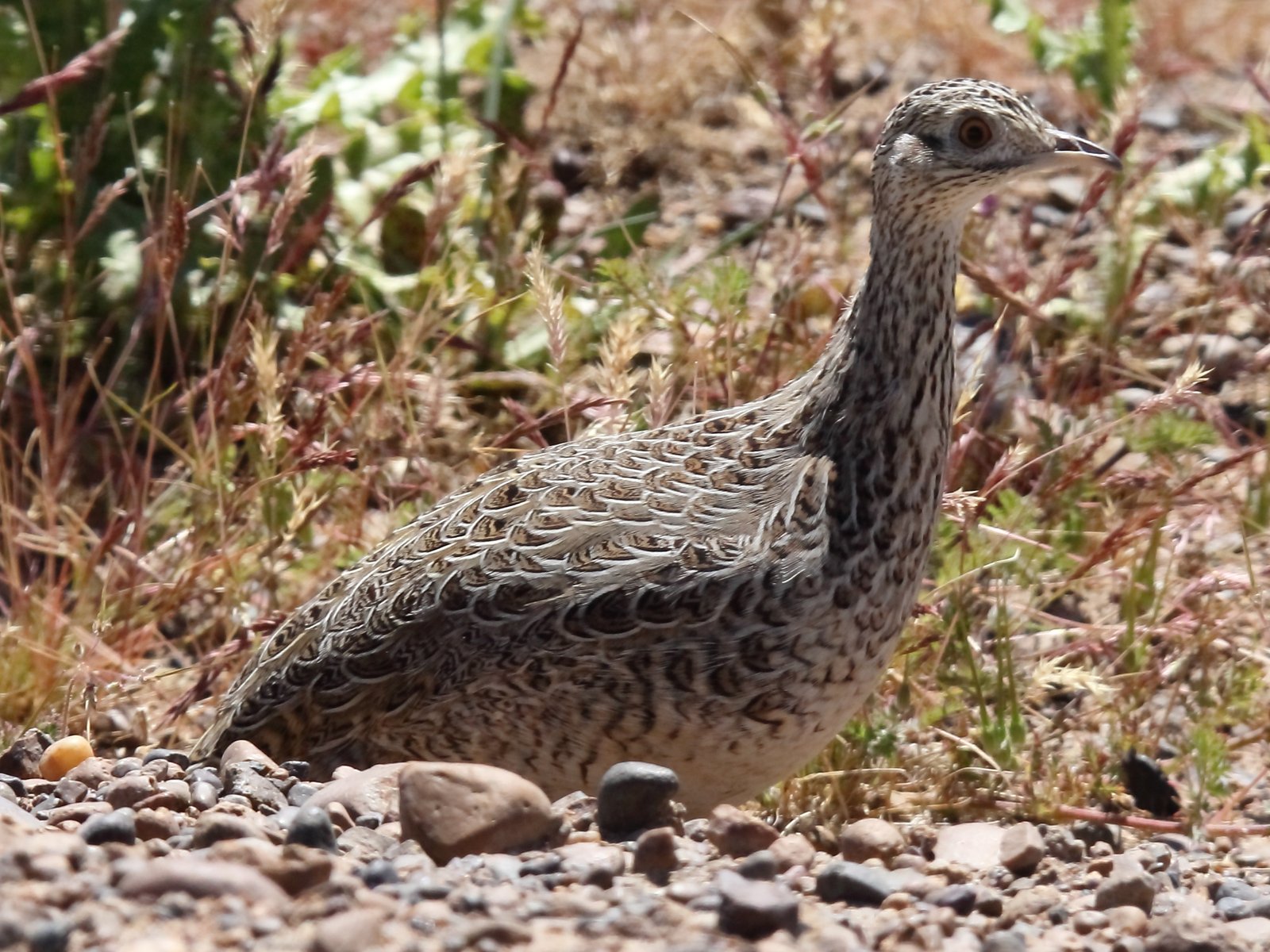
Darwin's Nothura is a small, streaked tinamou of open grassland in the Andes of southern Peru and Bolivia, and further south also in the lowlands of Argentina. Of the nothuras of the guide area it is the one most tied to the high Andes. It lives hidden among grass tussocks and fields and flushes late, with a short, whirring flight.
Voice
A series of high, thin whistles, mainly in the early morning and evening. When flushed a sharp call and a whirring sound of the wings.
Recording: Dan Lane — CC BY-NC-SA 4.0 · xeno-canto
Identification
24–26 cm, with a small head, a short, slightly decurved bill and almost no tail. The crown is blackish with pale streaks; the rest of the head is buff with fine dark speckling and a whitish throat. The neck and breast are buff with dark streaks and spots, and the belly is plain buff to cinnamon. The upperparts are greyish brown to buff, with black barring and pale longitudinal streaks. The legs are yellowish. The sexes are alike.
Confusion species
Andean Tinamou Nothoprocta pentlandii is larger and greyer, with a grey, finely white-spotted breast and a longer bill. Ornate Tinamou Nothoprocta ornata is much larger, with a whitish, black-spotted head. Puna Tinamou Tinamotis pentlandii is much larger, with black-and-white head stripes. White-bellied Nothura Nothura boraquira lives in the eastern lowlands of Bolivia and has a white belly.
Habitat
Dry and humid puna grassland, open grassland with low shrubs and the edges of fields and fallow land, mainly between 2800 and 4300 m. It walks on the ground, feeding on seeds, shoots and insects. The nest is on the ground, hidden in a grass tussock; the male incubates.
Where the bird is most at home, classified by the vegetation units of the Andes and the west coast.


Range and movements
In Peru in the Andes of the south, mainly in Cusco, Puno and Arequipa and around Lake Titicaca. In Bolivia on the altiplano and in the inter-Andean valleys. Absent from Colombia, Ecuador and the Galápagos. Outside the guide area in north-western Argentina and further on in the grassy steppes of central and southern Argentina.
- Resident
- dark = core range, pale = thinly spread
How and when to look
Walk slowly through grassland and along field edges on the altiplano, for example around Lake Titicaca; birds sit tight for a long time and flush only right at your feet. In the early morning they give themselves away by their whistles.
Conservation status
Least Concern. The species tolerates small-scale farming and grazed grassland well, but is hunted locally.
Scientific name
Nothura darwinii | Gray, 1867
Gray described the species in 1867 and placed it straight away in the genus where it still stands. The genus Nothura was introduced in 1827 by Wagler. The genus name comes from Greek nothos, 'spurious', and oura, 'tail'; the tail is barely visible. Named after Charles Darwin (1809–1882), English naturalist, who collected in Argentina during the Beagle voyage. The specimen the first description was based on came from Bahía Blanca, Buenos Aires, Argentina.