All species › Tinamous › Tinamous › Puna Tinamou
Puna Tinamou | Tinamotis pentlandii
Punatinamoe | Tinamú de la puna | Inhambu-da-puna
The Puna Tinamou is the largest highland tinamou and a characteristic bird of the dry puna of southern Peru and western Bolivia. It lives in small groups on open plains with bunchgrass and low shrubs, often above 4000 m. Despite the shared species name it is not a close relative of Andean Tinamou Nothoprocta pentlandii: its genus belongs to the steppe tinamous, together with the crested tinamous of the genus Eudromia.
Voice
A loud, nasal call of two or three syllables, roughly kew-la, often repeated in series; locally the species is named kiula after it. Members of a group often call in turn or together, mainly in the morning. When flushed a loud whirr of wings.
Recording: GABRIEL LEITE — CC BY-NC-SA 4.0 · xeno-canto
Identification
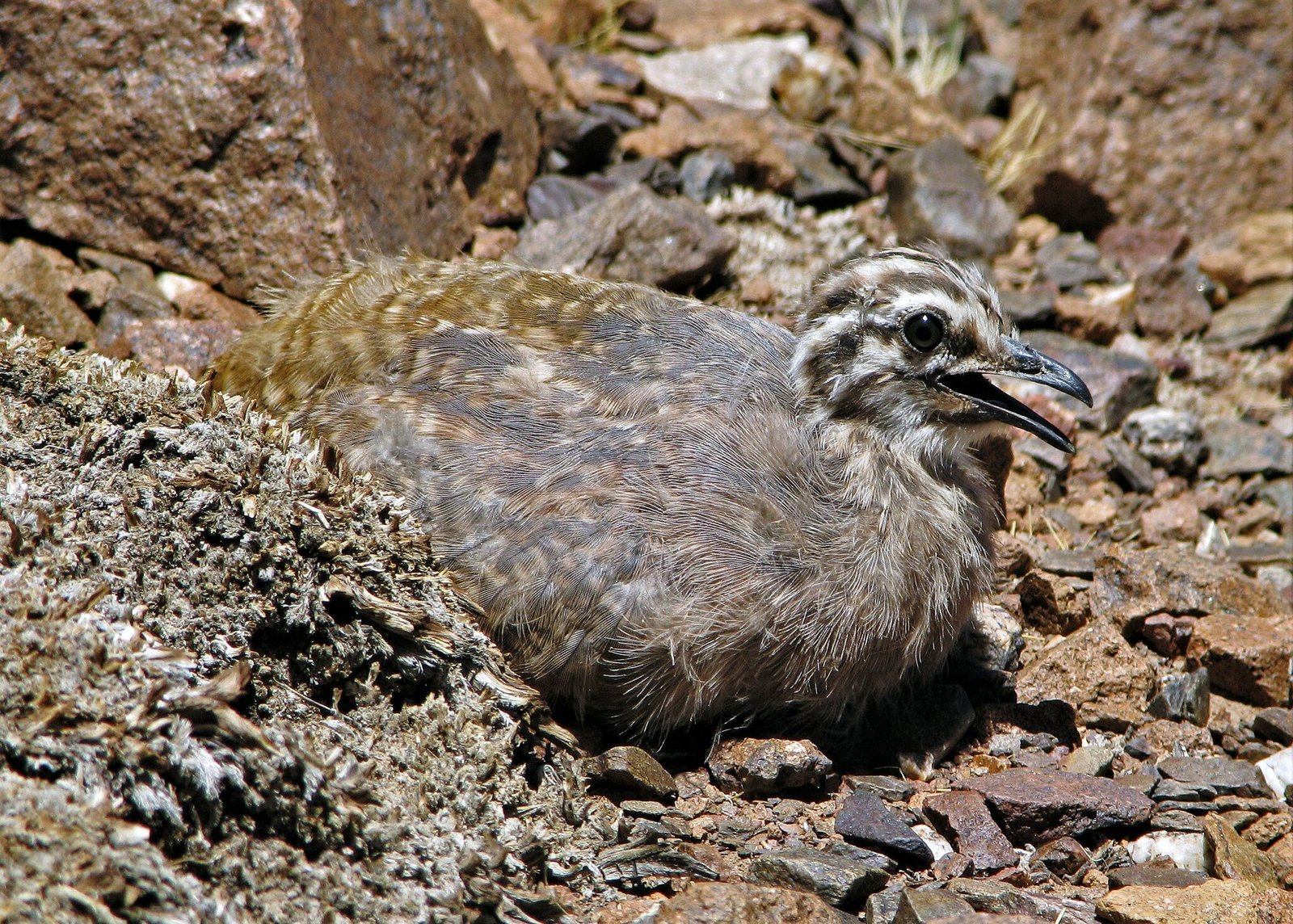
41–45 cm, stocky, with a small head, a short, slightly decurved bill and almost no tail. The head shows a pattern of black and white stripes: a white supercilium, a dark eyestripe and a white stripe across the cheek and side of the neck. The upperparts are greyish brown, finely spotted and streaked with black and buff. The breast is grey with pale spots, the belly buff and the undertail coverts rufous. The legs are grey, without a hind toe. The sexes are alike.
Confusion species
Andean Tinamou Nothoprocta pentlandii is much smaller, lacks black-and-white head stripes and lives lower, in scrub and along fields. Ornate Tinamou Nothoprocta ornata is smaller, with a whitish, black-spotted head and neck without continuous stripes. Darwin's Nothura Nothura darwinii is much smaller and buff, with a streaked breast. Taczanowski's Tinamou Nothoprocta taczanowskii is darker, with a long, decurved bill, and lives in wetter grassland near forest edges.
Habitat
Dry and humid puna with bunchgrass and low shrubs, sandy and stony plains and the edges of bogs (bofedales), mainly between 3800 and 5000 m. It lives in groups of a few to over ten birds, which walk together feeding on leaves, shoots, seeds and insects. The nest is a scrape on the ground, often sheltered by a grass tussock; the male incubates the eggs.
Where the bird is most at home, classified by the vegetation units of the Andes and the west coast.


Range and movements
In Peru in the Andes of the south, including Arequipa, Moquegua, Tacna and Puno, and locally further north in the centre. In Bolivia on the altiplano and the adjacent puna in the west of the country. Absent from Colombia, Ecuador and the Galápagos. Outside the guide area in northern Chile and north-western Argentina.
- Resident
- dark = core range, pale = thinly spread
How and when to look
Search open puna above 4000 m, for example in the Salinas y Aguada Blanca reserve near Arequipa or in Sajama National Park in Bolivia. Groups often walk off before they flush; in the early morning they can be heard calling.
Conservation status
Least Concern. The species is hunted locally and its eggs are collected, but its range is large and sparsely inhabited by people.
Scientific name
Tinamotis pentlandii | Vigors, 1837
Vigors described the species in 1837 and placed it straight away in the genus where it still stands. He introduced the genus Tinamotis in that same work. The genus name combines the genus Tinamus with Greek ōtis, 'bustard', after its bustard-like appearance. Named after Joseph Barclay Pentland (1797–1873), Irish natural scientist and geographer who worked in Bolivia. The specimen the first description was based on came from Andes, probably Bolivia.