All species › Waders, gulls and terns › Thick-knees and stone-curlews › Double-striped Thick-Knee
Double-striped Thick-Knee | Hesperoburhinus bistriatus
Caribische griel | Alcaraván americano | Téu-téu-da-savana
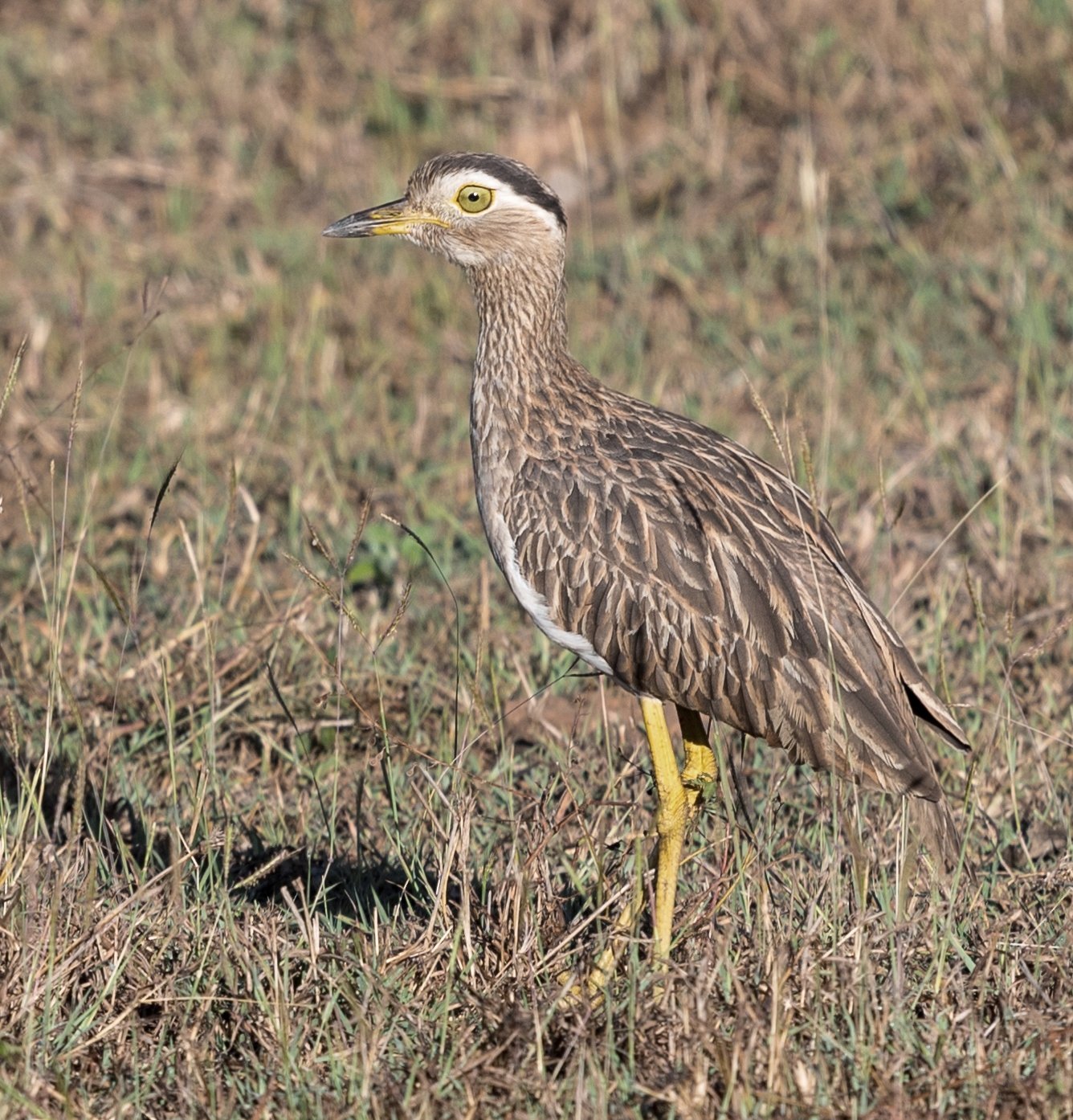
The Double-striped Thick-knee is the largest thick-knee in the Americas, an inhabitant of dry savanna and ranchland. By day it rests in small groups in open terrain, where its streaked plumage conceals it; at night it hunts and gives its loud call. In the guide area it occurs only in Colombia.
Voice
Mainly at night a loud, cackling series of calls, ka-ka-ka-ka-kaa, rising and then falling away; often several birds call at once.
No recording with a suitable Creative Commons licence is available for this species yet.
Identification
43–48 cm, with a large head, large yellow eyes, a short, stout dark bill with a yellow base and long, yellowish-green legs. The upperparts are brown with dark and pale streaks. A broad white supercilium is bordered above by a black stripe. The neck and breast are brownish grey and clearly streaked dark, and the belly is white. In flight it shows black flight feathers with white patches. The sexes are alike; juveniles are duller.
Confusion species
Peruvian Thick-knee Hesperoburhinus superciliaris is smaller and greyer, with a plain grey breast, and lives only on the dry coastal plain west of the Andes in Ecuador and Peru. In the guide area no other thick-knee occurs within its range.
Habitat
Open, dry savanna, grassland with scattered trees, pastures and ranchland and clearings in dry forest, mainly in the lowlands up to about 500 m, locally higher. At night it feeds on insects, other invertebrates and small vertebrates such as lizards and rodents. The eggs are laid in a bare scrape on the ground.
Where the bird is most at home, classified by the vegetation units of the Andes and the west coast.


Range and movements
In Colombia in the dry Caribbean lowlands, including the Guajira, the northern Magdalena valley and the Llanos east of the Andes. Absent from Ecuador, Peru, Bolivia and the Galápagos. Outside the guide area from southern Mexico through Central America to Venezuela, the Guianas and northern Brazil, and on Hispaniola.
- Resident
- dark = core range, pale = thinly spread
How and when to look
In the Llanos and the dry Caribbean lowlands, in the evening along roads through pastures and savanna, where birds stand on the ground in the beam of a torch. By day they often rest in the shade of shrubs or trees in open ranchland.
Conservation status
Least Concern. The species locally benefits from forest clearance for cattle ranching, but in some regions it is kept as a pet or hunted.
Scientific name
Hesperoburhinus bistriatus | (Wagler, 1829)
Wagler described the species in 1829 as Charadrius bistriatus; because it was later moved to another genus, the author and year stand in brackets. The genus Hesperoburhinus was introduced in 2023 by Černý, van Els, Natale & Gregory. The genus name combines Greek hesperos, 'western', with Burhinus: the only thick-knee genus of the Western Hemisphere. The species name comes from Latin bi-, 'two', and striatus, 'striped', after the double stripe over the eye. The specimen the first description was based on came from Mexico.