All species › Waders, gulls and terns › Thick-knees and stone-curlews › Peruvian Thick-Knee
Peruvian Thick-Knee | Hesperoburhinus superciliaris
Peruaanse griel | Alcaraván peruano | Téu-téu-peruano
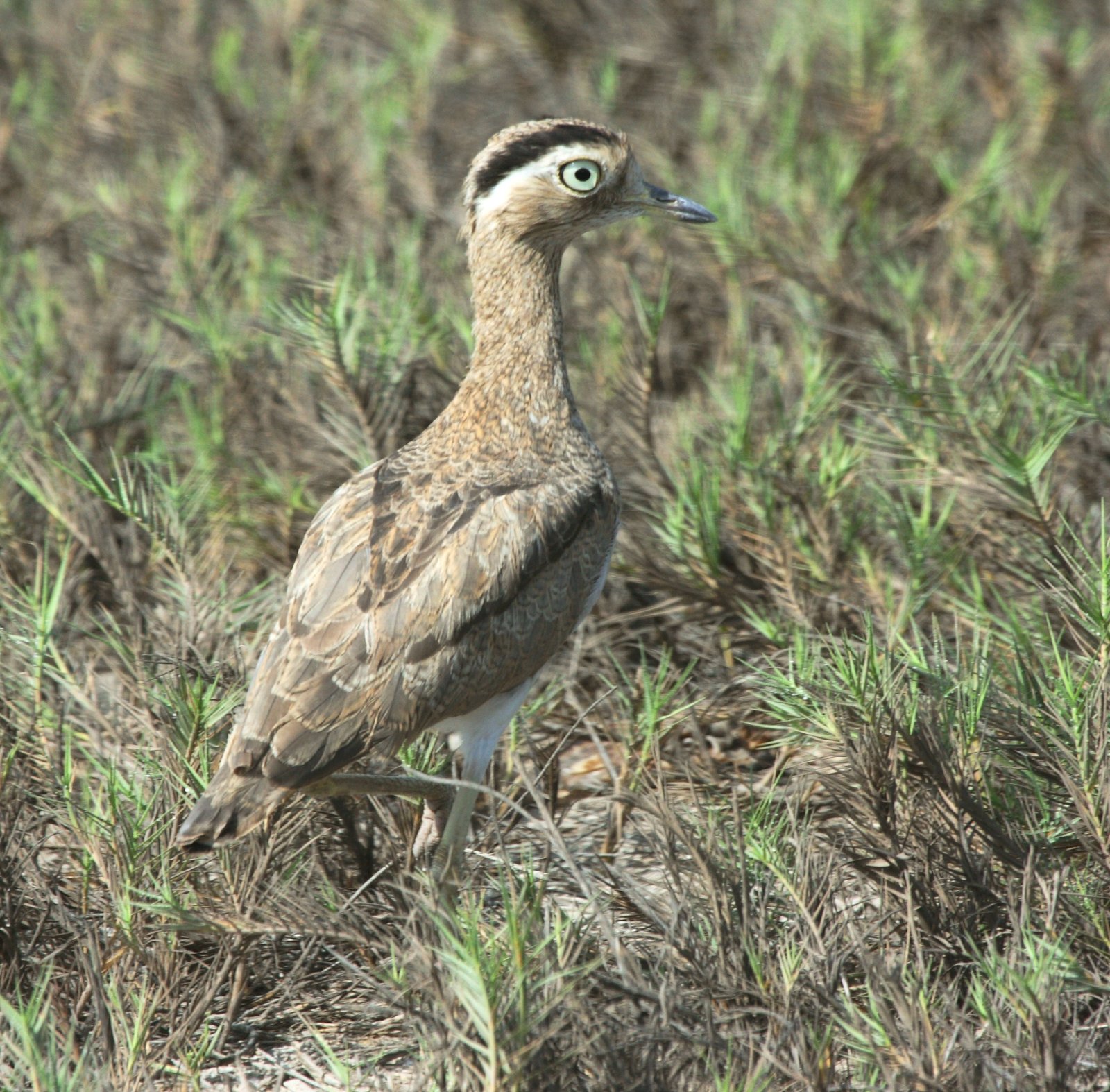
The Peruvian Thick-knee is a medium-sized, sandy-coloured thick-knee of the dry coastal plain along the Pacific. By day it stands or lies motionless in open terrain, where its streaked plumage blends with the bare ground; it becomes active only at dusk and at night. It is the only thick-knee in the west of the guide area.
Voice
Mainly at night and at dusk a series of loud, shrill, somewhat cackling calls, often accelerating and then fading, such as kee-kee-kee-kii. Pairs and small groups sometimes call together.
No recording with a suitable Creative Commons licence is available for this species yet.
Identification
38–43 cm, with a large, round head, large yellow eyes, a short, stout bill with a dark tip and long, yellowish-green legs. The upperparts are greyish brown with dark streaks. The head pattern stands out: a white supercilium, bordered black above, and a dark eye-stripe. The breast is pale grey and the belly white. In flight it shows black flight feathers with white patches. The sexes are alike; juveniles are duller, with a less sharp head pattern.
Confusion species
Double-striped Thick-knee Hesperoburhinus bistriatus is larger and warmer brown, with a more heavily streaked neck and breast, and occurs only east and north of the Andes in Colombia; the ranges do not meet. Plovers such as Killdeer Charadrius vociferus are much smaller, with a thinner bill and black breast bands.
Habitat
Dry, open terrain on the coastal plain: desert edge with scattered shrubs, dry forest and thorn scrub, fallow land, pastures, fields and irrigated areas, from sea level to about 300 m, locally higher in dry valleys. At night it feeds on insects, other invertebrates and small vertebrates, taken on the ground. The eggs are laid in a bare scrape on the ground.
Where the bird is most at home, classified by the vegetation units of the Andes and the west coast.


Range and movements
In Ecuador on the dry coastal plain in the south-west, especially on the Santa Elena peninsula and in El Oro. In Peru along the entire dry coast, from Tumbes south to Arequipa and Tacna. Absent from Colombia, Bolivia and the Galápagos. Outside the guide area only in the far north of Chile.
How and when to look
Search with a torch or at dusk along sandy tracks through dry scrub, fields and pastures on the coastal plain; the eyes reflect the light. By day birds sometimes stand still in the shade of a shrub and can only be found by slowly scanning the terrain.
Conservation status
Vulnerable. Numbers are declining due to the conversion of dry forest and scrub to intensive agriculture and building along the coast, and through disturbance and free-roaming dogs.
Scientific name
Hesperoburhinus superciliaris | (Tschudi, 1843)
Tschudi described the species in 1843 as Oedicnenus superciliaris; because it was later moved to another genus, the author and year stand in brackets. The genus Hesperoburhinus was introduced in 2023 by Černý, van Els, Natale & Gregory. The genus name combines Greek hesperos, 'western', with Burhinus: the only thick-knee genus of the Western Hemisphere. The species name comes from Latin supercilium, 'eyebrow', after the prominent supercilium. The specimen the first description was based on came from Coast of Peru.