All species › Cranes, rails and allies › Rails, gallinules and coots › Black Rail
Black Rail | Laterallus jamaicensis
Zwarte dwergral | Polluela negra | Sanã-preta
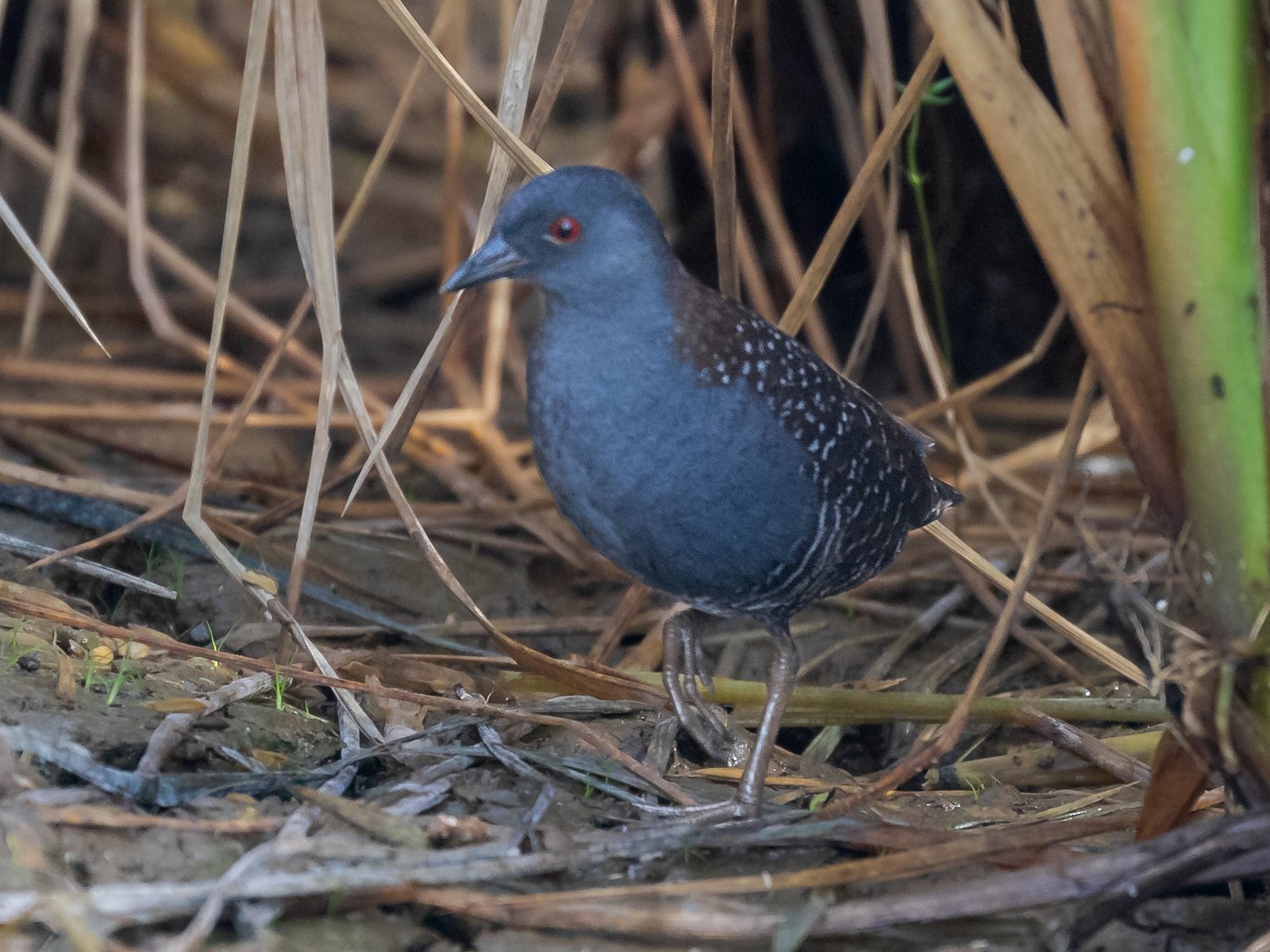
The Black Rail is the smallest rail in the guide area: a dark grey bird with white spots on the back and red eyes. In the guide area it occurs only in Peru, in coastal marshes and in the marshes around Lake Junín in the Andes. The Junín form is often treated as a separate species.
Voice
A fast series of high, sharp notes and dry rattles, mainly at night and at dusk. The voice of the South American forms differs from that in North America.
Recording: Paul Lenrumé — CC BY-NC-SA 4.0 · xeno-canto
Identification
13–15 cm. Head and underparts dark slate-grey, nape and upper back dark chestnut. Back and wings dark brown with fine white spots; flanks and undertail coverts with narrow white bars. The bill is short and black, the eyes are red and the legs dark. The sexes are nearly alike. The Peruvian coastal form is paler than the Junín form.
Confusion species
Galapagos Crake Laterallus spilonota is very similar, but occurs only on the Galápagos. Grey-breasted Crake Laterallus exilis has a white throat, a rufous nape and a greenish bill, and lives in the Amazonian lowlands. Plumbeous Rail Pardirallus sanguinolentus is much larger, with a long, greenish-yellow bill with a red and blue base. Paint-billed Crake Mustelirallus erythrops is larger, with plain brown upperparts and a red base to the bill.
Habitat
Dense, low marsh vegetation with sedges, rushes and grass, often where there are only a few centimetres of water: on the coast in brackish and freshwater marshes, in the Andes in the marshes around Lake Junín at about 4100 m. It forages on the ground for insects, small snails and seeds. The nest is a cup of plant material, low in dense vegetation.
Where the bird is most at home, classified by the vegetation units of the Andes and the west coast.


Range and movements
In the guide area only in Peru: locally in marshes along the coast (subspecies murivagans) and in the marshes around Lake Junín (subspecies tuerosi). Absent from Colombia, Ecuador, Bolivia and the Galápagos. Outside the guide area in North and Central America, the Caribbean, central Chile and adjacent western Argentina.
- Resident
- dark = core range, pale = thinly spread
How and when to look
Listen at dusk and at night at coastal marshes in Peru and at the shore zone of Lake Junín; the bird almost always stays under cover and runs off rather than flushing when disturbed.
Conservation status
Endangered. Coastal marshes are disappearing through drainage, building and agriculture; around Lake Junín fluctuating water levels from hydropower and pollution from mining are the main threats. The Junín form, treated as a separate species, is also considered Endangered.
Scientific name
Laterallus jamaicensis | (Gmelin, 1789)
Gmelin described the species in 1789 as Rallus jamaicensis; because it was later moved to another genus, the author and year stand in brackets. The genus Laterallus was introduced in 1855 by Gray. The genus name is a portmanteau of Rallus lateralis, an old name of the Rufous-sided Crake (Latin lateralis, 'of the side'). The species name refers to Jamaica. The specimen the first description was based on came from Jamaica.