All species › Cranes, rails and allies › Rails, gallinules and coots › Galapagos Crake
Galapagos Crake | Laterallus spilonota
Galápagosdwergral | Polluela de Galápagos | Sanã-de-galápagos
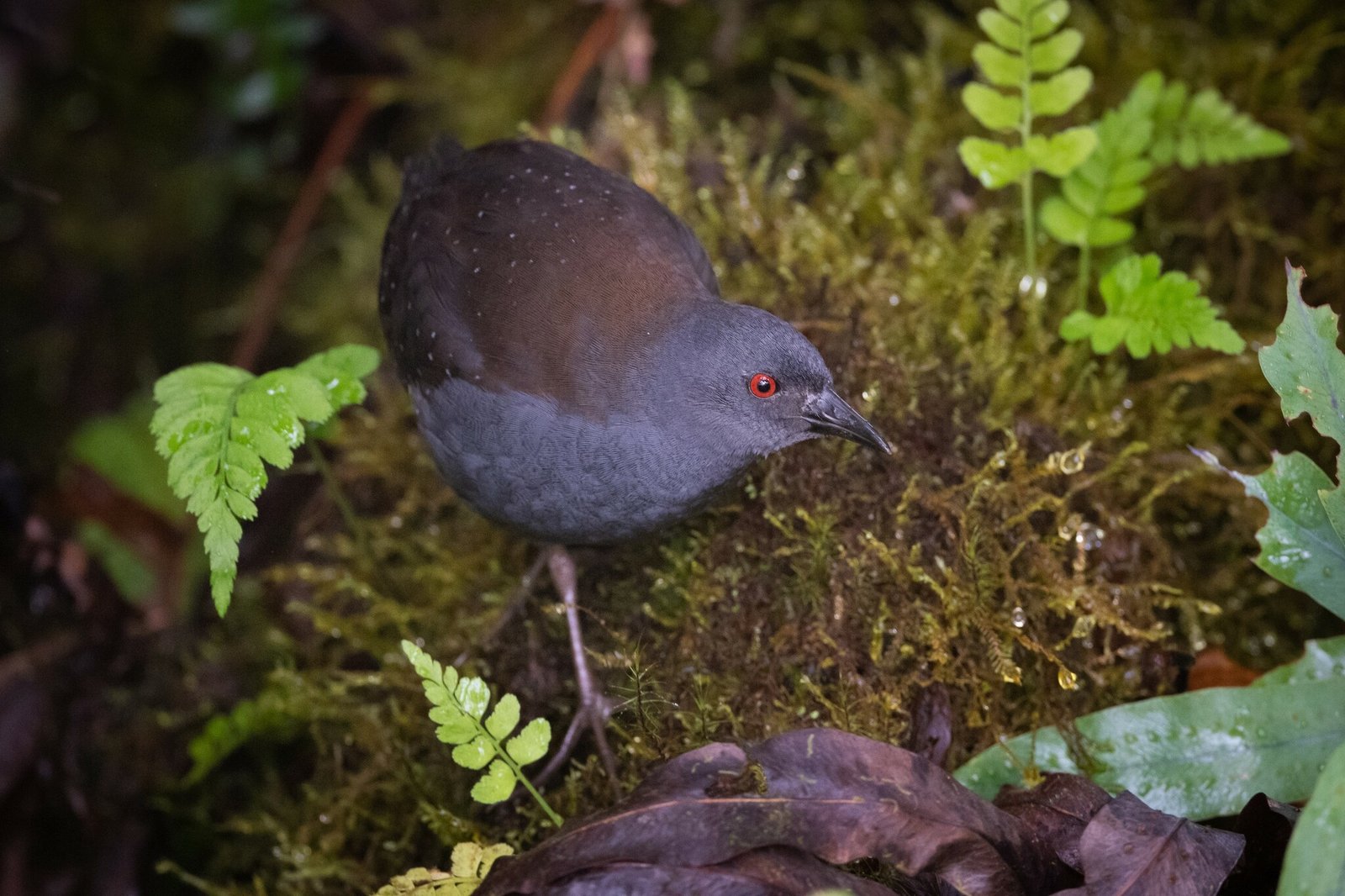
The Galapagos Crake is a small, dark rail found only on the Galápagos. It rarely flies and lives in dense vegetation of ferns, sedges and shrubs in the humid highlands. It is heard more often than seen.
Voice
A fast, descending series chi-chi-chi-chiroo, also a shrill rattle, chattering and squeaky contact calls.
Recording: Bram Vogels — CC BY-NC-SA 4.0 · xeno-canto
Identification
15–16 cm. Head and underparts slate-grey, the crown darker; flanks and thighs with narrow white bars. Upper back and scapulars chestnut-brown, lower back and tail dark brown. The wing coverts are brown, often with fine white spots. The eyes are red, the bill and legs dark brown. The sexes are alike; juveniles are mostly dark brown, with a greyish face.
Confusion species
Paint-billed Crake Mustelirallus erythrops, also on the Galápagos, is larger, with plain olive-brown upperparts, a yellow-green bill with a red base and red legs. Common Moorhen Gallinula chloropus is much larger, with a red frontal shield, and lives on open water.
Habitat
Dense vegetation in the humid highlands: ferns, sedges and grasses in the pampa zone, Miconia scrub and the understorey of Scalesia forest; locally also lower, in humid parts of the transition zone. It forages in leaf litter and among plants for insects and other invertebrates. The nest is a domed cup of grass and moss on or just above the ground.
Where the bird is most at home, classified by the vegetation units of the Andes and the west coast.


Range and movements
Endemic to the Galápagos, on Santa Cruz, Santiago, Isabela, Fernandina and Pinta, and on Floreana, where the species was rediscovered in 2025 after more than 180 years without records. Possibly extirpated on San Cristóbal. Does not occur on the mainland of Colombia, Ecuador, Peru and Bolivia.
- Resident
How and when to look
Listen along trails in the highlands of Santa Cruz, for example at Los Gemelos and on the slopes of the pampa zone; the bird sometimes walks briefly across the trail or comes to the edge of the ferns.
Conservation status
Vulnerable. Grazing goats, pigs and cattle have greatly altered the highland vegetation; introduced rats, cats and dogs and invasive plants are also a threat. After goats and pigs were removed from Santiago, the population there recovered.
Scientific name
Laterallus spilonota | (Gould, 1841) (GBIF: Laterallus spilonotus)
Gould described the species in 1841 as Zapornia spilonota; because it was later moved to another genus, the author and year stand in brackets. The genus Laterallus was introduced in 1855 by Gray. The genus name is a portmanteau of Rallus lateralis, an old name of the Rufous-sided Crake (Latin lateralis, 'of the side'). The species name comes from Greek spilos, 'spot', and nōtos, 'back', after the white spots on the back. The specimen the first description was based on came from Ovalau, Fiji (given in error).