All species › Cranes, rails and allies › Rails, gallinules and coots › Grey-breasted Crake
Grey-breasted Crake | Laterallus exilis
Amazonedwergral | Polluela pechigrís | Sanã-do-capim
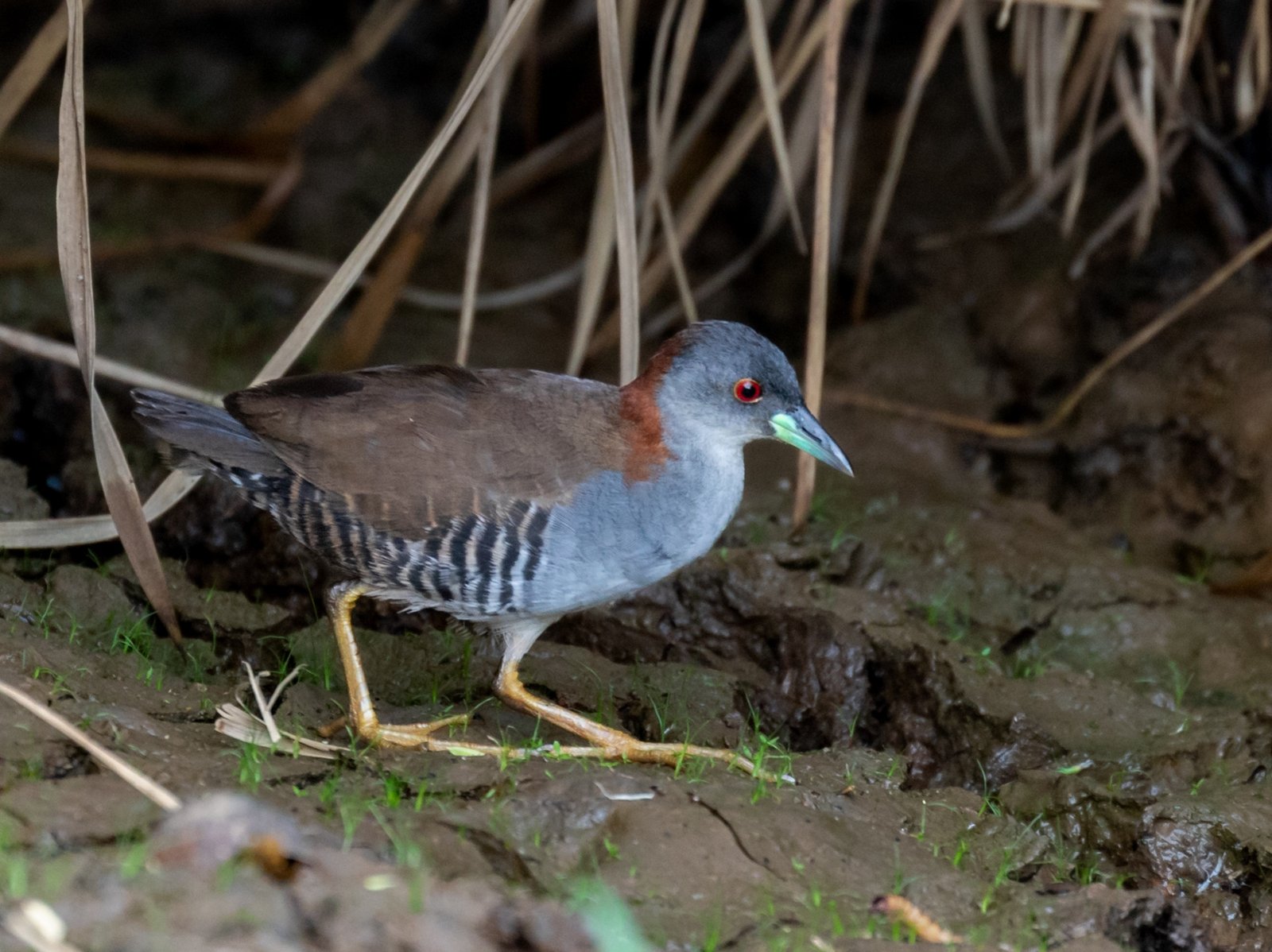
The Grey-breasted Crake is a small rail with a grey head and breast, a rufous nape and black-and-white barred flanks. It lives in wet grassland and rank growth in the lowlands and is mainly detected by its series of clear, ticking notes. It has a large range, but almost always stays under cover.
Voice
A series of clear, metallic notes, fast at first and then slower, like tink-tink-tink; also a short, dry rattle.
Recording: Juan Freile — CC BY-NC-SA 4.0 · xeno-canto
Identification
14–15 cm. Head, neck and breast grey, the throat whitish. Nape and upper back rufous, the rest of the upperparts olive-brown. Flanks and undertail coverts are barred black and white. The bill is greenish with a dark tip, the legs yellowish to brown and the eyes red. The sexes are alike; juveniles are duller, without the rufous nape.
Confusion species
Rufous-sided Crake Laterallus melanophaius and White-throated Crake Laterallus albigularis have a rufous head and breast. Yellow-breasted Crake Laterallus flaviventer has a buff breast and a white supercilium. Ash-throated Crake Mustelirallus albicollis is larger, with black-streaked upperparts. Paint-billed Crake Mustelirallus erythrops is larger, without a rufous nape, with a red base to the bill and red legs.
Habitat
Wet grassland, rank tall grass, the edges of marshes and rice fields, riverbanks and young river islands in the lowlands, mostly below 1000 m. It forages on the ground for insects and seeds. The nest is a domed ball of grass in dense vegetation.
Where the bird is most at home, classified by the vegetation units of the Andes and the west coast.


Range and movements
In Colombia locally in the northern lowlands, the Magdalena Valley and east of the Andes. In Ecuador in the Amazonian lowlands. In Peru in the Amazonian lowlands. In Bolivia in the lowlands of the north and east. Absent from the Galápagos. Outside the guide area from Belize to Panama and in Venezuela, the Guianas, Brazil and Paraguay.
- Resident
- dark = core range, pale = thinly spread
How and when to look
Listen in the morning along wet grassland and river islands for the series of ticking notes; the bird sometimes responds to other birds and then comes briefly to the edge of the grass.
Conservation status
Least Concern. The range is large and the species also uses rice fields and rough pastures.
Scientific name
Laterallus exilis | (Temminck, 1831)
Temminck described the species in 1831 as Rallus exilis; because it was later moved to another genus, the author and year stand in brackets. The genus Laterallus was introduced in 1855 by Gray. The genus name is a portmanteau of Rallus lateralis, an old name of the Rufous-sided Crake (Latin lateralis, 'of the side'). The species name is Latin exilis, 'small, slender'. The specimen the first description was based on came from Cayenne, French Guiana.